Public-domain ebook
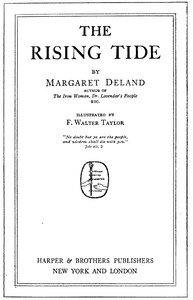
The Rising Tide
by Margaret Wade Campbell Deland
Language: en404 downloads on Project Gutenberg
Subjects
In: Novels·American Literature
Public-domain ebook sourced from Project Gutenberg #54910.
Public-domain ebook
by Margaret Wade Campbell Deland
Language: en404 downloads on Project Gutenberg
Subjects
In: Novels·American Literature
Public-domain ebook sourced from Project Gutenberg #54910.
The opening · free to read
A single car-track ran through Payton Street, and over it, once in a while, a small car jogged along, drawn by two mules. Thirty years ago Payton Street had been shocked by the intrusion upon its gentility of a thing so noisy and vulgar as a street-car; but now, when the rest of the town was shuttled with trolleys and clamorous with speed, it seemed to itself an oasis of silence. Its gentility had ebbed long ago. The big houses, standing a little back from the sidewalk, were given over to lodgers or small businesses. Indeed, the Paytons were the only people left who belonged to Payton Street's past--and there was a barber shop next door to them, and a livery-stable across the street.
"Rather different from the time when your dear father brought me here, a bride," Mrs. Payton used to say, sighing.
Her daughter agreed, dryly: "I hope so! Certainly nobody would live on Payton Street now, if they could afford to buy a lot in the cemetery."
Yet the Paytons, who could have bought several lots in the cemetery (or over on the Hill, either, which was where they belonged!), did not leave the old house--a big, brownstone cube, with a belvedere on top of it that looked like a bird-cage. The yard in front of the house was so shaded by ailanthus-trees that grass refused to grow there, and an iron dog, guarding the patch of bare earth, was spotted with mold.
The street was very quiet,--except when the barber's children squabbled shrilly, or Baker's livery-stable sent out a few funeral hacks, or when, from a barred window in the ell of the Payton house, there came a noisy laugh. And always, on the half-hour, the two mules went tinkling along, their neat little feet cupping down over the cobblestones, and their trace-chains swinging and sagging about their heels. The conductor on the car had been on the route so long that he knew many of his patrons, and nodded to them in a friendly way, and said it was a good day, or too cold for the season; occasionally he imparted information which he thought might be of interest to them.
On this October afternoon of brown fog and occasional dashes of rain he enlightened a lady with a vaguely sweet face, who signaled him to stop at No. 15.
"Miss Payton's out," he said, pulling the strap over his head and bringing his car to a standstill; "but her ma's at home. I brought the old lady back on my last trip, just as Miss Freddy was starting off with that pup of hers."
"It's the 'old lady' I've come to see," his fare said, smiling, and, gathering up her skirts, stepped down into the Payton Street mud. The bell jangled and the mules went clattering off over the cobblestones.
Mrs. William Childs, picking her way to the sidewalk, said to herself that she almost wished Freddy and her dog were at home, instead of the "old lady."
"Poor dear Ellen," she thought, in amiable detachment from other people's troubles; "she's always asking me to sit in judgment on Fred--and there's nothing on earth I can do."
It occurred to her as she passed under the dripping ailanthus-trees and up the white marble door-steps that Payton Street was a gloomy place for a young creature like Frederica to live. "Even my Laura would kick," she thought; her thoughts were often in her Laura's vernacular. In the dark hall, clutching at the newel-post on which an Egyptian maiden held aloft a gas-burner in a red globe, she extended a foot to a melancholy mulatto woman, who removed her rubbers and then hung her water-proof on the rack beside a silk hat belonging to the late Mr. Payton--kept there, Mrs. Childs knew, to frighten perennially expected burglars.
"Thank you, Flora," she said. "Has Mr. Weston come yet?" When Flora explained that Mr. Weston was not expected until later, she started up-stairs--then hesitated, her hand on the shoulder of the Egyptian maiden: "Mr. Mortimore--he's not about?"
"Land, no, Mis' Childs!" the woman reassured her; "he don't ever come down 'thout his ma or Miss Carter's along with him."
Mrs. Childs nodded in a relieved way, and went on up to the sitting-room where, as she had been warned, she and Mr. Arthur Weston, one of the trustees of what was popularly known as "the old Andy Payton estate," were to "sit in judgment." "It is hard for Fred to have Mortimore in the house," she thought, kindly; "poor Freddy!"
The sitting-room was in the ell, and pausing on the landing at the steps that led up to it, she looked furtively beyond it, toward another room at the end of the hall. "I wonder if Ellen ever forgets to lock the door on her side?" she thought;--"well, Nelly dear, how are you?" she called out, cheerfully.
Mrs. Payton, bustling forward to meet her, overflowed with exclamations of gratitude for her visit. "And such unpleasant weather, too! I do hope you didn't get your feet damp? I always tell Freddy there is no surer way to take cold than to get your feet damp. Of course she doesn't believe me, but I'm used to that! Is William's cold better? I suppose he's glad of an excuse to stay indoors and read about Bacon and Shakespeare; which was which? I never can remember! Now sit right down here. No, take this chair!"
The caller, moving from one chair to another, was perfectly docile; it was Ellen's way, and Mrs. Childs had long ago discovered the secret of a peaceful life, namely, always, so far as possible, to let other people have their own way. She looked about the sitting-room, and thought that her sister-in-law was very comfortable. "Laura would have teased me to death if I had kept my old-fashioned things," she reflected. The room was feminine as well as old-fashioned; the deeply upholstered chairs and couches were covered with flounced and flowery chintz; on a green wire plant-stand, over-watered ferns grew daily more scraggy and anemic; the windows were smothered in lambrequins and curtains, and beadwork valances draped corner brackets holding Parian marble statuettes; of course there was the usual womanish clutter of photographs in silver frames. On the center-table a slowly evolving picture puzzle had pushed a few books to one side--pretty little books with pretty names, Flowers of Peace and Messages from Heaven, most of them with the leaves still uncut. It was an eminently comfortable room; indeed, next to her conception of duty, the most important thing in Mrs. Andrew Payton's life was comfort.
Just now, she was tenaciously solicitous for Mrs. Childs's ease; was she warm enough? Wasn't the footstool a little too high? And the fire--dear me! the fire was too hot! She must put up the screen. She wouldn't make tea until Mr. Weston came; yes, he had promised to come; she had written him, frankly, that he had simply got to do something about Freddy. "He's her trustee, as well as mine, and I told him he simply must do something about this last wild idea of hers. Now! isn't it better to have the screen in front of the fire?"
Mrs. Childs said the screen was most comfortable; then added, in uncertain reminiscence, "Wasn't Mr. Weston jilted ages ago by some Philadelphia girl?"
"Oh, dear, yes; so sad. Kate Morrison. She ran off with somebody else just a week before they were to be married. Horribly awkward for him; the invitations all out! He went to Europe, and was agent for Payton's until dear Andrew died. You are quite sure you are not too warm?"
"No, indeed!" Mrs. Childs said. "How is Mortimore?" It was a perfunctory question, but its omission would have pained Mortimore's mother.
"_Very_ well!" Mrs. Payton said; her voice challenging any one to suspect anything wrong with Mortimore's health. "He knew Freddy to-day; he was in the hall when she went out; he can't bear her dog, and he--he scolded a little. I'm sure I don't blame him! I hate dogs, myself. But he knew her; Miss Carter told me about it when I came in. I was so pleased."
"That was very nice," her visitor said, kindly. There was a moment's silence; then, glancing toward a closed door that connected the sitting-room with that room at the end of the ell, she said, hesitatingly: "Nelly dear, don't you think that perhaps Freddy wouldn't be so difficult, if poor Mortimore were not at home? William says he thinks--"
"My son shall never leave this house as long as I am in it myself!" Mrs. Payton interrupted, her face flushing darkly red.
"But it is unpleasant for Fred, and--"
"'Unpleasant' to have her poor afflicted brother in the house? Bessie, I wouldn't have thought such a thing of you! Let me tell you, once for all, as I've told you many, many times before--never, while I live, shall Mortimore be treated cruelly and turned out of his own home!"
"But William says they are not cruel, at--at those places; and Mortimore, poor boy! would never know the difference."
"He would! He would! Didn't I tell you he recognized his sister to-day? His sister, who cares more for her dog than she does for him! And he almost always knows me. Bessie, you don't understand how a mother feels--" she had risen and was walking about the room, her fat, worn face sharpening with a sort of animal alertness into power and protection. The claws that hide in every maternal creature slipped out of the fur of good manners: "We've gone all over this a hundred times; I know that you think I am a fool; and I think that you--well, never mind! The amount of it is, you are not a mother."
"My dear! What about my three children?"
"Three healthy children! What do you know of the real child, the afflicted child, like my Mortimore? Why, I'd see Freddy in her grave before I'd--" She stopped short. "I--I love both my children exactly the same," she ended, weakly. Then broke out again: "You and I were brought up to do our duty, and not talk about it whether it was pleasant or unpleasant. And let me tell you, if Freddy would do her duty to her brother, as old Aunt Adelaide did to her invalid brother, she'd be a thousand times happier than she is now, mixing up with perfectly common people, and talking about earning her own living! Yes, that's the last bee in her bonnet,--Working! a girl with a good home, and nothing on earth to do but amuse herself. She uses really vulgar words about women who never worked for their living; you and me, for instance. 'Vermin'--no, 'parasites.' Disgusting! Yes; if Freddy was like her great-aunt Adelaide--" Mrs. Payton, sinking into a chair bubbly with springs and down, was calmer, but she wiped her eyes once or twice: "Aunt Adelaide gave up her life to poor Uncle Henry. Everybody says she had lots of beaux! I heard she had seven offers. But she never dreamed of getting married. She just lived for her brother. And they say he was dreadful, Bessie; whereas my poor Mortimore is only--not quite like other people." Mrs. Childs gasped. "When Morty was six months old," Mrs. Payton said, in a tense voice, "and we began to be anxious about him, Andrew said to the doctor, 'I suppose the brat' (you know men speak so frankly) 'has no brains?' and Dr. Davis said, 'The intellect is there, Mr. Payton, but it is veiled.' That has always been such a comfort to me; Morty's intellect is there! And besides, you must remember, Bessie, that even if he isn't--very intelligent, he's a man, so he's really the head of the family. As for Freddy, as I say, if she would follow her aunt Adelaide's example, instead of reading horrid books about things that when I was a young lady, girls didn't know existed, she'd be a good deal more comfortable to live with. Oh, dear! what am I going to do about her? As I wrote to Mr. Weston, when I asked him to come in this afternoon, what are we going to do about her?"
The book keeps going
Reading is free forever. Sign up and watch scenes appear while you read.



Scenes Storieta drew for other classics.
New illustrated classics
Once or twice a month: the latest books to get full character casts, scene art, and free comic editions. No account needed.