The opening · free to read
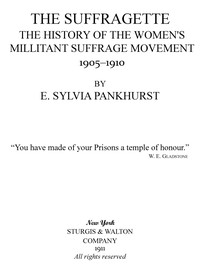
I believe that women striving for enfranchisement in other lands and reformers of future days may learn with renewed hope and confidence how the "family party," who in 1905 set out determined to make votes for women the dominant issue of the politics of their time, in but six years drew to their standard the great woman's army of to-day. It is certain that the militant struggle in which this woman's army has engaged and which has come as the climax to the long, patient effort of the earlier pioneers, will rank amongst the great reform movements of the world. Set as it has been in modern humdrum days it can yet compare with any movement for variety and vivacity of incident. The adventurous and resourceful daring of the young Suffragettes who, by climbing up on roofs, by sliding down through skylights, by hiding under platforms, constantly succeeded in asking their endless questions, has never been excelled. What could be more piquant than the fact that two of the Cabinet Ministers who were carrying out a policy of coercion towards the women should have been forced into the witness box to be questioned and cross-questioned by Miss Christabel Pankhurst, the prisoner in the dock? What, too, could throw a keener searchlight upon the methods of our statesmen than the evidence put forward in the course of that trial?
To many of our contemporaries perhaps the most remarkable feature of the militant movement has been the flinging-aside by thousands of women of the conventional standards that hedge us so closely round in these days for a right that large numbers of men who possess it scarcely value. Of course it was more difficult for the earlier militants to break through the conventionalities than for those who followed, but, as one of those associated with the movement from its inception, I believe that the effort was greater for those who first came forward to stand by the originators than for the little group by whom the first blows were struck. I believe this because I know that the original militants were already in close association with the truth that not only were the deeds of the old time pioneers and martyrs glorious, but that their work still lacks completion, and that it behoves those of us who have grasped an idea for human betterment to endure, if need be, social ostracism, violence, and hardship of all kinds, in order to establish it. Moreover, whilst the originators of the militant tactics let fly their bolt, as it were, from the clear sky, their early associates rallied to their aid in the teeth of all the fierce and bitter opposition that had been raised.
The hearts of students of the movement in after years will be stirred by the faith and endurance shown by the women who faced violence at the hands of the police and others in Parliament Square and at the Cabinet Minister meetings, and above all by the heroism of the noble women who went through the hunger strike and the mental and physical torture of forcible feeding.
A passionate love of freedom, a strong desire to do social service and an intense sympathy for the unfortunate, together, made the movement possible in its present form. Those who have worked as a part of it know that it is notable not merely for its enthusiasm and courage, but also for its cheery spirit of loyalty and comradeship, its patient thoroughness in organisation which has made possible its many great demonstrations and processions, its freedom from bitterness and recrimination, and its firm faith in the right.
E. SYLVIA PANKHURST.
London, May, 1911.
The book keeps going
Keep reading, and see it illustrated
Reading is free forever. Sign up and watch scenes appear while you read.
Scenes Storieta drew for other classics.