Public-domain ebook
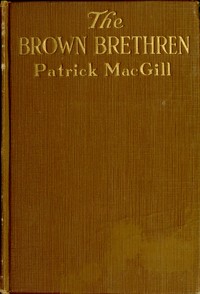
The Brown Brethren
Language: en306 downloads on Project Gutenberg
Subjects
In: Historical Novels·Novels·British Literature
Public-domain ebook sourced from Project Gutenberg #54990.
Public-domain ebook
Language: en306 downloads on Project Gutenberg
Subjects
In: Historical Novels·Novels·British Literature
Public-domain ebook sourced from Project Gutenberg #54990.
The opening · free to read
The night had fallen and the Café Belle Vue was crowded with soldiers in khaki. The day's work was at an end, and the men had left their billets to come out and spend a few hours in the wine-shop of Jean Lacroix. A whole division was quartered in the district; it had come back from the firing-line and was enjoying a brief period of rest prior to its departure for the trenches again.
Even here, back near the town of Cassel, the men were not free from the sights and sounds of the fighting. At night they could see the red agony of war painting the distant horizon, and hear the far-off rumbling of the big guns as the thunder and tumult of the conflict smote across the world. The men back from the line of slaughter tried not to think too clearly of what was happening out there. In the Café Belle Vue, where the wine was good, men could forget things.
The Café was crowded. Half-a-dozen soldiers stood at the bar and the patronne served out drinks with a speedy hand. Behind her was a number of shelves on which stood bottles of various sizes. Over the shelves were two photographs; one was her own, the other was that of her husband when he was a thinner man and a soldier in the army. In the house there was one child, a dirty, ragged little girl, who sat in a corner and fixed a dull meaningless stare on the soldiers as they entered the café.
Jean Lacroix sat beside the long-necked stove stroking his beard, a neat white little beard which stood perkily out from his fat chin. Jean Lacroix was fat, a jelly blob of a man with flesh hanging from his sides, from his cheeks and from his hands. He was a heap of blubber wrapped in cloth. When he changed his locality he shuffled instead of walking, when he laughed he shivered and shook his fat as if he wanted to fling it off. He was seldom serious, when he was, all those near him laughed. A serious Jean was a ridiculous figure.
His wife was an aggressive female with a dark moustache, the tongue of a shrew and the eye of a money-lender. She worked like an ant and seldom spoke to her husband. Jean, wise with the wisdom of a well-fed man, rarely said a word to her; he sat by the fire all day and spoke to anyone else who cared to listen.
A sergeant and three men entered and going up to the bar called for drinks. These soldiers were billeted at Y---- Farm which stood some three kilometres away from the Café Belle Vue. They belonged to the London Irish Regiment. The battalion had just come down from Hulluch for a rest. Having procured their drinks the four men sat down, lit their cigarettes and entered into a noisy conversation.
Before going any further it will be well to say a few words about these men, the principal personages of my story.
The sergeant's name was Snogger. He was a well-built man, straight as a ramrod and supple as an eel. He was very strict on parade, a model soldier, a terror to recruits and a rank disciplinarian. "When you're on parade you're on parade," was his pet saying. He had a tendency to use the letter "w" a little too often when speaking. Once he said admonishing a dilatory squad: "You blokes in the wear wank must wipe your wifles wiv woily wags in future!"
Sergeant Snogger was a handsome man, proud as Lucifer and very careful about his person. His moustache was always waxed, his finger nails were always clean, and whenever possible he slept with his trousers placed under his bed and neatly folded. Thus a most artistic crease was obtained.
Snogger had peculiar ears. Their tops pressed very closely into the head and the lobes stood out. Looking at the ears from the side they had an appearance similar to that of a shovel stretched out to catch something; seen from behind they looked as if crouching against a parapet waiting for an oncoming shell.
The men liked Snogger and the sergeant preferred the company of riflemen to that of his brother N.C.O.'s.
Bowdy Benners was a different type of man. A young fellow of twenty-four, slightly over medium height, but thick-set and sturdy. He had remarkably long arms, heavy buttocks and broad shoulders. The latter he swung vigorously when marching. This motion imparted a certain defiant swagger to the man which his placid nature utterly belied. He was of a kindly disposition, extremely good-humoured, but very self-conscious and blushed red as a poppy when spoken to. There was something very amiable and kind in his face; something good and comforting in his sleepy eyes, his rather thick lips and full cheeks. His ears perhaps were out of keeping with the repose which found expression on the rest of his features. They stood out from his head alert and ready, as it seemed, to jump from their perch on to the ground.
Bowdy could drink like a fish, but French beer never made him drunk and champagne merely made him merry. When merry he swore and his companions laughed at this unaccustomed violence.
"Devil blow me blind," he would say, stretching his long arm across the table at which he might be sitting and bringing down his massive fist with a thundering bang. "Devil blow me stone blind for a fool!" And all the soldiers around would laugh and wink at one another, as much as to say: "Is he not a big silly fool; not half as clever as we are."
Bowdy was not indeed particularly clever; he lacked excessive sharpness of wit. But his mates loved him, for his spirit of comradeship was very genuine and he had a generous sympathy for all things good and noble. Often when the boys' tongues were loosened in a French tavern one of them might be heard saying: "Old Bowdy's a damned good sort. I'd follow him anywhere, even to hell."
Then the others would answer: "None like old Bowdy. One of the best he is. And a good man."
Bowdy was indeed a good man; a great fighter. In raids, in bayonet charges and bombing encounters he was a force to be reckoned with and never had an adversary been known to get the better of him. Persistence, staying power and dogged courage were his great assets, and these when taken in conjunction with his good humour and simple nature made him a loved comrade and worthy friend.
Bowdy was now seated at the inn table, drinking beer with his mate, an alert youth with a snub nose and bright vivacious eyes. His name was Spudhole.
Spudhole was a Londoner, a native of Walworth. His real name was Thomas Bubb, but his mates nicknamed him Spudhole, a slang term for the guard-room. The nickname became him, he liked it and was not a little proud of the fact that no man in the regiment spent as many days in the guard-room as did Rifleman Thomas Bubb. He was eternally guilty of trivial offences against Army regulations. This was in a great measure due to his inability to accommodate himself to a changed environment. He was a coster unchangeable and unchanged; to him an officer was always "Guv'nor," he addressed an officer as such, and the Colonel was the "ole bloke." His tongue was seldom quiet and the cries of his trade were ever on his tongue, even on parade he often gave them expression. He sang well, drank well, fought well, and loved practical jokes.
Once at St. Albans he dressed himself up as a corporal, took two of his mates to the railway station and relieved the military police on duty there. Mistaking him for a real N.C.O. they left the station in his hands. Of course he took the first train to London. On his return he was awarded fourteen days' spud-hole.
When in the guard-room he decided to escape and at the hour of twelve on the first night when a sentry stood on watch outside his prison Spudhole broke the window with a resounding thump. Then he rushed back and stood behind the door. He was in stocking-soles, his boots were slung round his shoulders by the laces. On hearing the crash the sentry opened the door, sprang into the room and hurried to the window thinking that Spudhole was trying to escape by that quarter--and Spudhole went out by the door.
He was very good-natured, in fact quixotic. Once a recruit belonging to Bubb's section was so very slack that the officer brought him out in front of the squad and got him to perform several movements in musketry drill. The remainder of the party had to shout out when the man made any mistakes. As is usual, the onlookers saw many faults and shouted themselves hoarse. But Bubb was silent. When the slack recruit returned to his place in the ranks the officer spoke to Spudhole.
"Did you notice any of those mistakes?" he asked.
"Yes, sir," Bubb replied.
"And why did you not say so?" enquired the officer.
"Well, I didn't want to give the bloke away," was Bubb's answer.
The youngster had spent four years in a reformatory; afterwards as a coster he presided over a barrow in a turning off Walworth Road. His pitch was one of the best in the locality. He fell in love with a girl who kept a barrow beside him. He often spoke of her to Bowdy Benners.
"She's not 'arf a bird," he would say. "Nobody can take a mike out 'er. I'm goin' to get spliced after the war too."
Near the stove sat the remaining soldier, an Irishman named Fitzgerald. He was a thin graceful fellow of about five-and-twenty, and could not, to judge by his appearance, boast of very good health. His lips full and red, his straight nose, delicate nostrils, black liquid eyes and long lashes betrayed a passionate and sensitive nature. He was a thoughtful man, grave and dutiful, but at times as petulant and perverse as a child. Even when most perverse he was good company.
He was exceedingly superstitious. His thoughts generally wandered with startling suddenness from one subject to another but this was probably due to the use of strong drink. He had had a college education but took to drink early and squandered all his resources. Then he became a rover and wandered through many parts of the world as sailor, tramp and outcast. He had slept in doss-houses, on the pavements, in the fields. Once indeed he was a trombone player in the Salvation Army, and again he fought in a Mexican rebellion. Then he belonged to a regiment, the soldiers of which had to wear great coats on their triumphal march through a certain town because of the bad condition of their trousers. Fitz knew a smattering of most languages but vowed that he was only proficient in one--bad language.
At present he was in a gay good humour and as he spoke to young Benners his voice, loud enough but very soft and pleasant, penetrated to the very corners of the inn.
"Do you ever feel afraid, Bowdy?" he asked. "Funky, you know." Then, without waiting for an answer, he went on: "God! I do feel afraid, sometimes. Out on listening patrol. It's hell for a man with imagination. Crawling out in the darkness between the lines. You hear the grass whispering, and the darkness ahead of you may hide anything. An awful face covered with blood may rise up in front, a hand may come out and grasp you by the hair. The dead are lying around you, poor quiet creatures, but you know that they're stronger than you are. I often wish I couldn't think, that I lacked imagination, that I was a clod of earth, just something like that plebeian there." Fitzgerald raised his finger and pointed to Bubb who was rapping his idle fingers on the legs of his chair. Bubb gazed at Fitzgerald and laughed.
The book keeps going
Reading is free forever. Sign up and watch scenes appear while you read.



Scenes Storieta drew for other classics.
New illustrated classics
Once or twice a month: the latest books to get full character casts, scene art, and free comic editions. No account needed.