"That's what everyone says. I don't see why. I don't swear, like Jimmy Myers, nor steal, like Frank Balder, I don't tell lies—except when I have to, and I go to Sunday-school every Sunday, while there are lots of boys in town who spend the whole of that day in fishing. I didn't mean to hurt old Parkin's yellow dog; I only wanted to see what he'd do. And just didn't he travel?—oh, oh! But I don't see why I'm the worst boy in town. I declare. If it isn't just the morning to go fishing—warm, cloudy, worms easy to get. I wish't was Saturday, so there wouldn't be any school, and I wish school teachers knew what fun it is to go fishing; then they'd be easier on a fellow who played hookey, and they'd ask him where he caught them, and how many, and how big they were, instead of picking up their everlasting switches and making themselves disagreeable. Perch would bite splendidly to-day, and there are people in this town who'd be glad to have a good mess of perch. I declare! I've just the idea; school or no school, whipping or no whipping, it ought to be done. I'll go right away and see if Matt can't go with me."
Jack moved rapidly through streets which crossed the main thoroughfare of the town; then he approached a wood-pile where a boy of about his own age was at work; before this boy's eyes Jack dangled two new fish-lines and some hooks, and exclaimed—
"Come along, Matt!"
"I can't," said Matt, gazing hungrily at the new fishing tackle, "the governor wouldn't like it at all."
"Oh, never mind the governor," said Jack, "I'll explain things to him when we get back."
Matt seemed to be in some doubt as to whether the influence of his tempter with the governor amounted to much, for the functionary alluded to was master Matt Bolton's own father, a gentleman who held quite firmly to the general opinion about Jack. Besides, Matt was vigorously attacking the family wood-pile, his honest heart alive with a sense of the need there was for him to do all in his power to relieve his overworked father, and alive, too, with the conviction that he would have to work industriously if he would chop and split a day's supply before school-time. Besides, a fishing excursion implied truancy, which, in turn, implied the certainty of a whipping in school and the probability of punishment at home.
"Father would be very angry," said Matt, as he sighingly withdrew his eyes from the new fishing tackle, "and he has already enough to bother him, without having things made worse by me."
"But Matt, he won't feel bad when he knows what you did with the fish. We'll give them to widow Batty. (This resolution of Jack's was newer even than his tackle, for he had formed it while he talked). "She's been sick, you know, and I heard your father say the other day that she must have a hard enough time, at best, to feed that large family of her's."
"But suppose we don't catch any?" suggested Matt.
"Then you can tell him what we meant to have done if we had caught some. Besides, we can't help catching a lot at such a splendid fish-hole as the mill-dam. I think it's awful that a whole family should go hungry just because it hasn't got any father. Didn't your governor ever read you out of the Bible of visiting the fatherless and widows in their affliction?—mine has."
Boys are no more likely than adults to resist Satan when he appears as an angel of light, so Matt speedily agreed to go as soon as he had prepared a day's supply of firewood.
"Got another axe, and I'll help you," said Jack, and within five minutes those two boys were making chips fly at a rate which would have been the wonder of a hired wood-chopper, while Matt's mother, who happened to glance through a window wondered why Jack's father could accuse that boy of laziness. Then both boys carried the wood to the kitchen door, unearthed some worms between sundry logs at the wood-pile, and disappeared as stealthily as if in their benevolent project they were animated by the scriptural injunction, to not let the left hand know what the right hand was doing.
Reaching the brow of a little hill upon which the village was situated, Jack exclaimed—
"I vow, if the river hasn't overflowed its banks."
"Umph," replied Matt, "I knew that a week ago."
"Well," said Jack, "so did I, but I forgot it. We can get to the dam easily enough, though; it's only half a mile across the lowlands to the river, and there are fences all the way. Riding rail fences is bully fun. Wait till I get my rod; I've got two and I'll lend you one."
Jack extracted two bamboo rods from the blackberry thicket where he habitually kept them, lest they should occasion unpleasant questions, as they certainly would have done had his frequent expeditions with them begun at the house of his excellent father. Then both boys mounted the fence, which was of rails, and their trip to the dam was fairly begun.
Now to travel by fence-rail is a delightful method of passing time, as all liberally educated boys know, if one is bound for no where in particular, but when one is two, and both are boys, and are in quest of fish, and the middle of the day is approaching, in which fish do not bite, half a mile of rail fencing is a trip which consumes patience with great rapidity. Had the adventurers been other than boys, they would have turned back at once, but when a boy gets a project clearly into his head he never gives any one an excuse to say that the mule is the most obstinate of all living animals. Jack soon grew impatient of his slow progress, and conceived a brilliant idea. Raising himself to his feet on a rail of reasonable flatness (for a fence rail) he steadied himself with his rod, and accomplished with safety and celerity the trip to the angle where the rail terminated.
"Hurrah, Matt!" he shouted, "look here!" and he walked along another rail.
Matt saw and was glad, and following Jack's example, he made some excellent time himself.
"We'd never have learned that trick if it hadn't been for the overflow. How glad I am that I came, and—Ow!" Jack's abrupt termination was due to his own course having temporarily terminated, for the third rail upon which he ventured, not having been designed for the particular object which Jack had in view, had been split triangularly, and one of Jack's shoes had slipped to one side, the other slipping in an opposite direction, and the young man came down astride the unyielding oak with a thud whose sound was something inaudible when considered in the light of the anguish which it caused. No new word presented itself for use just then; Jack continued to remark "Ow," with a variety of long-drawn inflections, while Matt precipitately lowered himself to a position of safety, and manifested no inclination to go farther. After some moments devoted strictly to facial contortion, Jack succeeded in changing his position so that both legs hung upon the same side of the fence, then he examined the rail closely, as if to see if the tip of his spine had not driven a hole through it, and remarked,
"We'd better do this in our stockinged feet."
Matt thought so too, so both boys removed their shoes, tying them together with the strings upon which the fish were to be strung, and slinging them across their shoulders. Their progress thereafter was considerably more rapid, but a sudden shriek and a splash of voluminous sound and displacement announced that Matt had fallen entirely from his rail, and when Jack came to view the scene, Matt was swelling the flood with his own tears.
"I declare," exclaimed Jack, "that's too bad, old fellow! And you had the worms in your pocket, too—I hope the water hasn't got into the box and drowned them so they can't wiggle when they're on the hooks. Say, its warm; your clothes will dry on you, before we reach the dam. Oh, I'll tell you what,—we'll take them off and wring them out, and go swimming at the same time."
At the prospect of an unlooked for sport, Matt dried his tears, and a broad flat rail having been found the boys disrobed and took whatever comfort could be found in water eighteen inches deep with a field of corn stubble at the bottom of it. Matt's clothes seemed rather clammy as he again resumed his normal position inside them, but Jack described so delightfully the assortment of fish which he wished to catch, that damp clothing became a mere thing of the forgotten past. Started again, Jack moved rapidly for some moments, but suddenly stopped and shouted,
"Hurry up, Matt; here's the splendidest thing that ever was!"
Matt obeyed orders, and while yet twenty rail lengths behind he heard Jack shout,
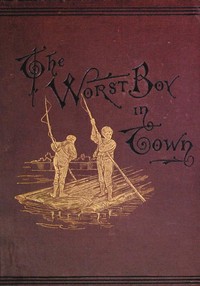
"Here's a bridge that floated away from one of the little brooks; we'll just make a raft of it and reach the dam in less than no time."
Matt eyed the bridge with manifest favor; it was simply two logs,—mud sills—connected by three cross-ties, upon which the planking was laid.
"Won't the current trouble us when we reach the river road?" he asked.
"We won't go that way," said Jack. "We'll go through the fields and then along a wood road that goes through the timber. It's half a mile the shorter way, besides being the safer. Come ahead; we'll use our rods for poles to push the raft with."
"Then we've got to knock down fences," said Matt.
"Well," said Jack, who had a conscience in hiding somewhere about him, "we'll come back in a few days, when the flood has gone down, and put them up again. And we'll play the raft is a ram—a regular Merrimac, you know,—and the fences are an enemy's fleet, or a chain stretched across the river. Let's back out and get a good start."
The bridge, which did not draw a foot of water, was backed across the road, one boy stood at each side, and at a signal from Jack it was driven against the fence, through which it crashed most gloriously, sprinkling a dozen fence-rails about the surface of the water.
"Hooray!" shouted Jack, "now for the next one! The Union forever!" and then Jack, while en route for the next fence, finding himself unequal to the task of extemporizing a stirring address to his command, began to quote from "Rolla's Address to the Peruvians," which was considered the gem of that much used book, "The Comprehensive School Speaker"—"My brave associates, partners of my toils, my feelings and my fame, can Rolla's words add fresh vigor to the——"
Just then the raft struck the fence, but this latter being of the "staked and ridered"[1] pattern, the result was that the raft came to a sudden standstill, and the crew were thrown flat upon it, their respective heads hanging somewhat astern and in danger of being water-soaked.
Footnote 1:
A rail fence across the angles of which two rails meet in X shape, their lowest ends driven into the grounds a little way and a rail lying in the upper angle of the X.
"Blazes!" exclaimed Jack wrathfully, as he endeavored to staunch a bleeding nose, "what did a man need to have a staked and ridered fence just here for? Well, we'll have to push down a couple of stakes and break our way through."
The commanding officer's plan was speedily acted upon, and the raft went on swimmingly until it seemed to slide upon some obstruction, then it came to a dead stop.