Public-domain ebook
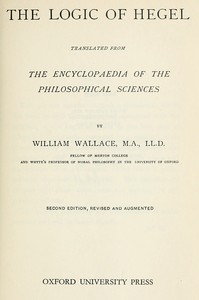
The Logic of Hegel
by Georg Wilhelm Friedrich Hegel
English2,156 downloads on Project GutenbergDownload EPUB
Public-domain ebook sourced from Project Gutenberg #55108.
Public-domain ebook
by Georg Wilhelm Friedrich Hegel
English2,156 downloads on Project GutenbergDownload EPUB
Public-domain ebook sourced from Project Gutenberg #55108.
The work presented here is Hegel’s Encyclopaedia of the Philosophical Sciences in Outline, the third installment of the four‑part system he assembled between 1807 and 1820. The opening passage situates the Encyclopaedia as the only complete and mature statement of his system, designed as a concise manual for students rather than a free‑wheeling speculative treatise. It explains that the Logic occupies the first third of the volume (pages 1‑126), while the subsequent sections develop the Philosophy of Nature and the Philosophy of Spirit. Hegel frames the text as a “new treatment of philosophy” that seeks to reconstruct the fragments of thought into a totality, contrasting his method with the formulaic approaches of his contemporaries. The introduction also recounts the historical context of its publication, noting the first edition of 1816, later revisions, and Hegel’s own doubts about the work’s breadth and pedagogical purpose.
Written in the dense, lecture‑style prose of early‑19th‑century German idealism, the book reflects Hegel’s ambition to present philosophy with the rigor of geometry while preserving its speculative depth. Readers who relish systematic argument, are comfortable with long, tightly packed paragraphs, and have an interest in the development of modern thought will find it rewarding. It appeals especially to students of philosophy, historians of ideas, and anyone wishing to trace the roots of concepts that later shaped continental philosophy, political theory, and aesthetics. Those seeking a more accessible entry point may prefer his Phenomenology of Spirit first, but the Encyclopaedia offers a concise yet profound glimpse into Hegel’s overarching system.
The opening · free to read
THE ENCYCLOPAEDIA OF THE PHILOSOPHICAL SCIENCES IN OUTLINE is the third in time of the four works which Hegel published. It was preceded by the Phenomenology of Spirit, in 1807, and the Science of Logic (in two volumes), in 1812-16, and was followed by the Outlines of the Philosophy of Law in 1820. The only other works which came directly from his hand are a few essays, addresses, and reviews. The earliest of these appeared in the Critical Journal of Philosophy, issued by his friend Schelling and himself, in 1802--when Hegel was one and thirty, which, as Bacon thought, 'is a great deal of sand in the hour-glass'; and the latest were his contributions to the Jahrbücher für wissenschaftliche Kritik, in the year of his death (1831).
This Encyclopaedia is the only complete, matured, and authentic statement of Hegel's philosophical system. But, as the title-page bears, it is only an outline; and its primary aim is to supply a manual for the guidance of his students. In its mode of exposition the free flight of speculation is subordinated to the needs of the professorial class-room. Pegasus is put in harness. Paragraphs concise in form and saturated with meaning postulate and presuppose the presiding spirit of the lecturer to fuse them into continuity and raise them to higher lucidity. Yet in two directions the works of Hegel furnish a supplement to the defects of the Encyclopaedia.
One of these aids to comprehension is the Phenomenology of Spirit, published in his thirty-seventh year. It may be going too far to say with David Strauss that it is the Alpha and Omega of Hegel, and his later writings only extracts from it.[1] Yet here the Pegasus of mind soars free through untrodden fields of air, and tastes the joys of first love and the pride of fresh discovery in the quest for truth. The fire of young enthusiasm has not yet been forced to hide itself and smoulder away in apparent calm. The mood is Olympian--far above the turmoil and bitterness of lower earth, free from the bursts of temper which emerge later, when the thinker has to mingle in the fray and endure the shafts of controversy. But the Phenomenology, if not less than the Encyclopaedia it contains the diamond purity of Hegelianism, is a key which needs consummate patience and skill to use with advantage. If it commands a larger view, it demands a stronger wing of him who would join its voyage through the atmosphere of thought up to its purest empyrean. It may be the royal road to the Idea, but only a kingly soul can retrace its course.
The other commentary on the Encyclopaedia is supplied partly by Hegel's other published writings, and partly by the volumes (IX-XV in the Collected works) in which his editors have given his Lectures on the Philosophy of History, on Aesthetic, on the Philosophy of Religion, and on the History of Philosophy. All of these lectures, as well as the Philosophy of Law, published by himself, deal however only with the third part of the philosophic system. That system (p. 28) includes (i) Logic, (ii) Philosophy of Nature, and (iii) Philosophy of Spirit. It is this third part--or rather it is the last two divisions therein (embracing the great general interests of humanity, such as law and morals, religion and art, as well as the development of philosophy itself) which form the topics of Hegel s most expanded teaching. It is in this region that he has most appealed to the liberal culture of the century, and influenced (directly or by reaction) the progress of that philosophical history and historical philosophy of which our own generation is reaping the fast-accumulating fruit. If one may foist such a category into systematic philosophy, we may say that the study of the 'Objective' and 'Absolute Spirit' is the most interesting part of Hegel.
Of the second part of the system there is less to be said. For nearly half a century the study of nature has passed almost completely out of the hands of the philosophers into the care of the specialists of science. There are signs indeed everywhere--and among others Helmholtz has lately reminded us--that the higher order of scientific students are ever and anon driven by the very logic of their subject into the precincts or the borders of philosophy. But the name of a Philosophy of Nature still recalls a time of hasty enthusiasms and over-grasping ambition of thought which, in its eagerness to understand the mystery of the universe jumped to conclusions on insufficient grounds, trusted to bold but fantastic analogies, and lavished an unwise contempt on the plodding industry of the mere hodman of facts and experiments. Calmer retrospection will perhaps modify this verdict, and sift the various contributions (towards a philosophical unity of the sciences) which are now indiscriminately damned by the title of Naturphilosophie. For the present purpose it need only be said that, for the second part of the Hegelian system, we are restricted for explanations to the notes collected by the editors of Vol. VII. part i. of the Collected works--notes derived from the annotations which Hegel himself supplied in the eight or more courses of lectures which he gave on the Philosophy of Nature between 1804 and 1830.
Quite other is the case with the Logic--the first division of the Encyclopaedia. There we have the collateral authority of the 'Science of Logic,' the larger Logic which appeared whilst Hegel was schoolmaster at Nürnberg. The idea of a new Logic formed the natural sequel to the publication of the Phenomenology in 1807. In that year Hegel was glad to accept, as a stop-gap and pot-boiler, the post of editor of the Bamberg Journal. But his interests lay in other directions, and the circumstances of the time and country helped to determine their special form. 'In Bavaria,' he says in a letter[2], 'it looks as if organisation were the current business.' A very mania of reform, says another, prevailed. Hegel's friend and fellow-Swabian, Niethammer, held an important position in the Bavarian education office, and wished to employ the philosopher in the work of carrying out his plans of re-organising the higher education of the Protestant subjects of the crown. He asked if Hegel would write a logic for school use, and if he cared to become rector of a grammar school. Hegel, who was already at work on his larger Logic, was only half-attracted by the suggestion. 'The traditional Logic,' he replied[3], 'is a subject on which there are text-books enough, but at the same time it is one which can by no means remain as it is: it is a thing nobody can make anything of: 'tis dragged along like an old heirloom, only because a substitute--of which the want is universally felt--is not yet in existence. The whole of its rules, still current, might be written on two pages: every additional detail beyond these two is perfectly fruitless scholastic subtlety;--or if this logic is to get a thicker body, its expansion must come from psychological paltrinesses,' Still less did he like the prospect of instructing in theology, as then rationalised. 'To write a logic and to be theological instructor is as bad as to be white-washer and chimney-sweep at once.' 'Shall he, who for many long years built his eyry on the wild rock beside the eagle and learned to breathe the free air of the mountains, now learn to feed on the carcases of dead thoughts or the still-born thoughts of the moderns, and vegetate in the leaden air of mere babble[4]?'
At Nürnberg he found the post of rector of the 'gymnasium' by no means a sinecure. The school had to be made amid much lack of funds and general bankruptcy of apparatus:--all because of an all-powerful and unalterable destiny which is called the course of business.' One of his tasks was 'by graduated exercises to introduce his pupils to speculative thought,'--and that in the space of four hours weekly[5]. Of its practicability--and especially with himself as instrument--he had grave doubts. In theory, he held that an intelligent study of the ancient classics was the best introduction to philosophy; and practically he preferred starting his pupils with the principles of law, morality and religion, and reserving the logic and higher philosophy for the highest class. Meanwhile he continued to work on his great Logic, the first volume of which appeared in two parts, 1812, 1813, and the second in 1816.
This is the work which is the real foundation of the Hegelian philosophy. Its aim is the systematic reorganisation of the commonwealth of thought. It gives not a criticism, like Kant; not a principle, like Fichte; not a bird's eye view of the fields of nature and history, like Schelling; it attempts the hard work of re-constructing, step by step, into totality the fragments of the organism of intelligence. It is scholasticism, if scholasticism means an absolute and all-embracing system; but it is a protest against the old school-system and those who tried to rehabilitate it through their comprehensions of the Kantian theory. Apropos of the logic of his contemporary Fries (whom he did not love), published in 1811, he remarks: 'His paragraphs are mindless, quite shallow, bald, trivial; the explanatory notes are the dirty linen of the professorial chair, utterly slack and unconnected.'[6] Of himself he thus speaks: 'I am a schoolmaster who has to teach philosophy,--who, possibly for that reason, believes that philosophy like geometry is teachable, and must no less than geometry have a regular structure. But again, a knowledge of the facts in geometry and philosophy is one thing, and the mathematical or philosophical talent which procreates and discovers is another: my province is to discover that scientific form, or to aid in the formation of it[7].' So he writes to an old college friend; and in a letter to the rationalist theologian Paulus, in 1814[8], he professes: 'You know that I have had too much to do not merely with ancient literature, but even with mathematics, latterly with the higher analysis, differential calculus, chemistry, to let myself be taken in by the humbug of Naturphilosophie, philosophising without knowledge of fact and by mere force of imagination, and treating mere fancies, even imbecile fancies, as Ideas.'
In the autumn of 1816 Hegel became professor of philosophy at Heidelberg. In the following year appeared the first edition of his Encyclopaedia: two others appeared in his lifetime (in 1827 and 1830). The first edition is a thin octavo volume of pp. xvi. 288, published (like the others) at Heidelberg. The Logic in it occupies pp. 1-126 (of which 12 pp. are Einleitung and 18 pp. Vorbegriff); the Philosophy of Nature, pp. 127-204; and the Philosophy of Mind (Spirit), pp. 205-288.
In the Preface the book is described (p. iv) as setting forth 'a new treatment of philosophy on a method which will, as I hope, yet be recognised as the only genuine method identical with the content.' Contrasting his own procedure with a mannerism of the day which used an assumed set of formulas to produce in the facts a show of symmetry even more arbitrary and mechanical than the arrangements imposed ab extra in the sciences, he goes on: 'This wilfulness we saw also take possession of the contents of philosophy and ride out on an intellectual knight-errantry--for a while imposing on honest true-hearted workers, though elsewhere it was only counted grotesque, and grotesque even to the pitch of madness. But oftener and more properly its teachings--far from seeming imposing or mad--were found out to be familiar trivialities, and its form seen to be a mere trick of wit, easily acquired, methodical and premeditated, with its quaint combinations and strained eccentricities,--the mien of earnestness only covering self-deception and fraud upon the public. On the other side, again, we saw shallowness and unintelligence assume the character of a scepticism wise in its own eyes and of a criticism modest in its claims for reason, enhancing their vanity and conceit in proportion as their ideas grew more vacuous. For a space of time these two intellectual tendencies have befooled German earnestness, have tired out its profound craving for philosophy, and have been succeeded by an indifference and even a contempt for philosophic science, till at length a self-styled modesty has the audacity to let its voice be heard in controversies touching the deepest philosophical problems, and to deny philosophy its right to that cognition by reason, the form of which was what formerly was called demonstration.'
The book keeps going
Reading is free forever. Sign up and watch scenes appear while you read.



Scenes Storieta drew for other classics.
New illustrated classics
Once or twice a month: the latest books to get full character casts, scene art, and free comic editions. No account needed.