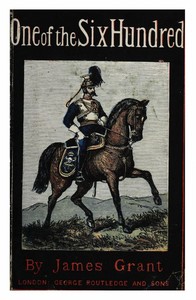
Public-domain ebook
One of the Six Hundred: A Novel
by James Grant
Language: en16,302 downloads on Project Gutenberg
Subjects
In: Historical Novels·Romance·Adventure
Public-domain ebook sourced from Project Gutenberg #55179.
Public-domain ebook
by James Grant
Language: en16,302 downloads on Project Gutenberg
Subjects
In: Historical Novels·Romance·Adventure
Public-domain ebook sourced from Project Gutenberg #55179.
One of the Six Hundred is a Victorian‑era novel set against the backdrop of the Crimean War, though its opening places the narrator in a tranquil Scottish landscape. The story begins with a lyrical description of sunrise over mist‑filled meadows, then swiftly moves to a group of well‑dressed companions, Lady Louisa, Cora, Miss Wilford, Berkeley, an MP, and the narrator, preparing for a ride to the ruined Castle of Piteadie. Their conversation mixes light banter about old family estates with sharper, sarcastic remarks from Berkeley, hinting at social tensions and personal rivalries that will surface as the party travels through the countryside toward the ancient ruin.
The prose is richly ornamental, echoing the elaborate diction of mid‑nineteenth‑century British fiction. Long, flowing sentences and frequent asides give the narrative a conversational, almost theatrical quality, while the detailed observations of dress, horse‑handling, and local folklore root the tale firmly in its period. Readers who enjoy immersive historical settings, intricate social dialogue, and a blend of romance with the looming specter of war will find this novel rewarding. It especially appeals to those who appreciate the ornate style of authors such as Sir Walter Scott and Anthony Trollope, and who relish a story that weaves personal intrigue into the larger canvas of the Crimean conflict.
The opening · free to read
The heavens were marked by many a filmy streak E'en in the Orient, and the sun shone through Those lines, as Hope upon a mourner's cheek Sheds, meekly chastened, her delightful hue. From groves and meadows, all empearled with dew, Rose silvery mist, no eddying wind swept by; The cottage chimneys, half concealed from view By their embowering foliage, sent on high Their pallid wreaths of smoke unruffled to the sky. BARTON.
Next day the snow had entirely disappeared; the country again looked fresh and green; and when we met for breakfast, and while the ladies were exchanging their morning kisses lightly on each cheek--a la Francaise, rather than a l'Ecossaise--various excursions were again projected.
Among others, Cora urged that we should visit the ruined Castle of Piteadie, which belonged of old to a branch of my uncle's family now extinct.
It stands on the slope of a gentle eminence, some distance westward of the famous "long town" of Kirkaldy, a pleasant ride of ten miles or so from the glen; and was a place we frequently rode to in the days of my boyhood, when my feats in the saddle were performed on a shaggy, barrel-bellied Shetland pony; so I longed to see the old ruin again.
A message was sent to the stable-yard after luncheon, and horses were ordered for the party, which was to consist of Lady Louisa, Cora, Miss Wilford, Berkeley, the M.P., and myself.
The ladies soon appeared in their riding-habits; and, to my perhaps partial fancy, there seemed something matchless in the grace with which Louisa Loftus held, or draped up, the gathered folds of her ample dark blue skirt in her tightly gloved left hand.
There was the faintest flush on her usually pale cheek, a furtive glancing in her long-lashed dark eyes, as she threw her veil over her shoulder, gave a last smoothing to the braids of her black hair, and tripped down the front steps, leaning on the arm of her courteous old host, to where our cavalry stood, pawing the gravel impatiently, arching their necks, and champing their bright steel bits.
We were soon mounted and en route. Cora and Lady Louisa, who were resolved on having a little private gossip, after merrily quizzing me about my dragoon seat on the saddle, rode at first together; and, as we paired off down the avenue, followed by my man, Willie Pitblado, and another well-mounted groom, I found myself alongside of Berkeley, after Sir Nigel, who had a county meeting to attend at Cupar, left us.
"Your uncle's stables make a good turn-out of cavalry," said Berkeley; "this grey is a good bit of horseflesh."
"'Treads well above his pasterns,' is rather a favourite with Sir Nigel," said I, coldly, for he had a patronizing tone about him that I did not relish. I could laugh with Lady Louisa when she spoke of Sir Nigel as "a queer old droll," or "a dear old thing;" but I could ill tolerate Berkeley, when he ran on in the following fashion--
"He is certainly a trump, Sir Nigel, but droll, as Lady Loftus says--exquisitely droll! If he--haw--spills salt, no doubt he remembers Judas, and throws a pinch over his left shoulder; knocks the bottoms out of his eggs, lest the fairies make tugs of'em; and--haw, haw--would faint, I suppose, if he dined one of thirteen."
"I am not aware that Sir Nigel has any of the proclivities that you mention," said I; but, heedless that I was staring at him, Berkeley, with his bland, insipid smile, continued his impertinence.
"Things have--haw--changed so much within the last few years, that these old fellows are actually ignorant of the world they live in; and the--haw, haw--world goes so fast, that in three years we learn more of it, and of life (Gad! they know nothing of real life), than they did in thirty. As a young man, Sir Nigel was, I have no doubt, a buck in leather breeches and hair powder--haw--drove a Stanhope, perhaps, and wore a Spenser, ultimus Romanorum; paid his first visit to London in the old mail coach, with a brace of pistols in his pocket, and the thorough conviction that every second Englishman was a thief."
I listened with growing indignation, for on this man, who quizzed him thus, my poor uncle was lavishing his genuine, old-fashioned Scottish hospitality. I had every disposition to quarrel with Berkeley, and had we been with the regiment, or elsewhere, would undoubtedly have done so; but in my uncle's house, a fracas with a guest, more especially a brother officer, was the last thing to be thought of.
"You are somewhat unfriendly in your remarks, Mr. Berkeley," said I, haughtily.
"I am--haw--not much of a reader, Norcliff; but I greatly admire a certain writer, who says that 'Friendship means the habit of meeting at dinner--the highest nobility of the soul being his who pays the reckoning!'" replied Berkeley.
"And you always thought that axiom----"
"To be doocid good! Slubber is the only old fellow I ever knew who kept pace with the times."
"Indeed!" said I, with an affected air of perfect unconcern. "I have heard of him--he is said to have proposed to our fair friend in front."
"Ah, may I ask which of them?"
"For Lady Louisa."
"It is very likely--the families are extremely intimate, and I know that she has gone twice to the Continent in Slubber's yacht."
Berkeley said this with a bearing cooler even than mine; but I was aware that the fellow was scanning me closely through his confounded eyeglass.
"His fortune is, I believe, handsome?"
"Magnificent! Sixty thousand a year, at least--haw! His father was a reckless fellow in the days of the Regency, going double-quick to the dogs; but luckily died in time to let the estates go to nurse during the present man's minority. I have heard a good story told of the late Lord Slubber de Gullion, who, having lost a vast sum on the Derby, applied to a well-known broker in town to give him five thousand pounds on my Lady Slubber's jewels.
"'Number the brilliants,' said he, 'and put false stones in their places; she will never know the difference.'
"'You are mosh too late, my lord,' replied he of the three six-pounders, with a grin.
"'Too late! What the devil do you mean, Abraham?'
"'My Lady Slubbersh shold the diamonds to me three years ago, and these stones are all falsh!'
"So my lord retired, collapsed with rage, to find that a march had been stolen upon him--doocid good, that!"
The snow, I have said, had entirely disappeared, save on the summits of the hills; but, swollen by its melting, the wayside runnels bubbled merrily along under the black whins and withered ferns, reflecting the pure blue of the sky overhead. At a place where the road became wider, by a dexterous use of the spurs, I contrived to get my horse between the pads of Cora and Lady Louisa, and so rid myself of Berkeley.
We chatted away pleasantly as we rode on at an easy pace, and ere long, on ascending the higher ground, saw the wide expanse of the Firth of Forth shining with all its ripples under the clear winter sun, with the hills of the Lothians opposite, half shrouded in white vapour.
I would have given all I possessed to have been alone for half an hour with Louisa Loftus, but no such chance or fortune was given me; and though our ride to the ruined castle was, in itself, of small importance, it proved ultimately the means towards an end.
One old woman, wearing one of those peculiar caps which Mary of Gueldres introduced in Scotland, with a black band--the badge of widowhood--over it, appeared at the door of a little thatched cottage, and directed us by a near bridle-path to the ruin, smiling pleasantly as she did so.
"Newton," said Cora, "you remember old Kirsty Jack?"
"Perfectly," said I; "many a luggie of milk I have had from her in past years."
Cora always wondered why people loved her, and why all ranks were so kind to her; but the good little soul was all unaware that her girlish simplicity of manner, her softness of complexion and feature, her winning sweetness of expression and modulation of voice, were so alluring. Had she been so, the charm had, perhaps, vanished, or had become more dangerous by the exercise of coquetry. Often when I looked at her, the idea occurred to me that if I had not been dazzled by Lady Louisa, I should certainly have loved Cora.
The cottage bore a signboard inscribed, "_Christian Jack--a callender[*] by the hour or piece_," an announcement which caused some speculation among our English friends; and ignorant alike of its origin and meaning, or what is more probable, affecting to be so, Berkeley laughed immoderately at the word, simply because it was not English.
[*] Literally a mangle, from calandre, the French. The term has been common all over Scotland for centuries. In Paris there is a street named Rue de la Calandre.
"Christian Jack--Presbyterian John, I should suggest," said he, as we cantered along the bridle-path, in Indian file, Cora at our head, with a firm little hand on her reins, her blue veil and her skirt, and two long black ringlets, floating behind her.
The book keeps going
Reading is free forever. Sign up and watch scenes appear while you read.



Scenes Storieta drew for other classics.
New illustrated classics
Once or twice a month: the latest books to get full character casts, scene art, and free comic editions. No account needed.