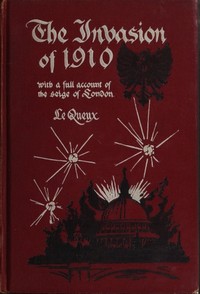
Public-domain ebook
Lord Roberts' Message to the Nation
Language: en291 downloads on Project Gutenberg
Subjects
In: Essays, Letters & Speeches·History - British·History - Modern (1750+)
Public-domain ebook sourced from Project Gutenberg #55235.
Public-domain ebook
Language: en291 downloads on Project Gutenberg
Subjects
In: Essays, Letters & Speeches·History - British·History - Modern (1750+)
Public-domain ebook sourced from Project Gutenberg #55235.
The opening · free to read
This is only the second occasion in a long life on which I have had the privilege of speaking in your city; and it is with no inadequate sense of the value of that occasion and of the responsibility attaching to the position which, for the past ten years, I have taken up towards this Empire and its armies that I come before you this afternoon. For in the upbuilding of that Empire what city in our dominions has taken a more conspicuous part than this city, made illustrious almost since its foundation by commercial enterprise and by its political sagacity and spirit in affairs? In the eighteenth century your merchants aided the designs of the elder Pitt, and of the statesmen who followed him, in founding that power in India and the East which to-day is the envy and the admiration of the nations. In the nineteenth, within my own memory, your city, under the unforgotten leadership of John Bright, Richard Cobden, and Milner Gibson, gave a great watchword[1] to a great and still living party, and by its resolute effort forced through Parliament the repeal of the Corn Laws, one of the most momentous and revolutionary measures in this nation's history.
Nor, in more recent times, has Manchester abated her zeal or her vital energy in every phase of English political life. The greatest, most temperate, and statesmanlike Liberal newspaper in England is night by night printed within your walls; so that, at least in one phase of our national life and amongst one group of our fellow-citizens--the Liberal party, that is to say--it is literally true that what Manchester thinks to-night London thinks to-morrow. And a certain election the other day, and the overflow meetings which, I understand, have been held in favour of Tariff Reform within the sacred precincts of the Free Trade Hall itself, give a further proof that here in Manchester you are not petrified in your opinions, but that the stream of your political life flows fresh and from the fountain-head.
Judge then, gentlemen, whether it was not with some concern that I looked forward to this occasion; judge whether it was not with some searching of the heart that I reflected upon what I have this afternoon to say to you. For does it not appear at first sight as if what I have to say is not merely antagonistic to the teaching of the two greatest names of the Manchester School, John Bright and Richard Cobden, but is in every way the contradiction of the characterizing ideas and the traditions associated with this city itself?
For I come before you to-day to advocate the necessity of National Service; to affirm once more that the "Nation in Arms" is the only worthy and sure bulwark of this Empire and these islands.[2] Cobden, on the other hand, has left it on record that he considered it the glory and the exceeding great reward of all his labours that he had contributed, in however small a degree, to that universal disarmament of Europe, which, he sanguinely hoped, would be the result of Free Trade and of expanding commerce and the organization of labour. And John Bright, his great colleague, in one speech after another, added the lustre of his eloquence to that same high and flattering anticipation. I can remember easily the ardent and sympathetic reception which those anticipations met in the France of Louis Napoleon; I can remember also the added weight which France's enthusiasm gave to those happy anticipations here in England. War, indeed, seemed at an end. To-morrow, it seemed, we should be turning our barracks into granaries and our arsenals into banking houses.
Gentlemen, I am, I trust, doing no wrong to the memory of these statesmen when I point out that in the very years--nay, in the very months--that they were cherishing these illusions of peace and universal disarmament, in those very months the mightiest and most disciplined force that this earth has ever contained was silently being drilled in that wide region from the Rhine to the Elbe and the Oder, and from the North Sea to the Bavarian frontier, until, the right hour having struck, that army disclosed itself in all its prodigious and crushing mass and in all its unmatched capacity for destruction and war. And, amid those auspicious dreams of peace, for what was that army being trained? Koeniggrätz, Metz, St. Privat, and Sedan are the answer. Nor did that army pause until upon the ruins of the Empire of the third Napoleon--upon the ruins, I may say, of France, unprepared in peace, and in war scattered and dismayed--it had reared a new Empire, the Empire of William I., of Frederick I., and of William II., for whose personal character, noble and imaginative patriotism, and capacities as a ruler, I yield to no man in my admiration. Such, gentlemen, was history's ironic comment upon John Bright's and Richard Cobden's eloquently-urged enthusiasm. Let me not increase by any word of mine the crushing weight of Destiny's criticism.
Now, gentlemen, at the present day, now in the year 1912, our German friends, I am well aware, do not, at least in sensible circles, assert dogmatically that a war with Great Britain will take place this year or next; but in their heart of hearts they know, every man of them,[3] that, just as in 1866 and just as in 1870, war will take place the instant the German forces by land and sea are, by their superiority at every point, as certain of victory as anything in human calculation can be made certain. "Germany strikes when Germany's hour has struck." That is the time-honoured policy of her Foreign Office. That was the policy relentlessly pursued by Bismarck and Moltke in 1866 and 1870; it has been her policy decade by decade since that date; it is her policy at the present hour. And, gentlemen, it is an excellent policy. It is, or should be, the policy of every nation prepared to play a great part in history. Under that policy Germany has, within the last ten years, sprung, as at a bound, from one of the weakest of naval Powers to the greatest naval Power, save one, upon this globe. But yesterday, so to speak, the British Fleets did not feel the furrow of a German war-keel on the wide seas. To-day every British warship and every British merchant vessel thrills in all her iron nerves to that mighty presence. Just as in 1866, by the massing of her armies towards this frontier or towards that frontier, Prussia controlled the action of Austria, so Germany constrains the action of England at the present day. Do you wish for proofs? I point to the gradual displacement of the British Fleet before the German menace. I point to the Mediterranean, bereft of British battleships, and to the gradual narrowing, year by year, of our once far-flung battle-line.
We may stand still: Germany always advances, and the direction of her advance, the line along which she is moving, is now most manifest. It is towards that consummation which I have described--a complete supremacy by land and sea. She has built a mighty fleet; but, as if nothing were done so long as anything stands between her and her goal, still she presses on--here establishing a new Heligoland, for every available island in the North Sea has been fortified--there enclosing Holland in a network of new canals, and deepening old riverbeds for the swifter transport of the munitions of war, whether to her army or her fleet.
Contrasted with our own apathy or puerile and spasmodic efforts, how impressive is this magnificent and unresting energy! It has the mark of true greatness; it extorts admiration even from those against whom it is directed!
But, it is urged by the advocates of universal peace, how monstrous is this expenditure of human strength and human ingenuity, if unused, and how yet more monstrous the waste of human life if actually used in war![4] And how much more sane is the policy of Cobden and of Bright and of their imitators or followers at the present day! Gentlemen, arguments which prove the folly and criminality of war are, at the present stage of history, like the arguments which prove the folly and criminality of ambition and of the love of glory. Even those who argue most eloquently against glory do, by that very eloquence, seek to win glory; and those who argue most forcibly against war do, nevertheless, live, and for long will continue to live, under an invisible power which has made war an inseparable portion of human polity. Much, during the autumn of 1911, was said and written upon arbitration. America's action in the Panama Canal, and the impotence of diplomatists in the Balkan crisis,[5] are again history's ironic comment in the autumn of 1912! Arbitration most certainly is more humane than war; but, at the present stage of the polity of nations, arbitration again and again refuses to extend itself to some of the most vital and essential questions--questions which, to a nation or empire sensitive alike to its honour and to its abiding interests, make war unavoidable.
Again, we have heard much during the current year of the power of Labour in international politics. The German Socialist, it is said, will not make war upon his French or his English comrade. Gentlemen, it is to the credit of the human race that patriotism, in the presence of such organizations, has always proved itself superior to any class or any individual. Love of country has on the actual day of battle always proved itself superior to love of profit. That law has not been abrogated, and if war broke out to-morrow the German working man would quit himself like a German, and the British working man, I hope, like a Briton.
Hence, gentlemen, the mistrust with which I have always viewed the proposals of British Ministers for a limitation of armaments. Emanating from Great Britain, such proposals must always, I imagine, impress a foreign observer as either too early or too late in English history. For how was this Empire of Britain founded? War founded this Empire--war and conquest! When we, therefore, masters by war of one-third of the habitable globe, when we propose to Germany to disarm, to curtail her navy or diminish her army, Germany naturally refuses; and pointing, not without justice, to the road by which England, sword in hand, has climbed to her unmatched eminence, declares openly, or in the veiled language of diplomacy, that by the same path, if by no other, Germany is determined also to ascend! Who amongst us, knowing the past of this nation, and the past of all nations and cities that have ever added the lustre of their name to human annals, can accuse Germany or regard the utterance of one of her greatest Chancellors a year and a half ago,[6] or of General Bernhardi three months ago, with any feelings except those of respect?
Gentlemen, other world-Powers besides Germany have arisen and are arising around us; but there is one way in which Britain can have peace, not only with Germany, but with every other Power, national or imperial, and that is, to present such a battle-front by sea and land that no Power or probable combination of Powers shall dare to attack her without the certainty of disaster. That is the only reply worthy of our past and wise for our future which we can or ought to make to those unparalleled efforts which I have described. And there is a way in which England can have war; there is a way in which she is certain to have war and its horrors and calamities: it is by persisting in her present course, her apathy, unintelligence, blindness, and in her disregard of the warnings of the most ordinary political insight, as well as of the examples of history.
The book keeps going
Reading is free forever. Sign up and watch scenes appear while you read.



Scenes Storieta drew for other classics.
New illustrated classics
Once or twice a month: the latest books to get full character casts, scene art, and free comic editions. No account needed.