Public-domain ebook
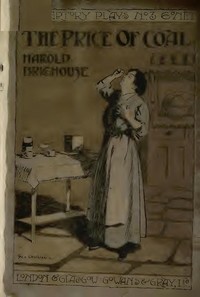
The Price of Coal A Play
Language: en364 downloads on Project Gutenberg
Subjects
In: Plays/Films/Dramas·British Literature
Public-domain ebook sourced from Project Gutenberg #55287.
Public-domain ebook
Language: en364 downloads on Project Gutenberg
Subjects
In: Plays/Films/Dramas·British Literature
Public-domain ebook sourced from Project Gutenberg #55287.
The opening · free to read
Miss Agnes Bartholomew. Mr. R. B. Drysdale.
Miss Elspeth Dudgeon. Miss Lola Duncan.
The Scene is laid in a Lanarkshire Colliery Village.
Modern industrialism has evolved its special types, and the Lanarkshire collier is small and wiry. He swings a pickaxe for hours on end crouched in an impossibly small space in heated atmosphere, and physique on the grand scale is unsuited to such conditions. He takes tremendous risks as part of his daily routine. His recreations are, to a fastidious taste, coarse. He works hard under ground and plays hard above ground. Constrained attitude is so much his second nature that he sits in perfect comfort on his haunches, in the pictured pose of the mild Hindoo, his back to a wall, discussing, amongst expectoration—a long row of him—, football, dogs, his last spree and his next, the police reports, women.
Altogether a most unpleasant person, this undersized, foul-mouthed, sporting hewer of coal-until you come to know him better, to discover his simplicity of soul, his directness, his matter-of-fact self-sacrifice, the unconscious heroism of his life: and to lose sight of his superficial frailties in your admiration for his finer qualities.
The womenkind of the colliers are marked by the life of the pits no less than the men. They are rough, capable housewives, dressing with more care for durability than effect, tolerant of their menfolks’ weaknesses, and, above all, stamped with the pit-side stoicism apt to be mistaken for callousness. The sudden death of their breadwinner is an everyday hazard, accepted without complaint and without concealment as part of their life. Like their husbands, they exist from hand to mouth on the brink of eternity. Thrift, when any day’s work may be your last, seems a misplaced virtue. Lean fare approaches as pay day recedes, and illness, meagrely provided for by membership of a “sick” society, is tided over in the main by the unfailing generosity of neighbours whose own table suffers by the charity.
The scene represents the living room of a collier’s cottage in Lanarkshire. The room has three doors, one to the right and one to the left, which lead to the sleeping rooms, and one in the centre which opens on to the village street. A fireplace with a cooking stove set in it is at the right. A holland blind is drawn down at the window, but it does not completely shut out the night, which is now dissolving into a grey, cold dawn, for the cheap German alarm clock that ticks loudly on the mantleshelf marks the hour five-thirty. When the curtain rises the room is in darkness save for the glint of bluish-grey light that shows at the window. Then Mary Brown enters from the door on the right, she strikes a match and lights a lamp, when you see she is a girl of about twenty; she does not look her best, her hair has been hurriedly screwed up, her print blouse, murky with toil, has not yet been fastened, she wears a draggle- tailed skirt of sombre colour and list slippers are on her feet.
A small spirit-lamp is on the hob and a little tin kettle near by; she lights the lamp, puts the kettle on it, then crosses to the door on the left and knocks.
Mary takes a plain and fairly clean apron from a hook by the dresser and puts it on briskly; she then takes a cup and saucer from the rack, putting them on the dresser, from the cupboard of which she takes a cocoa-tin and puts a spoonful of cocoa in the cup. Then she takes bread and meat from the cupboard and makes a couple of huge sandwiches. These she puts on a tin plate, and covering them with another tin plate, she ties the whole in a large red handkerchief with the ends looped for carrying. A tin can with a screw top is placed near by. Then, from the door at the left, enters Jock Brown, Mary’s cousin.
He is dressed in his working or “black” clothes, which may have been coloured once but are now blackened with coal dust. He wears no collar, but a muffler, which, because it is doffed in the pit, still preserves something of its original hue, which was a bright red.
The book keeps going
Reading is free forever. Sign up and watch scenes appear while you read.



Scenes Storieta drew for other classics.
New illustrated classics
Once or twice a month: the latest books to get full character casts, scene art, and free comic editions. No account needed.