Public-domain ebook
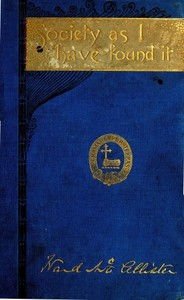
Society as I Have Found It
Language: en8,930 downloads on Project Gutenberg
Subjects
In: Biographies·History - American·History - European
Public-domain ebook sourced from Project Gutenberg #55300.
Public-domain ebook
Language: en8,930 downloads on Project Gutenberg
Subjects
In: Biographies·History - American·History - European
Public-domain ebook sourced from Project Gutenberg #55300.
Society as I Have Found It is a sprawling memoir by Ward McAllister, the self‑styled arbiter of New York’s Gilded‑Age social scene. The book opens with a flamboyant title page and a series of authorial asides that promise a “miscellaneous” work, a “noble disdain of regularity,” and a mental journey as rough as a stage‑coach ride over a corduroy road. From there McAllister launches into a chronologically organized series of chapters that trace his family origins, his early New York life, and a litany of high‑society adventures in Europe, the South, and the capital. The contents list alone reveals a kaleidoscope of anecdotes, costly balls, wine tastings, hunting expeditions, and elaborate dinner‑planning, each presented as a vignette of the rituals and personalities that defined his world.
The voice is unapologetically boastful and conversational, peppered with the period’s genteel diction and a penchant for detail that reads like a social register as much as a personal diary. Written in the late nineteenth century, the style reflects the era’s fascination with status, etiquette, and the spectacle of lavish entertaining. Readers who relish insider accounts of Gilded‑Age aristocracy, the mechanics of Victorian‑era hospitality, or a vivid portrait of a man who shaped New York’s elite circles will find McAllister’s memoir both entertaining and illuminating.
The opening · free to read
My Family--My Mother an Angel of Beauty and Charity--My Father’s Nobleness of Character--Building Bonfires on Paradise Rocks and Flying Kites from Purgatory with Uncle Sam Ward--My Brother the Soldier--My Brother the Lawyer.
In 1820 my mother, a beautiful girl of eighteen years, was introduced into New York society by her sister, Mrs. Samuel Ward, the wife of Samuel Ward, the banker, of the firm of Prime, Ward & King. She was a great belle in the days when Robert and Richard Ray and Prescott Hall were of the jeunesse dorée of this city. In my opinion, she was the most beautiful, Murillo-like woman I have ever seen, and she was as good as she was beautiful;--an angel in works of charity and sympathy for her race. Charlotte Corday’s picture in the Louvre is a picture of my mother. The likeness arose from the fact that her family were descended on the maternal side from the Corday family of France. This also accounts for all my family being, from time immemorial, good Democrats. No one was too humble to be received and cared for and sympathized with by my mother. Her pastime was by the bedside of hospital patients, and in the schoolroom of her children. She followed the precepts of her mother’s great-grandfather, the Rev. Gabriel Marion (grandfather of Gen. Francis Marion) as expressed in his will to the following effect: “As to the poor, I have always treated them as my brethren. My dear family will, I know, follow my example.” It also contained this item: “I give her, my wife, my new carriage and horses, that she may visit her friends in comfort.” This ancestor came from Rochelle in a large ship chartered for the Carolinas by several wealthy Huguenot families. The Hugers and Trapiers and others came over in the same ship. He did not leave France empty-handed, for on his arrival in Carolina he bought a plantation on Goose Creek, near Charleston, where he was buried.
While a belle in this city her admirers were legion, until a young Georgian, in the person of my father, stepped in, and secured the prize and took her off to Savannah. He was fresh from Princeton College, cut short in his college career by a large fire in Savannah (his native city), which burnt it down, destroying my grandfather’s city property. The old gentleman, when the fire occurred, refused to leave his residence (now the Pulaski Hotel), and was taken forcibly from the burning building in his chair. He then owned the valuable business portion of the city, and at once went to work to rebuild. His relatives would not assist him, and so he sent for his only son, then at college, and got him to indorse all his notes, and in this way secured from the banks the money he wanted for building purposes. He undertook too much, and my father bore for one-third of his life a burden of debt then incurred. Nothing daunted, he went to work at the bar and commenced life with his beautiful, young Northern wife.
At that time, there was a great prejudice against Northern people. My father’s mother never forgave my mother for being a Northern woman, and when she died, though she knew her son was weighed down with his father’s debts, insisted on his freeing all the negroes she owned and left him by will, enjoining him to do this as her last dying request. It is needless to say that he did it, and not only this, but became the guardian of those people and helped and cared for them so long as he lived. Being repeatedly Mayor of the City of Savannah, he was able to protect them, and so devoted were the whole colored population to him, that one Andrew Marshall, the clergyman of the largest colored church in the city of Savannah, offered up prayers for him on every Sunday, as is done in our Episcopal church for the President of the United States. Blest with five sons and one daughter, struggling to maintain them by his practice at the bar, this best of fathers sent his family North every summer, with one or two exceptions, to Newport, R. I., which at that time was really a Southern colony.
It was the fashion then at Newport to lease for the summer a farmer’s house on the Island, and not live in the town. Well do I remember, with my Uncle Sam Ward and Dr. Francis, of New York, and my father, building bonfires on Paradise Rocks on the Fourth of July and flying kites from Purgatory. The first relief to this hard-worked man was sending his oldest son to West Point, where, I will here add, he did the family great credit by becoming, being, and dying a noble soldier and Christian. Fighting in both armies, one may say, though I believe he was in active service only in the Mexican War, having graduated second in his class at West Point and entered the Ordnance Corps; so in place of fighting, he was making arms, casting cannon, etc. His pride lay in the fact that he was a soldier. His last request was that the Secretary of War should grant permission for his remains to be buried at West Point, which request was granted. My second brother, Hall, grew up with the poet Milton always under his arm. He was a great student. At the little village of Springfield, Georgia, where my family had a country house, and where we occasionally passed the summer in the piney woods, I remember as a boy of fifteen years of age, reading the Declaration of Independence on the Fourth of July from the pulpit of the village church to the descendants of the old Salzburghers, who came over soon after Oglethorpe, and it was before an audience of these piney woods farmers, that, with this brother, at a meeting of our Debating Society in this village, I discussed the question, “Which is the stronger passion, Love or Ambition,” he advocating Ambition, I Love. I well remember going for him, as follows: “If his motto be that of Hercules the Invincible, I assume for mine that of his opponent, Venus the Victorious. With my sling and stone I will enter this unequal combat and thus hope to slay the great Goliath.” The twelve good and true men who heard the discussion decided in my favor. To the end of his days this brother of mine was guided and governed by this self-same ambition; it made him what he became, a great lawyer, the lawyer of the Pacific coast; his boast to me being that he had saved seventeen lives, never having lost a murder case. I let ambition go, and through life and to the present moment swear by my goddess Venus. This brother, after entering the Georgia bar, started for a trip around the world. On reaching San Francisco he heard of the discovery of gold, and Commodore Jones, then in command of our Pacific Squadron, urged him to prosecute some sailors who had thrown an officer overboard and deserted, and it was this which caused him to settle down there to the practice of law.
LAW AND HOUSEKEEPING.
My New York Life--A Penurious Aunt who Fed me on Turkey--My First Fancy Ball--Spending One Thousand Dollars for a Costume--The Schermerhorns give a Ball in Great Jones Street--Sticking a Man’s Calf and Drawing Blood--A Craze for Dancing--I Study Law--Blackstone has a Rival in Lovely Southern Maidens--I go to San Francisco in ’50--Fees Paid in Gold Dust--Eggs at $2--My First Housekeeping--A faux pas at a Reception.
I myself soon left Savannah for New York after Hall’s departure, residing there in Tenth Street with an old maiden lady, my relative and godmother, whom I always felt would endow me with all her worldly goods, but who, I regret to say, preferred the Presbyterian church and the Georgia Historical Society to myself, for between them she divided a million. At that time Tenth Street was a fashionable street; our house was a comfortable, ordinary one, but my ancient relative considered it a palace, so that all her visitors were taken from garret to cellar to view it. Occupying the front room in the third story, as I would hear these visitors making for my room, I often had to scramble into the bath-room or under the bed, to hide myself. Having a large fortune, my relative, whom I called Aunt (but who was really only my father’s cousin), was saving to meanness; her plantations in the South furnished our table; turkeys came on in barrels. “It was turkey hot and turkey cold, turkey tender, and turkey tough, until at grace one would exclaim, ‘I thank ye, Lord, we’ve had enough.’” As the supposed heir of my saving godmother, the portals of New York society were easily open to me, and I well remember my first fancy ball, given by Mrs. John C. Stevens in her residence in College Place. A company of soldiers were called in to drill on the waxed floors to perfect them for dancing. A legacy of a thousand dollars paid me by the New York Life Insurance and Trust Company I expended in a fancy dress, which I flattered myself was the handsomest and richest at the ball. I danced the cotillion with a nun, a strange costume for her to appear in, as “I wont be a nun” was engraved on every expression of her face. She was at that day one of the brightest and most charming young women in this city, and had a power of fascination rarely equaled.
The next great social event that I recall was the great fancy ball given by the Schermerhorns in their house on the corner of Great Jones Street and Lafayette Place. All the guests were asked to appear in the costume of the period of Louis XV. The house itself was furnished and decorated in that style for this occasion. No pains or expense were spared. It was intended to be the greatest affaire de luxe New Yorkers had ever seen. The men, as well as the women, vied with each other in getting up as handsome costumes as were ever worn at that luxurious Court. The lace and diamonds on the women astonished society. All the servants of the house wore costumes, correct copies of those worn at that period. The men in tights and silk stockings, for the first time in their lives, became jealous of each other’s calves, and in one instance, a friend of mine, on gazing at the superb development in this line of a guest, doubted nature’s having bestowed such generous gifts on him; so, to satisfy himself, he pricked his neighbor’s calf with his sword, actually drawing blood, but the possessor of the fine limbs never winced; later on he expressed forcibly his opinion of the assault. By not wincing the impression that he had aided nature was confirmed.
These two balls were the greatest social events that had ever occurred in this city. Even then subscription balls were the fashion. One of the most brilliant was given at Delmonico’s on the corner of Beaver and William streets (the old building in which the ball was given is now being torn down). Saracco’s dancing-rooms were then much resorted to. They became the rage, and every one was seized with a desire to perfect himself in dancing.
Disgusted with book-keeping, I resolved to study law, and knowing that I could not do much studying whilst flirting and going to balls and dinners, I went South to my native city, took up the second volume of Blackstone, committed it to memory, passed an examination, and was admitted to the bar by one of our ex-ministers to Austria, then a judge.
The book keeps going
Reading is free forever. Sign up and watch scenes appear while you read.



Scenes Storieta drew for other classics.
New illustrated classics
Once or twice a month: the latest books to get full character casts, scene art, and free comic editions. No account needed.