Public-domain ebook
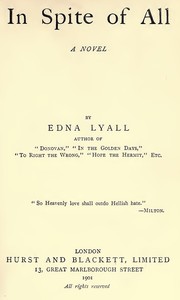
In Spite of All: A Novel
by Edna Lyall
Language: en651 downloads on Project Gutenberg
Subjects
In: Historical Novels·Romance·Novels
Public-domain ebook sourced from Project Gutenberg #55324.
Public-domain ebook
by Edna Lyall
Language: en651 downloads on Project Gutenberg
Subjects
In: Historical Novels·Romance·Novels
Public-domain ebook sourced from Project Gutenberg #55324.
The opening · free to read
And all-repaying eyes look proud on them in death.
--Lowell.
There had been a heavy fall of snow in Hereford during the night, but the south walk in Dr. Harford’s garden had been swept, and the still, frosty air and mid-day sunshine made the place as pleasant a playground as could be wished. The merry voices of a boy and girl had rung for the last half-hour in the pleasance, and the joys of snowballing were far too keen to allow the little couple to notice even for a moment the beauty of the wintry scene, with the rime-covered trees and bushes bordering the river, and in the background the cathedral, its massive tower surmounted in those seventeenth century days by a lofty spire covered with lead which glittered in the bright sunshine.
Presently the two playmates grew tired of snowballing and retired to a little arbour, commonly called the sun-trap, for here on the coldest days warmth could generally be found. There was a lull in the merry sounds, but it was only the calm which precedes a storm, for before long came a vehement expostulation, “Gabriel! Gabriel! let me have it. I will have it.”
“Not till you have promised,” was the teasing retort, and from the arbour there sprang out a small boy, with the most winsome and mischievous face, his hazel eyes sparkling with elfish mirth, while he held high above his head a wooden puppet, as dear to its small owner as the loveliest of modern dolls.
The bereft mother refused to enter into the game; it might be sport to him, but it was death to her.
“I won’t promise!” she said, angrily. “Give me my babe.”
“No,” said Gabriel, laughing. “I can’t have you chopping and changing. You said yesterday you would, and now you have changed your mind. Come, promise, Hilary, and I’ll give you the puppet.”
“Never!” said Hilary, furiously.
With a teasing laugh he tossed the puppet high in the air, intending to catch it as it fell; but, Hilary, frantic at this treatment of her Bartholomew babe, charged him with fury like a little goat, and the next minute both children were rolling in the snow..
By the time they had picked themselves up the whole situation had changed, for, much to their astonishment, a huge mastiff came bounding through the garden and, seizing the puppet on the path, began to worry it.
For a minute both paused, the girl aghast, the boy with knitted brows. It was well enough to tease his small playmate now and then, but he had not reckoned on this four-footed intruder. A sob from Hilary made him fly to the rescue.
“Leave go, you brute!” he shouted, trying in vain to drag back the mastiff by his collar.
This was clearly hopeless. He pulled and tugged with all his might, but the dog unconcernedly chewed the doll.
“Oh, my babe--my poor babe!” wailed Hilary.
Whereupon Gabriel, pricked at heart, made a valiant snatch at the puppet, got it firmly by the head and succeeded in wrenching it from the very jaws of death.
“There!” he said, flinging it towards the little girl in triumph; but the triumph was short-lived, for it was now the turn of the dog, who, defrauded thus unceremoniously of his toy, seized angrily on the arm of the knight-errant.
A scream of genuine terror from Hilary brought Dr. Harford rushing from the house, and in his wake followed a grave, stately gentleman whom the little girl at once recognised as Sir Robert Harley, of Brampton Bryan. Apparently the mastiff belonged to him, for at his stern summons it came to heel obediently, while Dr. Harford began to examine his son’s arm.
“How did you anger him, child?” he asked, deftly unfastening Gabriel’s dripping sleeve.
“It was my fault, sir,” replied the boy, trying bravely to stiffen his lip. “I threw up the puppet, and then the dog worried it.”
“I trust Nero has not hurt him much,” said Sir Robert, concerned to see the wound on the small, shapely arm.
“Oh, we’ll soon set it right,” said Dr. Harford, leading the child to the house; “but with dog-bites you should never take half-measures. I must put a hot iron to it, so screw up your courage, laddie, and think how brave Cranmer thrust his hand into the flames.”
Gabriel’s heart sickened at the prospect before him, but he held up his head and stepped out more briskly, while Hilary crept after him with tearful eyes.
“You will excuse me, Sir Robert, if I see to this matter at once,” said the doctor, “for delays are dangerous. I ran forth in such haste on hearing little Hilary Unett’s scream that I have not yet even asked whether you will not lie here this night.”
“Nay, I am to be the guest of Sir Richard Hopton at Canon Frome,” said Sir Robert, seating himself by the fire in the doctor’s study and watching his host’s rapid movements as he prepared to dress the child’s wound.
“I did but come to bear to you and to Doctor Wright the news of Sir John Eliot’s death.”
“What! Is he indeed gone?” said Dr. Harford, sorrow clouding his fine, thoughtful face.
“Here is a letter I received last night from London,” said Sir Robert. “An you will I will read it.”
“Sir John Eliot, one of the Members for Cornwall in the last Parliament, died this 27th day of November, after nigh upon four years’ imprisonment in the Tower, for refusing to answer for his conduct in Parliament anywhere but in Parliament itself, this being, he maintained, one of the inalienable rights of the English people, without which a just liberty would be impossible. Having incurred the displeasure of His Majesty on this account, and for his fearless unveiling of divers other Court abuses and irregularities, the King refused to release him, and, indeed, for the last year did keep him close prisoner in a dark, cold and wretchedly uncomfortable room, denying him, even at his physician’s request, air and exercise, and forbidding him to see any save his sons. His health was thus undermined, and a fortnight since, when he did petition for a temporary release to recover from his sickness, the request was refused by His Majesty, and now that he lies dead the King will not grant his sons’ petition to carry the body for burial to Port Eliot, but orders that Sir John shall be buried in the church within the walls of the Tower. This harshness hath greatly angered all who knew the late Member for Cornwall, and, knowing him, could but admire his integrity, his courage and his patriotic devotion.”
“A brave man--a truly great man,” said Dr. Harford. “Sir John Eliot is the martyr who by his blood will safeguard our Parliamentary rights.”
As he spoke he took the hot iron from the fire and drew Gabriel gently towards him.
“Now, my son,” he said, in the voice which by its tender but firm cheerfulness had nerved many a sufferer, “what a joy it will be to your father if you follow in that great man’s steps. Nothing could daunt Sir John; cost what it might he was ever true.”
The boy being of a highly-strung, nervous temperament turned deathly white, but never flinched as the hot iron seared his flesh; only a stifled moan escaped him, and Hilary through her tears saw the strangest look of triumph in his dilated eyes--a look that made her heart throb with love and admiration. In a few minutes more the arm was carefully bandaged, the two gentlemen continuing meantime their grave talk.
“I will send word to Frank Unett that you are here, sir,” said Dr. Harford, “for he, too, is one that deplores the present illegal rule without a Parliament; he will mourn Sir John’s death.”
“We call it a death,” said Sir Robert, “but he has been as surely murdered by the rigours of imprisonment as though he had been stabbed in the Tower. Well,” with a sigh, “the day of reckoning cannot long be delayed.”
“There, laddie,” said the doctor, drawing the sleeve gently over the bandage, “you have borne it like an Englishman; now run off into the fresh air and forget your troubles.”
With respectful salutes to their elders the children returned to the garden; Hilary, with her pretty eyes still tender and subdued, slipped her arm caressingly round her playmate’s neck. “I’m sorry, Gabriel,” she said, in a tremulous voice, “and all the time I didn’t really mean it. I will be your little wife.”
Gabriel turned and kissed her soft, rosy cheek with great frankness and warmth. “If you will,” he said, “I’ll promise not to worry your puppets any more. I don’t know how it is,” he continued reflectively, “but there’s something that makes a boy feel to a puppet like a dog does to a cat--he must worry it.”
“There was the one you roasted last Lammastide,” said Hilary, sadly.
“But you know it did make a glorious bonfire, and you enjoyed that part of it,” said Gabriel, with mirth in his eyes.
The book keeps going
Reading is free forever. Sign up and watch scenes appear while you read.



Scenes Storieta drew for other classics.
New illustrated classics
Once or twice a month: the latest books to get full character casts, scene art, and free comic editions. No account needed.