Public-domain ebook
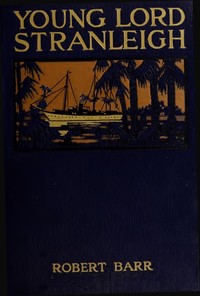
Young Lord Stranleigh: A Novel
by Robert Barr
Language: en483 downloads on Project Gutenberg
Subjects
Public-domain ebook sourced from Project Gutenberg #55329.
Public-domain ebook
by Robert Barr
Language: en483 downloads on Project Gutenberg
Subjects
Public-domain ebook sourced from Project Gutenberg #55329.
The opening · free to read
IT was shortly after nine o’clock in the morning that young Lord Stranleigh of Wychwood, in a most leisurely fashion, descended the front steps of his town house into the street. The young man was almost too perfectly dressed. Every article of his costume, from his shiny hat to the polished boots, was so exactly what it should he, that he ran some danger of being regarded as a model for one of those beautiful engravings of well-dressed mankind which decorate the shops of Bond-Street tailors. He was evidently one who did no useful work in the world, and as a practical person might remark, why should he, when his income was more than thirty thousand pounds a year? The slightly bored expression of his countenance, the languid droop of his eyelids, the easy but indifferent grace of motion that distinguished him, might have proclaimed to a keen observer that the young man had tested all things, and found there was nothing worth getting excited about. He was evidently a person without enthusiasm, for even the sweet perfection of his attire might be attributed to the thought and care of his tailor, rather than to any active meditation on his own part. Indeed, his indolence of attitude made the very words “active” or “energetic” seem superfluous in our language. His friends found it difficult, if not impossible, to interest Lord Stranleigh in anything, even in a horse race, or the fling of the dice, for he possessed so much more money than he needed, that gain or loss failed to excite a passing flutter of emotion. If he was equipped with brains, as some of his more intimate friends darkly hinted, he had hitherto given no evidence of the fact. Although well set up, he was not an athlete. He shot a little, hunted a little, came to town during the season, went to the Continent when the continental exodus took place, always doing the conventional thing, but not doing it well enough or bad enough to excite comment. He was the human embodiment of the sentiment: “There is nothing really worth while.”
In marked contrast to him stood, undecided, a man of his own age, with one foot on the lower stone step which led up to the front door of his lordship’s town house. His clothes, of undistinguished cut, were worn so carelessly that they almost gave the impression of being ready-made. His flung-on, black slouch hat suggested Western America or Southern Africa. His boots were coarse and clumsy.
But if the attire was uninspiring, the face merited, and usually received, a second glance. It was smooth-shaven, massive and strong, tanned to a slight mahogany tinge by a more eager sun than ever shines on England. The eyes were deep, penetrating, determined, masterful.
Lord Stranleigh’s delicate upper lip supported a silken mustache carefully tended; his eyes were languid and tired, capable of no such gleam of intensity as was now turned upon him from the eyes of the other.
“I beg your pardon, sir, but are you Lord Stranleigh of Wychwood?”
His lordship paused on the upper steps, and drawled the one word “Yes.”
“My name is Peter Mackeller, and the Honorable John Hazel gave me a letter of introduction to you, saying I should probably catch you in at this hour. It seems he underestimated your energy, for you are already abroad.”
There was an undercurrent of resentment in the impatient tone Mackeller had used. He was manifestly impressed unfavorably by this modern representative of a very ancient family, but the purpose he had in view caused him to curb his dislike, although he had not been tactful enough to prevent a hint of it appearing in his words. If the other had gathered any impression of that hint, he was too perfectly trained to betray his knowledge, either in phrase or expression of countenance. The opinion of his fellows was a matter of complete indifference to him. A rather engaging smile stirred the silken mustache.
“Oh, Jack always underestimates my good qualities, so we won’t trouble about his note of introduction. Besides, a man cannot read a letter in the street, can he?”
“I see no reason against it,” replied the other sharply.
“Don’t you really? Well, I am going across to my club, and perhaps as we walk along together, you will be good enough to say why you wish to see me.”
Lord Stranleigh was about to proceed down another step when the other answered “No” so brusquely that his lordship paused once more, with a scarcely perceptible elevation of the eyebrows, for, as a rule, people did not say “No” to Lord Stranleigh of Wychwood, who was known to enjoy thirty thousand pounds a year.
“Then what do you propose?” asked his lordship, as though his own suggestion had exhausted all the possibilities of action.
“I propose that you open the door, invite me in, and give me ten minutes of your valuable time.”
The smile on his lordship’s countenance visibly increased.
“That’s not a bad idea,” he said, with the air of one listening to unexpected originality. “Won’t you come in, Mr. Mackeller?” and with his latchkey he opened the door, politely motioning the other to precede him.
Young Mackeller was ushered into a small room to the left of the hall. It was most severely plain, paneled somberly in old oak, lit by one window, and furnished with several heavy leather-covered chairs. In the center stood a small table, carrying a huge bottle of ink, like a great dab of black metal which had been flung while soft on its surface, and now, hardened, sat broad and squat as if it were part of the table itself. On a mat lay several pens, and at one end of the table stood a rack such as holds paper and envelopes, but in this case of most minute proportions, displaying three tiers, one above the other, of what appeared to be visiting cards; twelve minute compact packs all in all, four in each row.
“This,” said Lord Stranleigh, with almost an air of geniality, “is my business office.”
The visitor looked around him. There were no desks; no pillars of drawers; no japanned-metal boxes that held documents; no cupboards; no books; no pictures.
“Pray be seated, Mr. Mackeller,” and when the young man had accepted the invitation, Lord Stranleigh drew up opposite to him at the small table with the packets of cards close to his right hand.
“And now, if you will oblige me with Jack’s letter, I will glance over it, though he rarely writes anything worth reading.”
Mackeller handed him the letter in an open envelope. His lordship slowly withdrew the document, adjusted an eyeglass, and read it; then he returned it to the envelope, and passed it back to its owner.
“Would it be too much if I asked you to replace it in your pocket, as there is no waste-paper basket in this room?”
Mackeller acted as requested, but the frown on his broad brow deepened. This butterfly seemed to annoy him with his imperturbable manner, and his trifling, finicky, childish insincerity. Confronted with a real man, Mackeller felt he might succeed, but he had already begun to fear that this bit of mental thistle-down would evade him, so instead of going on with his recital, he sat there glowering at Lord Stranleigh, who proved even more of a nonentity than the Honorable John Hazel had led him to believe. He had been prepared to meet some measure of irresponsible inanity, but not quite so much as this. It was Lord Stranleigh himself who broke the silence.
“What do you want?” he asked, almost as if some of his opponent’s churlishness had hypnotically permeated into his own being.
“Money,” snapped the other shortly.
“Ah, they all do,” sighed his lordship, once more a picture of indolent nonchalance.
He selected from the rack beside him four cards, one from each of the little packs in the lower range. These he spread face upward on the table before him.
“I never trouble about money,” said his lordship, smiling.
“You probably don’t need to, with thirty thousand a year,” suggested Mackeller.
“Ah, that’s exaggerated,” explained his lordship. “You forget the beastly income tax. Still, I was not referring to the amount; I merely wished to explain my methods of dealing with it. Here are the names and addresses of four eminent solicitor persons in the city. There is little use of my keeping four dogs and barking myself, is there? I’ve really twelve dogs altogether, as represented in this cardcase, but one or other of these four will doubtless suit our purpose. Now, this firm of solicitors attends to one form of charity.”
“I don’t want charity,” growled Mackeller.
“Quite so. I am merely explaining. This firm attends to all the charities that are recognized in our set; the hospitals, the--well whatever they happen to be. When applied to personally in these matters, I write my name on the card of these solicitors, and forward it. Application is then made to them. They look into the matter, and save me the fatigue of investigation. The next firm”--holding up a second card--“deals with charities that are our of our purview; halfdays at the seaside, and that sort of thing. Now I come to business. This firm”--showing the third card--“looks after permanent investments, while this”--lifting the fourth--“takes charge of anything which is speculative in its nature. The applicant receives the particular card which pertains to his particular line of desire. He calls upon the estimable firm of solicitors, and either convinces them, or fails: gets his money, or doesn’t. So you see, my affairs are competently transacted, and I avoid the emotional strain of listening to explanations which probably I have not the mental grasp of business to understand. Now, which of these four cards may I have the pleasure of autographing for you?”
“Not one of them, my lord,” replied Mackeller. “The Honorable John Hazel said that if you would listen to me, he thought I might interest you.”
“Oh, impossible,” drawled his lordship, sitting back languidly in his chair.
“Yes, he said it would be a hard task, but I am accustomed to difficulties. I asked you, as we came in, to give me ten minutes. Will you do it?”
“Why,” protested his lordship, “we have already spent ten minutes at least.”
“Yes, fooling with cards.”
“Ah, I’m more accustomed to handling cards than listening to a financial conversation; not these kind of cards, either.”
“Will you, for the sake of John Hazel, who tells me he is a friend of yours, give me ten minutes more of your time?”
The book keeps going
Reading is free forever. Sign up and watch scenes appear while you read.



Scenes Storieta drew for other classics.
New illustrated classics
Once or twice a month: the latest books to get full character casts, scene art, and free comic editions. No account needed.