Public-domain ebook
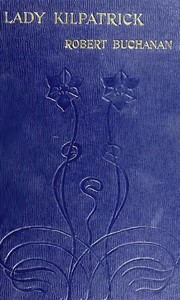
Lady Kilpatrick
Language: en398 downloads on Project Gutenberg
Subjects
Public-domain ebook sourced from Project Gutenberg #55337.
Public-domain ebook
Language: en398 downloads on Project Gutenberg
Subjects
Public-domain ebook sourced from Project Gutenberg #55337.
The opening · free to read
On a summer evening, twenty years ago, a girl and a youth were strolling slowly along the strip of yellow sands which leads from the verge of the Atlantic to the steep line of rock dominated by Kilpatrick Castle.
The girl, who was not more than seventeen years of age, carried her hat and parasol in her hand: the first a serviceable article, little superior in form and material to that generally worn by the superior peasants of the district; the other a dainty trifle in pale blue silk, better in keeping with the tailor-made dress and dainty French shoes in which its owner was dressed. She had a delightfully fair and fresh complexion, a little freckled by a too free exposure to the sun, and her dark blue eyes shone from under the rather disorderly waves of her light golden hair with an expression of harmless audacity and frank gaiety eloquent of youth and health and innocence.
Her companion, who might have been three or four years her senior, was a long-limbed, supple youngster of the finest Western Irish type. His hair, long, black and curly, escaped in natural ripples from under a battered soft felt hat, and framed an olive-hued face of great strength and delicacy, lit by a pair of black eyes sparkling with honest, boyish impudence. The merest shade of callow down darkened his upper lip. He was clad in rough and rather ill-cut tweeds, stained in brown patches with salt water, and the collar of a flannel shirt, innocent of stud or necktie, left to view a sun-tanned, muscular throat. His long legs kept swinging pace with the tripping lightness of the girl’s walk, and he looked down at her from his superior height with a mingling of admiration and protection very pretty to witness, and of which she was perhaps a shade too obviously unconscious.
‘We shall be late for dinner,’ said the girl, breaking the first silence which had fallen upon them since the beginning of a long day’s ramble. ‘Uncle will be angry.’
‘Sorra a bit,’ replied the boy. ‘The old gentleman’s temper’s queer at times, but it has to be mighty bad before he’s angry with you. And as to being angry with me, sure I’m used to it. It’s not often he’s anything else.’
‘My uncle is very fond of you,’ said the girl, ‘and very kind to you--kinder than you deserve, most people think.’
‘Your uncle!’ repeated the boy. ‘Which of ’em?’
‘Lord Kilpatrick, of course!’
‘Indeed he is, then! He’s been as good as a father to me nearly all my life. I owe to him all I have and all I am.’
‘Tell me, Desmond,’ said the girl, after another short interval of silence, ‘why does Lord Kilpatrick take so great an interest in you, and yet let you run about like--like a young colt? Isn’t it time that you began to take life seriously, and to think of doing something?’
‘Faith, I suppose it is,’ said Desmond. ‘I’ve been trying for the last six months to find what kind o’ life I’m fit for. I’ll take to something by-and-by. As to why Lord Kilpatrick’s so good to me, you know just as much as I know myself, Lady Dulcie; Mr. Peebles, that knows more of his ways than anybody else, says ’tis to aise his conscience.’
‘To ease his conscience?’ the girl repeated.
‘Just that,’ said Desmond. ‘An old debt he owed and never paid till my parents were dead. ’Twas my mother asked him to pay it by looking after me. He promised, and he’s kept his word--more power to him.’
‘Do you remember your parents?’
‘No. Both died before I could run about. They were gentlefolk, I suppose, or I’d not be called the Squireen, and I’ve the true gentlemanly knack o’ getting into scrapes. But let’s talk of something else, Lady Dulcie; ’tis a subject that always makes me sad.’
‘Why?’ asked Dulcie.
‘Why,’ said Desmond, ‘there’s times when I feel like a boat on the sea, all alone. I’ve neither kith nor kin, only friends. You’ll laugh at me, I know, but there’s times, when I’m by myself, I feel the mist rising to my eyes and the lump in my throat, thinking I’ve never known a father’s care nor a mother’s love.’
The bright face had lost its merry impudence for the moment, and the quick, swinging step slackened.
‘Laugh at you!’ repeated Dulcie. ‘I’ll never laugh at you for that. And I care for you, Desmond.’
‘And that might come to be the bitterest of all,’ said Desmond. ‘You’re like a star in the sky above me, Lady Dulcie. You’re a rich young lady, and I’m only a poor boy dependent on strangers. But come, now,’ he continued after a short pause, ‘I’ve answered your question, will you answer mine? Is it true what I hear all about the place, that you’re to marry Richard Conseltine?’
‘Nonsense!’ said Dulcie, flushing redly. ‘I’m not going to marry anybody!’
‘Ah!’ said Desmond dryly, ‘that’s what all the girls say, but they never mean it.’
‘I mean it. I think marriage is absurd. Don’t you?’
‘Sure I do,’ responded Desmond. ‘But the priest says it’s convenient, if the world is to continue. Tell me, now, what d’ye think of Master Richard?’
‘Think of him?’ said Dulcie slowly. ‘Oh, I think--I think he’s my cousin, and as stupid as girls’ cousins always are.’
‘That’s mighty hard on boys in general,’ said Desmond laughingly, ‘for they’re mostly some girl’s cousin. I may be myself, for all I know. But Richard’s as fond of you as a fox of a goose--a duck, I mean. And that’s why he hates me.’
‘For shame, Desmond! How has he ever shown that he hates you?’
‘Shown it? Faith, he doesn’t need to show it. It just comes out of him like steam from boiling water. Much I care for the hate or the love of the likes o’ him! I can run him out of breath, fight him out of time, gallop him out of hearing, swim him out of seeing, chaff him out of temper--and as for loving, sure if he loves you, I’ll just adore you, and so beat him at that as well!’
The girl smiled, with her face concealed by the brim of her sun-bonnet, and turned a little away from this brisk wooer, whose bursts of affectionate impudence were generally followed by long intervals of silence.
‘You adore too many, Desmond,’
‘Sorra one but yourself.’
‘Nonsense!’ cried Dulcie. ‘What were you doing with Rosie this morning in the stable-yard?’
‘I mistook her for her mistress,’ said Desmond. ‘No, sure,’ he added, as the girl flushed a little angrily, ‘I don’t mane that.’
‘I should think you didn’t “mane that!”’ said the young lady. ‘I should like to catch you kissing me.’
‘I’m agreeable to be caught,’ returned the unabashable.
‘Oh, you Irish boys!’ cried Dulcie, with a transparent simulation of contempt. ‘You kiss anybody, so it’s no compliment.’
‘That depends,’ said Desmond. ‘There’s kissing for duty, and kissing for interest, and kissing for love. There’s a mighty difference between kissing a rose and kissing a thorn. But, after all, what’s a kiss but a salutation?’
‘You’re a great deal too forward,’ said Dulcie, with an almost matronly air of reproof.
‘Then get behind me,’ responded Desmond, ‘and I’ll go backward.’
The battle of wit was interrupted at this point by the sudden appearance of a man at the end of the ascent leading to the Castle. As he approached, the young couple fell apart a little, and advanced to meet him with a proper and respectful distance between them.
The book keeps going
Reading is free forever. Sign up and watch scenes appear while you read.



Scenes Storieta drew for other classics.
New illustrated classics
Once or twice a month: the latest books to get full character casts, scene art, and free comic editions. No account needed.