
Public-domain ebook
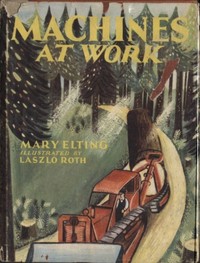
Machines at Work
by Mary Elting
Language: en372 downloads on Project Gutenberg
Subjects
In: Children & Young Adult Reading·Engineering & Technology
Public-domain ebook sourced from Project Gutenberg #55482.
Public-domain ebook
by Mary Elting
Language: en372 downloads on Project Gutenberg
Subjects
In: Children & Young Adult Reading·Engineering & Technology
Public-domain ebook sourced from Project Gutenberg #55482.
The opening · free to read
You could do everything that the machines in this book do. For some of the jobs, of course, you’d have to get friends to help you. But people have always been able to work and build wonderful things, using just their muscles. And they can do a very great deal more when they use their brains, too. They can invent machines to make work thousands of times easier and faster.
The big machine in the picture is a shovel that’s used for digging an enormous hole. In one bite, its scoop can tear out a chunk of earth more than twice as tall as a man. Its long arm, called the boom, lifts the load as high as the top of a seven story building, then swings around and drops it almost a city block away.
There are only a few shovels like this in the world. They were especially made to work where beds of coal lie close to the surface of the earth, covered by a layer of soil. The shovels clear away the soil so that other machines can dig out the coal.
When a giant shovel has cleared off one spot, its crawlers begin to turn, and it creeps slowly ahead. But it can’t travel on roads. It’s far too big and heavy and tall--so big, in fact, that it came to the mine in separate pieces. Forty-five freight cars were needed to haul all the parts for just one machine from the factory to the mine. Then experts put the parts together right where the shovel was to start digging.
And dig it does. In one minute its scoop can bite out as much dirt as 3,600 men could dig just using their muscles to lift ordinary hand shovels!
The giant shovel is one of the biggest machines ever made, but there’s another that can lift even bulkier things. It is an overhead crane that works in a shipyard.
Often the crane hoists big boilers out of ships so that repair men can work on them. It is so huge that it carries another crane on its back. The piggy-back crane--that’s its real name--reaches down and lifts things off the deck of the ship, too.
Hammering is another kind of muscle work that
machines can do quickly and easily. Suppose the water pipes under your street need mending. Repair men have to tear up the pavement in order to reach the pipes. So they bring in jack hammers to do the pounding. Strong blasts of air run the hammers, and, in no time, the pavement is broken up.
Crushed rock was used for making the paved street in the first place. It came from a big machine called a rock crusher, which breaks up chunks of stone into small pieces. Strong jaws inside the crusher chew at the stone until they have made it into bits that are just the right size.
An even bigger pounding machine is the pile driver. It can hammer a great thick log down into the ground almost as easily as a man can hammer a nail through a board. One kind of pile driver does its pounding job with a steam piston. Another kind lifts a heavy weight and lets it bang down on top of the log, called a pile. The one in the picture works in a harbor. It drives piles deep into the earth that lies under water. A whole group of piles make the foundation for a pier in the harbor, for ships to tie up alongside.
Harbors and rivers must be kept safe for ships. If mud and sand pile up in a thick layer on the bottom, ships may get stuck. So dredges go to work clearing the mud and sand away. Often a clean-up job takes a long time. The men who run the machinery live on board the dredge, just as sailors live on a ship.
Some dredges have scoops that dig under water. Others, like the one in the picture, use giant suction pumps. The mud or sand they suck up is called spoil.
If there’s hard-caked mud on the bottom, cutter heads break it up. Then it’s ready to be pumped out through huge steel pipes that stretch away from the dredge like a great snake and pour the spoil out on land.
Of course, a dredge must stay in one place while it is working. So it carries along two huge spikes called spuds. These move straight up and down at the stern of the dredge. When they ram into the earth underwater, they keep the dredge from drifting.
A spud is so heavy that it pokes its own hole in the muddy bottom of a river or harbor. But making holes on dry land is a different problem. For instance, you can’t just poke a telephone pole into the hard ground, or pound it in easily with a pile driver, either. So, in many places, a machine bores holes for telephone poles, just the way a carpenter bores a hole with a brace and bit. Then the machine’s long arms reach out, lift a pole into the air and plug it down neatly into place.
Long ago our ancestors discovered how to use simple tools--such as hammers, shovels, crowbars and rollers. These things seem very ordinary to us, but they were really wonderful discoveries. The clever men who invented them were providing ideas, one by one, which scientists and engineers used much later. Our great machines are combinations of many, many things that men discovered from using simple tools.
The giant shovel digs; the overhead crane lifts; the pile driver pounds. All machines multiply the power that’s in the muscles of men--or of animals. The pushingest animal is an elephant. In some places in the world, elephants are trained to clear land by putting their foreheads against a tree and heaving until the tree topples over.
A tree-dozer can out-push an elephant. The one in the picture has a special forehead built in front. With a slow, steady shove, it clears the way for roads or opens up fields for farms.
Farmers used to dig their fields by hand. Then they hitched horses to plows. Now a tractor does the work, but we still measure its strength in horsepower.
Dan is a farmer. He knows how to use almost any kind of farm machine, and he has lots of them. The most important is his tractor, for it is busy all year round. Sometimes it pushes. Sometimes it pulls. Or it may stand still and lend its power to other machinery.
When the frost is out of the soil in the spring, Dan backs his tractor into the tool shed and bolts on a plow. This one is a two-gang plow--it can make two furrows in the earth at the same time. Dan touches a lever. The blades of the plow lift up so they can’t dig into the farmyard and the road, and Dan chugs off to the field. Another touch on the lever sends the blades down. In a few minutes, Dan has made the first furrows across the field.
Now he has to turn. He lifts the plow and steps on the left brake pedal. While the big left wheel stands still, the right one keeps going and turns the tractor, ready to start the next furrows. When Dan wants to stop, he steps on both the left and right brake pedals at once.
After plowing comes harrowing. The tractor pulls a different implement for this job--a whole row of saucer-shaped metal discs that chew up the soil and spread it out evenly. Now Dan is ready to plant corn.
The corn planter does five jobs in one trip down the field. It makes trenches for two rows of corn. It drops corn seeds into the trenches. It drops fertilizer alongside to give food to the young plants. It covers the seeds. And it leaves a mark all along the field to show exactly where the tractor should go to plant the next row of seeds. Dan follows the mark very carefully. All the rows must be exactly the same distance apart, because the tractor will have to go through the field again to cut out the weeds after the corn starts to grow. If the rows are badly spaced, the tractor wheels will squash some of the plants.
When Dan was a little boy, he used to help his father hoe the corn by hand, getting rid of weeds and loosening the soil. Now he has an implement called a cultivator which does the job.
After the corn is well up, Dan pulls the cultivator through the field, driving carefully, with the wheels between the rows. Small blades on the cultivator cut through the weeds and break the soil into loose chunks. The pictures show several kinds of cultivator blades.
All summer long the corn grows tall. Dan waits till the ears are dry before he harvests them, ready for his cows and chickens to eat in winter.
Dan’s farm is small, so he can’t afford to buy a big corn-picking machine. But his neighbor Al has one that he rents out, and one morning Dan drives it to his cornfield. His tractor seems lost inside the picking machine. Gatherers that look like the pointed snouts of huge mice creep along in front of the tractor close to the ground. One by one the stalks of corn go into the machine, which snaps the ears off. Then revolving claws and rubber paddles rip off the husks, and an elevator carries the clean ears back to a wagon which the tractor pulls along. In a very short time, Dan’s whole field is done.
Corn isn’t the only thing that grows on Dan’s farm. He raises tomatoes for the market, too. At planting time, he needs two helpers who ride on little seats very close to the ground behind the tractor. They put the tender little tomato plants one by one into a trench which the planting machine digs, and then a special wheel covers the roots with earth.
Dan has some wheat fields, too. In the spring, after the ground is harrowed, a wide planting machine sows many rows of wheat at a time. And it drops out fertilizer to feed the plants on the same trip.
Many farmers use their tractors for harvesting wheat, but Dan doesn’t. Instead, he rents a shiny red reaper which he calls a “package job,” because it moves itself along and does the whole harvesting at once. It cuts the wheat, shakes the grain loose from the stalk and separates it from the husks. If there are weeds growing in the wheat, the machine separates the weed seeds from the wheat kernels and spills them into different bags.
Dan sits high in the air at the front of the machine. He says he has a “box seat.” Behind him on a bench sits a helper who ties the bags as they fill up and puts new bags in place. Dan says it won’t be long before somebody invents a machine that will reap the wheat, grind the flour and bake bread right there in the field!
All of Dan’s machines are wonderful inventions, but they can be dangerous, too, if people are careless. To give himself and his helpers warning, he has painted bright stripes and markers around open places where fingers might get caught in moving parts.
Dan has a flock of fine white Leghorn chickens. He takes care of them by machinery, for eggs are a crop, too. The hens live in cages with wire floors, so that they keep very clean. All their droppings go through the wire to a platform below. With a special scoop, run by his tractor, Dan cleans the manure from the platform and puts it in a pile to be used as fertilizer on the fields.
Every day the chickens have their meals brought to them on a moving belt. The eggs they lay drop through their nests onto another belt that carries them away. Finally a machine sorts the eggs according to size, ready for packing.
Some farmers raise chickens for the market. Of course, the feathers must be taken off after the chickens have been killed. There are machines for this, too. One kind has mechanical fingers that pluck the feathers as chickens go past on a moving belt.
Dan’s neighbor Al has a big dairy farm, with lots of cows to milk every day, and land enough to grow their feed. Besides his corn picker, Al has other special machines. One of them cuts corn while it is still green, chops it up fine and loads it into a truck. The truck has a sort of cage over it to keep the corn from spilling out. Next, Al turns his tractor into a stationary engine which runs a blowing machine. A wide belt from a pulley on the tractor turns the blower, which shoots the chopped-up corn to the top of a storage tower called a silo. The green stuff ferments in the silo and turns into wonderful food for the cows.
The book keeps going
Reading is free forever. Sign up and watch scenes appear while you read.



Scenes Storieta drew for other classics.
New illustrated classics
Once or twice a month: the latest books to get full character casts, scene art, and free comic editions. No account needed.



![Cover of Peter Pan: [Peter and Wendy]](/covers/16.jpg)