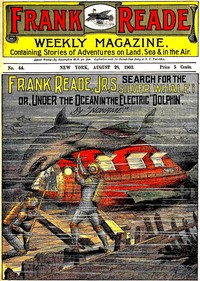
“A submarine boat? Do you really mean it, Frank? I trust you are not becoming mentally unbalanced with the success of your inventive efforts. Not content with the Electric Air-ship, you now meditate the construction of a submarine vessel.”
“That is what I said, friend Stanhope.”
“But, pshaw, man! Do you realize what an impossible feat that is?”
“I realize only that it is quite possible,” replied the young inventor, imperturbably.
“And you are really in earnest?”
“As much as I ever was in my life.”
George Stanhope, explorer and geologist, and a handsome, well developed American, of forty years, of varied experiences, sat quite still for a moment and studied the features of his companion.
This was Frank Reade, Jr., of Readestown, U. S. A., the most famous man in the inventive line of the present generation.
Despite his youth, he had brought to perfection some of the most wonderful and gigantic of enterprises.
At the moment the two men were sitting in the smoking room of the Southern Hotel in New Orleans.
It was while discussing various topics that the subject of the submarine boat was broached.
At once Stanhope was interested and incredulous.
He listened to Frank’s theories for awhile, then began to express his incredulity.
And thus we find them arguing the matter at the opening of our story.
“You may be in earnest, Frank,” said the explorer, with a laugh, “but I think you have tackled a pretty difficult subject. Don’t you agree with me?”
Frank smiled.
“It is not so difficult to solve submarine navigation as aerial flight,” he said; “there is enough in Nature to teach us how the problem may be accomplished.”
“Ah, but it is impossible to always copy Nature.”
“Yet we may draw our plans from her liberal sources.”
“In what way has Nature assisted you in your plan of submarine navigation?”
“She has given me a model.”
“A model?”
“Yes.”
“How is that?”
“In the salt water there swims a fish called the bream, or sunfish. He is at once the most buoyant and generally agile of fish. He will furnish my model.”
“So you propose to model your boat after a fish?”
“Why not? All the necessary points may be obtained from the fish. For instance, I shall have in my boat a system of air reservoirs akin to the bladders of the fish, for the purpose of arising or descending, as necessity may require. Fins shall preserve the equilibrium, and a screw shall furnish the motive power. What more do I want?”
“How will you live without oxygen?”
“I shall have plenty of oxygen. I have already devised a system of electric and chemical generators which destroy the poisonous gases as readily as they create pure air. This will enable a perfect circulation to be kept up aboard the craft.”
Stanhope drew a deep breath and knocked the ashes from his cigar.
“You are too deep for me, Frank,” he said, sententiously. “To use a slang phrase—I am not in it. I wish you success in your emulation of Captain Nemo.”
“It is possible that I may fail,” said the young inventor, consulting his watch, “but I shall endeavor to win success.”
“I hope you may.”
“I have now to leave to catch my train. I bid you goodbye.”
“Wait!”
Stanhope seized Frank’s hand.
“I want to ask a favor.”
“Well?”
“When you get ready to start your submarine boat will you grant me permission to accompany you on the trial trip?”
“Have you considered the risk?”