
Public-domain ebook
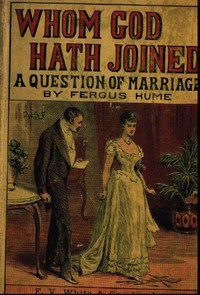
Whom God Hath Joined: A Question of Marriage
by Fergus Hume
Language: en564 downloads on Project Gutenberg
Subjects
Public-domain ebook sourced from Project Gutenberg #55571.
Public-domain ebook
by Fergus Hume
Language: en564 downloads on Project Gutenberg
Subjects
Public-domain ebook sourced from Project Gutenberg #55571.
The opening · free to read
"Like doth not always draw to like--in truth Old age is ever worshipful of youth, Seeing in boyish dreams with daring rife, A reflex of the spring time of its life, When sword in hand with Hope's brave flag unfurled, It sallied forth to fight the blust'ring world."
It was about mid-day, and the train having emerged from the darkness of the St. Gothard tunnel, was now steaming rapidly on its winding line through the precipitous ravines of the Alps, under the hot glare of an August sun. On either side towered the mountains, their rugged sides of grey chaotic stone showing bare and bleak at intervals amid the dense masses of dark green foliage.
Sometimes a red-roofed châlet would appear clinging swallow-like to the steep hill-side--then the sudden flash of a waterfall tumbling in sheets of shattered foam from craggy heights: high above, fantastic peaks swathed in wreaths of pale mist, and now and then the glimpse of a white Alpine summit, milky against the clear blue of the sky.
On sped the engine with its long train of carriages, as though anxious to leave the inhospitable mountain land for the fertile plains of Italy--now crawling fly-like round the giant flank of a hill--anon plunging into the cool gloom of a tunnel--once more panting into the feverish heat--sweeping across slender viaducts hanging perilously over foaming torrents--gliding like a snake under towering masses of rock--and running dangerously along the verge of dizzy precipices, while white-walled, red-roofed, green-shuttered villages, shapeless rocks, delicately green forests, snow-clad peaks, and thread-like waterfalls flashed past the tired eyes of the passengers in the train with the rapidity of a kaleidoscope.
And it was hot--the insufferable radiance of the southern sun, blazing down from a cloudless sky, beat pitilessly on the roofs of the railway carriages, until the occupants were quite worn out with the heat and glare from which they could not escape.
In one of the first-class carriages two men were endeavouring to alleviate the discomfort in some measure, and had succeeded in obtaining a partial twilight by drawing down the dark blue curtains, but the attempt was hardly successful, as through every chink and cranny left uncovered, shot the blinding white arrows of the sun-god, telling of the intolerable brilliance without.
One of the individuals in question was lying full length on the cushions, his head resting on a dressing-bag, and his eyes half closed, while the other was curled up in a corner on the opposite side, with his hands in his pockets, his head thrown back, and a discontented look on his boyish face, as he stared upward. Both gentlemen had their coats off, their waistcoats unbuttoned and their collars loose, trying to make themselves as comfortable as possible in the sweltering heat.
On the seats and floor of the carriage a litter of books and papers showed how they had been striving to beguile the time, but human nature had given in at last, and they were now reduced to a state of exhaustion, to get through the next few hours as best they could until their arrival at Chiasso, where they intended to leave the train and drive over to their destination at Cernobbio, on Lake Como.
"Oh Jove!" groaned the lad in the corner, settling himself into a more comfortable position, "what a devil of a day."
"The first oath," murmured the recumbent man lazily, with his eyes still closed, "is apt, and smacks of classic culture suitable to the land of Italy, but the latter is English and barbaric."
"Oh, bother," retorted his friend impatiently, "I can't do the subject justice in the way of swearing."
"Then don't try; the tortures of Hades are bad enough without the language thereof."
"You seem comfortable at all events, Gartney," said the boy crossly.
"St. Lawrence," observed Mr. Gartney, opening his eyes, "had a bed of roses on his gridiron compared with this eider-down cushion on which I lie--the saint roasted, I simmer--I'll be quite done by the time we reach Chiasso."
"I'm done now," groaned his companion. "Do shut up, Gartney, and I'll try and get some sleep."
Gartney laughed softly at the resigned manner in which the other spoke, and once more closed his eyes while his friend, following his example, fell into an uneasy slumber interrupted by frequent sighs and groans.
He was a pleasant enough looking boy, but not what would be called handsome, with his merry grey eyes, his rather wide mouth, his well-cut nose with sensitive nostrils, and his wavy auburn hair suiting his fair freckled skin; all these taken individually were by no means faultless, yet altogether they made up a countenance which most people liked. Then he had a tall, well-knit figure, and as he dressed well, rode well, was an adept in all kinds of athletic sports, with exuberant animal spirits and a title, Angus Macjean, Master of Otterburn, was a general favourite with his own sex, and a particular favourite with the other.
What wit and humour the lad possessed came from his Irish mother, who died, poor soul, shortly after he was born, and was not sorry to leave the world either, seeing it was rendered so unpleasant by her stern Presbyterian husband. Why she married Lord Dunkeld when, as a Dublin belle, she could have done so much better, was a mystery to everyone, but at all events marry him she did with the aforesaid results, death for herself after a year of unhappy married life, and an heir to the Macjean title.
Lord Dunkeld was sincerely sorry in his own cold way when she died, never dreaming, narrow-minded bigot as he was, that life in the gloomy Border castle was unsuited to the brilliant, impulsive Irishwoman, and after placing her remains in the family vault, he proceeded to apply to his son's life the same rules that finished Lady Dunkeld's existence. The boy, however, had Scotch grit in him as well as Celtic brilliance, and as he grew up under his father's eye, gave promise both intellectually and physically of future excellence, so that when he reached the age of nineteen, he was the pride of the old lord, and of the endless Macjean clan, who were very proud, very poor, and very numerous.
But whatever pride Dunkeld felt in the perfections of his heir he took care never to show it to the lad on the principle that it would make him vain, and vanity, according to Mr. Mactab, the minister who looked after the spiritual welfare of the family, "was a snare o' the auld enemy wha gaes roaring up an' doon the warld." So Angus was never pandered to in that way, but led a studious, joyless existence, his only pleasures being shooting and fishing, while occasionally Dunkeld entertained a few of his friends who were of the same way of thinking as himself, and made merry in a decorous, dreary fashion.
At the age of nineteen, however, the lad rebelled against the dismal life to which his father condemned him, for as the princess in the brazen castle, despite all precautions, found out about the prince coming to release her, so Angus Macjean, from various sources, learned facts about a pleasant life in the outside world, which made him long to leave the cheerless castle and rainy northern skies for a place more congenial to the Irish side of his character. With such ideas, it is scarcely to be wondered at that he became more unmanageable every day, until Lord Dunkeld with many misgivings sent him to Oxford to finish his education, but as a safeguard placed by his side as servant one Johnnie Armstrong, a middle-aged Scotchman of severe tendencies, who was supposed to be "strong in the spirit."
So to this seat of learning, Otterburn went, as his progenitors had gone before him, and falling in by some trick of Fate with a somewhat fast set, indulged his Irish love for pleasure to the utmost. Not that he did anything wrong, or behaved worse than the general run of young men, but his 'Varsity life was hardly one which would have been approved of by his severe parent or the upright minister who had nurtured his young intellect on the psalms of David.
Still Johnnie Armstrong!
Alas, for the frailty of human nature, Johnnie Armstrong, the strong in spirit, the guardian of morality, the prop of a wavering faith, yielded to the temptations of the world, and held only too readily that tongue which should have warned Otterburn against the snares of Belial, for, truth to tell, Johnnie made as complaisant a guardian as the most dissipated rake could have desired. The world, the flesh, and the devil was too strong a trinity for Johnnie to stand against, so he surrendered himself to the temptations of this life in the most pusillanimous manner, aiding and abetting his young master with misdirected zeal. Behold then, Angus Macjean and his leal henchman both fallen away from grace and having a good time of it at Oxford, so much so, indeed, that Otterburn was quite sorry when his father, after two years' absence, summoned him to Dunkeld Castle to grace the ceremony of his coming of age.
That coming of age was a severe trial to Angus, as the guests were mostly Free Kirk ministers and their spouses, the ministers in lengthy speeches, exhorting him to follow in the footsteps of his father, i.e., support the Free Kirk, make large donations to the funds thereof, and entertain ministers of that following on all possible occasions. Otterburn having learnt considerable craft at Oxford, made suitable replies, promising all kinds of things which he had not the slightest idea of fulfilling, and altogether produced a favourable impression both by such guile and by a display of those educational graces with which Alma Mater had endowed him. It is needless to say that, aided by the faithful Johnnie Angus did not tell either his father or Mactab of his gay life at the University, and the result of this reticence was that the old lord, bestowing on him a small income out of the somewhat straitened finances of the Macjeans, bade him enjoy himself in London for a year, and then return to marry.
To marry! Poor Angus was horror-struck at such a prospect, the more so when his father introduced him to the lady selected to be his bride, a certain Miss Cranstoun who had a good income, but nothing else to recommend her to his fastidious taste.
However, being a somewhat philosophical youth, he accepted the inevitable, for he knew it would be easier to move Ben Nevis than his father, and trusting to the intervention of a kind Providence to avert his matrimonial fate, he went up to London with Johnnie to enjoy himself, which he did, but hardly in the way anticipated by Lord Dunkeld.
Thinking his marriage with the plain-looking Miss Cranstoun was unavoidable, he made up his mind to see as much of life as he could during his days of freedom, and proceeded to do so to his own detriment, morally, physically and pecuniarily, when he chanced to meet with Eustace Gartney.
Eustace Gartney, whimsical in his fancies, took a liking to the lonely lad, left to his own devices in such a dangerous place as London, and persuaded him to come to Italy hoping to acquire an influence over the young man and keep him on the right path until his return to Dunkeld Castle.
The book keeps going
Reading is free forever. Sign up and watch scenes appear while you read.



Scenes Storieta drew for other classics.
New illustrated classics
Once or twice a month: the latest books to get full character casts, scene art, and free comic editions. No account needed.