Public-domain ebook
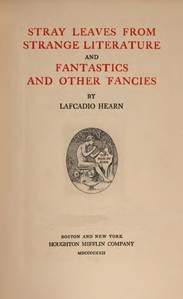
Stray leaves from strange literature; and, Fantastics and other fancies
Language: en751 downloads on Project Gutenberg
Subjects
In: Mythology, Legends & Folklore
Public-domain ebook sourced from Project Gutenberg #55650.
Public-domain ebook
Language: en751 downloads on Project Gutenberg
Subjects
In: Mythology, Legends & Folklore
Public-domain ebook sourced from Project Gutenberg #55650.
The opening · free to read
While engaged upon this little mosaic work of legend and fable, I felt much like one of those merchants told of in Sindbad's Second Voyage, who were obliged to content themselves with gathering the small jewels adhering to certain meat which eagles brought up from the Valley of Diamonds. I have had to depend altogether upon the labor of translators for my acquisitions; and these seemed too small to deserve separate literary setting. By cutting my little gems according to one pattern, I have doubtless reduced the beauty of some; yet it seemed to me their colors were so weird, their luminosity so elfish, that their intrinsic value could not be wholly destroyed even by so clumsy an artificer as I.
In short, these fables, legends, parables, etc., are simply reconstructions of what impressed me as most fantastically beautiful in the most exotic literature which I was able to obtain. With few exceptions, the plans of the original narratives have been preserved. Sometimes I have added a little, sometimes curtailed; but the augmentations were generally made with material drawn from the same source as the legend, while the abbreviations were effected either with a view to avoid repetition, or through the necessity of suppressing incidents unsuited to the general reading. I must call special attention to certain romantic liberties or poetic licenses which I have taken.
In the Polynesian story ("The Fountain Maiden") I have considerably enlarged upon the legend, which I found in Gill's _Myths and Songs of the South Pacific_--a curious but inartistic book, in which much admirable material has been very dryly handled. In another portion of Mr. Gill's book I found the text and translation of the weird "Thieves' Song"; and conceived the idea of utilizing it in the story, with some fanciful changes. The Arabic "Legend of Love" is still more apocryphal, as it consists of fragmentary Arabian stories, borrowed from De Stendhal's L'Amour, and welded into one narrative.
In the Rabbinical legends I have often united several incidents related about one personage in various of the Talmudic treatises; but this system is sufficiently specified by references to the Gemara in the text. By consulting the indices attached to Hershon's Miscellany, and Schwab's translations of the Jerusalem Talmud, it was easy to collect a number of singular traditions attaching to one distinguished Rabbi, and to unite these into a narrative. Finally, I must confess that the story of "Natalika" was not drawn directly from Ferista, or Fihristah, but from Jacolliot, a clever writer, but untrustworthy Orientalist, whose books have little serious value. Whether true or false, however, the legend of the statue seemed to me too pretty to overlook.
In one case only have I made a veritable translation from the French. Léouzon Le Duc's literal version of the "Kalewala" seemed to me the most charming specimen of poetical prose I had met with among translations. I selected three incidents, and translated them almost word for word.
Nearly all of the Italic texts, although fancifully arranged, have been drawn from the literatures of those peoples whose legends they introduce. Many phrases were obtained from that inexhaustible treasury of Indian wisdom, the Pantchatantra; others from various Buddhist works. The introductory text of the piece, entitled "The King's Justice," was borrowed from the Persian Mantic Uttaïr, of Farid Uddin Attar; and the text at the commencement of the Buddhist Parable (which was refashioned after a narrative in Stanislas Julien's Avadanas) was taken from the Dhammapada. The briefer stories, I think, have generally suffered less at my hands than the lengthier ones. That wonderful Egyptian romance about the Book of Thoth is far more striking in Maspéro's French translations from the original papyrus; but the Egyptian phrases are often characterized by a nakedness rather more startling than that of the dancing girls in the mural paintings....
Upon another page will be found a little bibliography of nearly all the sources whence I have drawn my material. Some volumes are mentioned only because they gave me one or two phrases. Thus, I borrowed expressions or ideas from "Amarou," from Fauche's translation of the Ritou Sanhara, and especially from the wealth of notes to Chézy's superb translation of Sacountala.
This little collection has no claim upon the consideration of scholars. It is simply an attempt to share with the public some of those novel delights I experienced while trying to familiarize myself with some very strange and beautiful literatures.
During its preparation two notable works have appeared with a partly similar purpose: Helen Zimmern's Epic of Kings, and Edwin Arnold's Rosary of Islam. In the former we have a charming popular version of Firdusi, and upon the latter are exquisitely strung some of the fairest pearls of the "Mesnewi." I hope my far less artistic contribution to the popularization of unfamiliar literature may stimulate others to produce something worthier than I can hope to do. My gems were few and small: the monstrous and splendid await the coming of Sindbad, or some mighty lapidary by whom they may be wrought into jewel bouquets exquisite as those bunches of topaz blossoms and ruby buds laid upon the tomb of Nourmahal.
An Egyptian tale of weirdness, as told in a demotic papyrus found in the necropolis of Deir-el-Medineh among the ruins of hundred-gated Thebes.... Written in the thirty-fifth year of the reign of some forgotten Ptolomæus, and in the month of Tybi completed by a scribe famous among magicians.... Dedicated, doubtless, to Thoth, Lord of all Scribes, Grand Master of all Sorcerers; whose grace had been reverently invoked upon whomsoever might speak well concerning the same papyrus....
...Thoth, the divine, lord of scribes, most excellent of workers, prince of wizards, once, it is said, wrote with his own hand a book surpassing all other books, and containing two magical formulas only. Whosoever could recite the first of these formulas would become forthwith second only to the gods--for by its simple utterance the mountains and the valleys, the ocean and the clouds, the heights of heaven and the deeps of hell, would be made subject unto his will; while the birds of air, the reptiles of darkness, and the fishes of the waters, would be thereby compelled to appear, and to make manifest the thoughts secreted within their hearts. But whosoever could recite the second formula might never know death--for even though buried within the entrails of the earth, he would still behold heaven through the darkness and hear the voices of earth athwart the silence; even in the necropolis he would still see the rising and setting of the sun, and the Cycle of the Gods, and the waxing and waning of the moon, and the eternal lights of the firmament.
And the god Thoth deposited his book within a casket of gold, and the casket of gold within a casket of silver, and the casket of silver within a casket of ivory and ebony, and the casket of ivory and ebony within a casket of palm-wood, and the casket of palm-wood within a casket of bronze, and the casket of bronze within a casket of iron. And he buried the same in the bed of the great river of Egypt where it flows through the Nome of Coptos; and immortal river monsters coiled about the casket to guard it from all magicians.
Now, of all magicians, Noferkephtah, the son of King Minibphtah (to whom be life, health, and strength forevermore!), first by cunning discovered the place where the wondrous book was hidden, and found courage to possess himself thereof. For after he had well paid the wisest of the ancient priests to direct his way, Noferkephtah obtained from his father Pharaoh a royal cangia, well supplied and stoutly manned, wherein he journeyed to Coptos in search of the hidden treasure. Coming to Coptos after many days, he created him a magical boat and a magical crew by reciting mystic words; and he and the shadowy crew with him toiled to find the casket; and by the building of dams they were enabled to find it. Then Noferkephtah prevailed also against the immortal serpent by dint of sorcery; and he obtained the book, and read the mystic formulas, and made himself second only to the gods.
But the divinities, being wroth with him, caused his sister and wife Ahouri to fall into the Nile, and his son also. Noferkephtah indeed compelled the river to restore them; but although the power of the book maintained their life after a strange fashion, they lived not as before, so that he had to bury them in the necropolis at Coptos. Seeing these things and fearing to return to the king alone, he tied the book above his heart, and also allowed himself to drown. The power of the book, indeed, maintained his life after a strange fashion; but he lived not as before, so that they took him back to Thebes as one who had passed over to Amenthi, and there laid him with his fathers, and the book also.
Yet, by the power of the book, he lived within the darkness of the tomb, and beheld the sun rising, and the Cycle of the Gods, and the phases of the moon, and the stars of the night. By the power of the book, also, he summoned to him the shadow of his sister Ahouri, buried at Coptos--whom he had made his wife according to the custom of the Egyptians; and there was light within their dwelling-place. Thus Noferkephtah knew ghostly happiness in the company of the Ka, or shadow, of his wife Ahouri, and the Ka of his son Mikhonsou.
Now, four generations had passed since the time of King Minibphtah; and the Pharaoh of Egypt was Ousirmari. Ousirmari had two sons who were learned among the Egyptians--Satni was the name of the elder; Anhathorerôou that of the younger. There was not in all Egypt so wise a scribe as Satni. He knew how to read the sacred writings, and the inscriptions upon the amulets, and the sentences within the tombs, and the words graven upon the stelæ, and the books of that sacerdotal library called the "Double House of Life." Also he knew the composition of all formulas of sorcery and of all sentences which spirits obey, so that there was no enchanter like him in all Egypt. And Satni heard of Noferkephtah and the book of Thoth from a certain aged priest, and resolved that he would obtain it. But the aged priest warned him, saying, "Beware thou dost not wrest the book from Noferkephtah, else thou wilt be enchanted by him, and compelled to bear it back to him within the tomb, and do great penance."
Nevertheless Satni sought and obtained permission of the king to descend into the necropolis of Thebes, and to take away, if he might, the book from thence. So he went thither with his brother.
Three days and three nights the brothers sought for the tomb of Noferkephtah in the immeasurable city of the dead; and after they had threaded many miles of black corridors, and descended into many hundred burial pits, and were weary with the deciphering of innumerable inscriptions by quivering light of lamps, they found his resting-place at last. Now, when they entered the tomb their eyes were dazzled; for Noferkephtah was lying there with his wife Ahouri beside him; and the book of Thoth, placed between them, shed such a light around, that it seemed like the brightness of the sun. And when Satni entered, the Shadow of Ahouri rose against the light; and she asked him, "Who art thou?"
The book keeps going
Reading is free forever. Sign up and watch scenes appear while you read.



Scenes Storieta drew for other classics.
New illustrated classics
Once or twice a month: the latest books to get full character casts, scene art, and free comic editions. No account needed.