Public-domain ebook
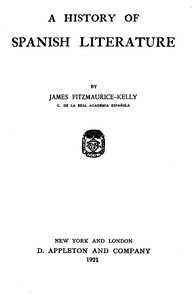
A History of Spanish Literature
Language: en2,459 downloads on Project Gutenberg
Subjects
In: History - Other
Public-domain ebook sourced from Project Gutenberg #55771.
Public-domain ebook
Language: en2,459 downloads on Project Gutenberg
Subjects
In: History - Other
Public-domain ebook sourced from Project Gutenberg #55771.
James Fitzmaurice‑Kelly’s A History of Spanish Literature is a scholarly survey that confines itself to Castilian writing, deliberately excluding the peripheral languages of Asturias, Galicia, Basque, and Catalan. The opening pages set out the author’s ambition to answer a pair of eighteenth‑century questions about Spain’s contribution to Europe, tracing literary development from Roman antiquity through the Gothic, Arabic, and Hebrew periods, and then following the “heroic age” from Carlos Quinto to Felipe IV. The work is organized chronologically, with each epoch given a dedicated chapter, and the author openly acknowledges the inevitable omissions and the assistance of leading Spanish critics such as Menéndez y Pelayo. By framing Spanish letters as both derivative of French and Italian models and uniquely original, the book promises a comprehensive, if selective, narrative of the nation’s literary evolution.
Written in the formal, essayistic style of late‑nineteenth‑century scholarship, the text combines detailed historical argument with occasional polemic, reflecting the author’s confidence in his own judgments. Readers who appreciate a measured, reference‑rich account, students of comparative literature, historians of the Iberian Peninsula, or anyone interested in the interplay of language, culture, and politics, will find the volume rewarding. Its dense prose and extensive footnotes suit those accustomed to academic tomes rather than casual literary surveys.
The opening · free to read
Spanish literature, in its broadest sense, might include writings in every tongue existing within the Spanish dominions; it might, at all events, include the four chief languages of Spain. Asturian and Galician both possess literatures which in their recent developments are artificial. Basque, the spoiled child of philologers, has not added greatly to the sum of the world's delight; and even if it had, I should be incapable of undertaking a task which would belong of right to experts like Mr. Wentworth Webster, M. Jules Vinson, and Professor Schuchardt. Catalan is so singularly rich and varied that it might well deserve separate treatment: its inclusion here would be as unjustifiable as the inclusion of Provençal in a work dealing with French literature. For the purposes of this book, minor varieties are neglected, and Spanish literature is taken as referring solely to Castilian—the speech of Juan Ruiz, Cervantes, Lope de Vega, Tirso de Molina, Quevedo, and Calderón.
At the close of the last century, Nicolas Masson de Morvilliers raised a hubbub by asking two questions in the Encyclopédie Méthodique:—"Mais que doit-on à l'Espagne? Et depuis deux siècles, depuis quatre, depuis six, qu'a-t elle fait pour l'Europe?" I have attempted an answer in this volume. The introductory chapter has been written to remind readers that the great figures of the Silver Age—Seneca, Lucan, Martial, Quintilian—were Spaniards as well as Romans. It further aims at tracing the stream of literature from its Roman fount to the channels of the Gothic period; at defining the limits of Arabic and Hebrew influence on Spanish letters; at refuting the theory which assumes the existence of immemorial romances, and at explaining the interaction between Spanish on the one side and Provençal and French on the other. It has been thought that this treatment saves much digression.
Spanish literature, like our own, takes its root in French and in Italian soil; in the anonymous epics, in the fableaux, as in Dante, Petrarch, and the Cinque Cento poets. Excessive patriotism leads men of all lands to magnify their literary history; yet it may be claimed for Spain, as for England, that she has used her models without compromising her originality, absorbing here, annexing there, and finally dominating her first masters. But Spain's victorious course, splendid as it was in letters, arts, and arms, was comparatively brief. The heroic age of her literature extends over some hundred and fifty years, from the accession of Carlos Quinto to the death of Felipe IV. This period has been treated, as it deserves, at greater length than any other. The need of compression, confronting me at every page, has compelled the omission of many writers. I can only plead that I have used my discretion impartially, and I trust that no really representative figure will be found missing.
My debts to predecessors will be gathered from the bibliographical appendix. I owe a very special acknowledgment to my friend Sr. D. Marcelino Menéndez y Pelayo, the most eminent of Spanish scholars and critics. If I have sometimes dissented from him, I have done so with much hesitation, believing that any independent view is better than the mechanical repetition of authoritative verdicts. I have to thank Mr. Gosse for the great care with which he has read the proofs; and to Mr. Henley, whose interest in all that touches Spain is of long standing, I am indebted for much suggestive criticism. For advice on some points of detail, I am obliged to Sr. D. Ramón Menéndez Pidal, to Sr. D. Adolfo Bonilla y San Martín, and to Sr. D. Rafael Altamira y Crevea.
The book keeps going
Reading is free forever. Sign up and watch scenes appear while you read.



Scenes Storieta drew for other classics.
New illustrated classics
Once or twice a month: the latest books to get full character casts, scene art, and free comic editions. No account needed.