Semi-Monthly. Novel Series.
No. 107.
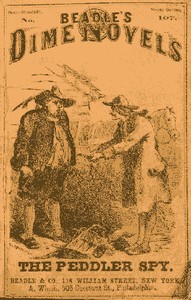
THE PEDDLER SPY.
BEADLE & CO., 118 WILLIAM STREET, NEW YORK. A. Winch, 505 Chestnut St., Philadelphia.
Beadle’s Dime Novels, No. 108, TO ISSUE TUESDAY, OCTOBER 16, IS THE LOST SHIP; OR A Cruise After a Shadow.
BY ROGER STARBUCK, AUTHOR OF “OVERBOARD,” “CAST AWAY,” “MAD SKIPPER,” ETC.
Few writers of sea stories throw around the personages of his narratives so much that is novel in character as this pleasing author. His plot and incidents, too, are widely out of the “beaten path”—he always gives us something new. In this admirable production we have such a commingling of the elements of parental affection and devotion, of singular and deeply stirring adventure, of the tenderness of the loves of two good lives as renders the work one of its author’s most readable sea creations.
🖙 For sale by all Newsdealers; or sent, post-paid, to any address, on receipt of price—TEN CENTS. Address,
BEADLE AND COMPANY, General Dime Book Publishers, 118 William Street, New York.
Entered according to Act of Congress, in the year 1866, by BEADLE AND COMPANY, in the Clerk’s Office of the District Court of the United States for the Southern District of New York.
THE PEDDLER SPY; OR, DUTCHMEN AND YANKEES.
A TALE OF THE CAPTURE OF GOOD HOPE.
BY W. J. HAMILTON, AUTHOR OF “BIG FOOT, THE GUIDE,” “EAGLE EYE,” ETC.
NEW YORK: BEADLE AND COMPANY, PUBLISHERS, 118 WILLIAM STREET.
Entered according to Act of Congress, in the year 1866, by BEADLE AND COMPANY, In the Clerk’s Office of the District Court of the United States for the Southern District of New York.
(No. 107.)
THE PEDDLER SPY.
Down the Connecticut, not many miles from the city of Hartford, in the early days of the State of Wooden Nutmegs, stood an ancient fort, known by the name of “The House of Good Hope.” By reference to that veracious chronicle known as “Knickerbocker’s History of New York,” you will find that it was built by the good people of New Netherlands, to prevent further encroachment on the part of a race which has since taken the generic name of Yankee. Although the history mentioned may be correct, it might be open to censure on the ground that the writer was biased in favor of his own people. Be that as it may, the people of Good Hope had planted themselves upon the river, determined to keep back, as far as possible, the domineering race which had intruded upon the happy valley.
Although honest Diedrich may have been somewhat angry at our ancestors, the Puritans, still we are forced to say that they were not very far wrong in their estimate of character. The stolid Dutchmen were poorly suited to contend with them in an encounter in which wit was the weapon used. Placed face to face, each with a stout oak cudgel in his hand, perhaps no Dutchman would have feared to meet one of the hated race. But when it came to the commodity in which they did not deal, namely, cunning, the Puritans had the advantage.
The New Netherlanders claimed all the land extending from the banks of the Hudson to the Connecticut; and certainly, if any white man could claim the soil at all, their claim was prior to that of the English. But, with the wholesome proviso that “might makes right,” the Puritans pushed their settlements to the side of the Happy River, under the very nose of the Dutch commandant at Good Hope.
What that worthy thought, when the first members of the hardy band, who pushed their way through the trackless wilderness to this spot, made their appearance, is not fully set down. We only know, by the history before mentioned, that they became obnoxious to the Dutch from their desire to teach the damsels the absurd custom of “bundling,” in which no true Dutchman would indulge. Besides, they had begun, even at this early period, to show that sharpness in making bargains which since has distinguished them above other nations in the world. Certain of them made a practice of “swapping horses” with the men of Good Hope; and, although the beasts they brought for “dicker” were, to all appearance, good ones, yet no sooner was the bargain completed than the horses begun to show traits which had not been “set down in the bill.” Indeed, it begun to be proverbial that horse-trading with the Windsor people meant a transaction in which a Dutchman gave a very good beast and some gelt for a very poor one and no gelt at all. Moreover, the English were addicted to the practice of overreaching the spouses of absent Hans and Yawcop with transactions for small articles, such as constitute a peddler’s pack in our day. Some will go so far as to say that, under the mask of perfect disinterestedness of purpose, these Yankees would almost break up housekeeping on the part of a couple possessed of considerable means, in a single visit—so much were they ahead of the tramps of the present day. Indeed, it is averred that the main cause of hostility on the part of the Dutchmen against the English was the fact of the influence of these profane wanderers over the partners of their phlegmatic joys and stolid sorrows.
But, be that as it may, the inhabitants of Hartford were not in very good order with those of Good Hope. On whose side the blame lay, we will leave to historians to decide—if they can—while we proceed with our narrative.
Good Hope was an awkward structure of mud and logs, such as the Dutch built in that day; strong enough, however, for the purpose for which it was built, if it had been in different hands. It faced upon the river, was armed with some of the clumsy ordnance common to the period, and was garrisoned by about forty men from the settlement at New York, who were somewhat overfed, and inclined to smoke all the time they were not eating or drinking. Their leader, Van Curter, was one of those fiery, self-willed men sometimes found in his nation, who mistake pig-headed obstinacy for firmness of heart. An old soldier, trained under the unhappy Prince of Orange, he thought no people like his own, and no soldier like himself. He had seen, with ill-disguised jealousy, that a people were growing up about him who were ahead of his own in acuteness, and who were daily outstripping them in matters of business. He had written a dispatch to Wouter Von Twiller, Governor of New Netherlands, acquainting him with the inroad of these Windsor people, and of the absolute incapacity of his men to compete with them. The governor thereupon issued a proclamation, commanding the English to withdraw from land which was the property of the Dutch East India Company.
The Yankees’ answer was very much to the same effect as that of the worthy Master Nicholas, when he defied the trumpeter of William Kieft, applying his thumb to the tip of his nose, and spreading out the fingers like a fan. At least, they paid no attention to the proclamation, but continued to take up land, and increase the limits of their colony. The only reply they did vouchsafe to the demand of the governor was that they claimed the land in the right of possession, and would not give it up. The New Netherlanders had no desire to make a quarrel with their neighbors, who were, for the most part, strong men, who would not hesitate to use manual persuasion in case it became necessary. Hence the Dutchmen resorted to all manner of threats, entreaties—any thing but violence.
There was one person, in particular, who was a source of constant annoyance to the people of Good Hope. This was a hawker of small trinkets, known in the settlements as Boston Bainbridge. A sharp, business-like fellow, not a bad prototype of the Down-Easter of our day, he made his way into every house from Boston to the City of Brotherly Love. His pack was welcomed in the houses of his own countrymen, who, being as sharp in buying as he was in selling, seldom allowed him to get the better of them. But the Dutchmen were not so cunning, and were overreached in many a bargain. Boston did not confine himself entirely to dealing in small wares, but sold many articles of greater value; bought and sold horses, or, as he expressed himself, was a “mighty man on a dicker.”
Boston came into Good Hope on a bright morning in the early part of the month of June. His pack had been replenished in Hartford, and he hoped to diminish its contents among the Dutch. He was a middle-sized, active-looking man, about forty years of age, clad in a suit of gray homespun. His pack was, as usual strapped upon his back, while he led a forlorn-looking Narragansett pony, which paced slowly along behind its master, like a captive led to the stake. Boston had some misgivings that certain things sold to these people must have come to grief since his last visit. But this was not by any means the first time he had been tackled by them for selling bad wares, and he never was at a loss for an answer.
The families of the Dutch had built up a little village about the fort, and he entered boldly. The first man he met was an unmistakable Teuton, with a broad, bulky figure, built after the manner of Wouter Von Twiller, then Governor of New Netherlands. This individual at once rushed upon the Yankee, exhibiting the blade of a knife, severed from the handle.
“Ah-ha, Yankee! You see dat, eh? You sell dat knife to me; you sheat me mit dat knife.”
“You git eout,” replied the Yankee. “I never sold you that knife!”
“Yaw! Dat ish von lie; dat ish von pig lie! You vas sell dat knife mit me.”
Boston lowered the pack from his shoulder and took the despised blade in his hand.
“Now then, Dutchy, what’s the matter with this knife, I should like to know?”
“Donner unt blitzen! Das ish von big sheat knife. Goot for nix. Das knife not coot preat, py Shoseph!”
“How did you break it?” asked the peddler, fitting the pieces of the knife together and taking a wire from his pocket. “This is a good knife, I reckon. You broke the rivet. Now look at me, and see how far we are in advance of you in the arts and sciences. I tell you, Hans Drinker, you don’t know any thing about these matters—blamed if you do.”
As he spoke, he took out a pair of pincers, riveted the blade in, pounded it, and held up the knife for inspection.
“Look at that, neow, Hans Drinker. Any one but a Dutchman would have done that long ago, instead of waiting for a poor fellow who sold you the knife at a sacrifice.”
“Vat ish dat, eh? I no care for dat? I says de knife vill not cut preat,” cried Hans.
“See here—where have you had this knife? You put it in hot water, I know. Tell the truth and shame the adversary—didn’t you, now?”
“Vell, I did; but dat no hurt.”