Public-domain ebook
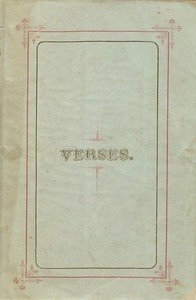
Verses
Language: en348 downloads on Project Gutenberg
Subjects
In: Poetry·American Literature
Public-domain ebook sourced from Project Gutenberg #55807.
Public-domain ebook
Language: en348 downloads on Project Gutenberg
Subjects
In: Poetry·American Literature
Public-domain ebook sourced from Project Gutenberg #55807.
The opening · free to read
(An Organ-stop.)
O soft, caressing sound, more sweet than scent Of violets in woody hollows! Tone As amorous as the ring-dove’s tender moan Beneath the spreading forest’s leafy tent; What mystery of earth or air hath lent Thee that bewitching music, where the drone Of Summer bees in dewy buds new blown With trembling, fainting melody is blent? What master did conceive thee, as the sound Most fit to woo his lady from her rest, What wakeful maiden in thy wooing found The passion of her lover first exprest, And from her silken pillows, beauty-crowned, Stept forth and smiled on him who loved her best?
November 10th, 1875.
II. VESPERS.
It is the vesper hour, and in yon aisle Where fainting incense clouds the heavy air My lady’s kneeling at her evening prayer, Alone and silently; for in a file The choristers have passed, and left her there, Where martyrs from the tinted windows stare, And saints look downward with a holy smile Upon her meek devotions, while the day Fades slowly, and a tender amber light From coloured panes about her head doth play-- Her veil falls like a shade, and ghostly white Her clasped hands glimmer through the deepening gray; So will she kneel, until from Heaven’s height The Angels bend to hear their sister pray.
November 11th, 1875.
III. BETTINE TO GOETHE.
“Be friendly, pray, with these fancies of mine.” BETTINE.
Could youth discrown thy head of its gray hair, I could not love it as I love it now; Could one grand line be smoothed from thy brow, ’Twould seem to me less stately and less fair. O no, be as thou art! For thou dost wear The signs of noble age that cannot bow Thine intellect like thy form, and I who know How each year that did visibly impair Thy first fresh youth, left inwardly such grand And gracious gifts, would rather have thee so-- Believe me, master, who erect doth stand In soul and purpose, age cannot lay low Till he receive, new from the Father’s hand The youth he did but outwardly forego.
April, 1876.
Spring Song.
“O primavera! Gioventù dell’ anno.”
The first warm buds that break their covers, The first young twigs that burst in green, The first blade that the sun discovers, Starting the loosened earth between.
The pale soft sky, so clear and tender, With little clouds that break and fly; The crocus, earliest pretender To the low breezes passing by;
The chirp and twitter of brown builders, A couple in a tree, at least; The watchful wisdom of the elders For callow younglings in the nest;
The flush of branches with fair blossoms, The deepening of the faint green boughs, As leaf by leaf the crown grows fuller That binds the young Spring’s rosy brows;
New promise every day of sweetness, The next bright dawn is sure to bring; Slow breaking into green completeness, Fresh rapture of the early Spring!
May, 1876.
Prophecies of Summer.
I found a wee leaf in the cleft Where the half-melted ice had left A sunny corner, moist and warm, For it to bud, beyond all harm. The wet, brown sod, Long horned with ice, had slowly grown So soft, the tender seedling blown By Autumn winds, in earliest Spring Sent through the sun-warmed covering, Its little leaf to God.
I found it there, beneath a ledge, The dawning Spring time’s fairest pledge, And to my mind it dimly brought The sudden, joyous, leafy thought Of Summer-time. I plucked it from the sheltered cleft Which the more kindly ice had left. Within my hand to drop and die, But for its sweet suggestions, I Revive it in a rhyme.
1876.
Song.
O Love, where are the hours fled, The hours of our young delight? Are they forever gone and dead, Or only vanished out of sight?
O can it be that we shall live To know once more the joys gone by, To feel the old, deep love revive, And smile again before we die?
Could I but fancy it might be, Could I the past bring back again, And for one moment, holding thee, Forget the present and its pain!
O Love, those hours are past away Beyond our longing and our sighs-- Perhaps the Angels, some bright day, Will give them back in Paradise!
August, 1876.
Heaven.
Not over roof and spire doth Heaven lie, Star-sentinelled from our humanity, Beyond the humble reach of every day. And only near us when we weep or pray; But rather in the household and the street, Where loudest is the noise of hurrying feet, Where hearts beat thickest, where our duties call, Where watchers sit, where tears in silence fall. We know not, or forget, there is no line That marks our human off from our divine; For all one household, all one family In different chamberings labouring are we; God leaves the doors between them open wide, Knowing how life and death are close allied, And though across the threshold, in the gloom, We cannot see into that other room, It may be that the dear ones watching there Can hear our cry of passionate despair, And wait unseen to lead us through the door When twilight comes, and all our work is o’er.
January, 1877.
“Maiden, Arise.”
She, whom through life her God forbade to hear The voices of her nearest and most dear, So that she dwelt, amid the hum and rush Of cities, in a vast, eternal hush, Yet heard the first low calling of the voice That others had not heeded in the noise, And rising, when it whispered “Come with me,” Followed the form that others could not see, Smiling, perchance, in death at last to hear The voices of the Angels fill her ear, While the great, silent void that closed her round Was overflowed with rippled floods of sound, And the dumb past in Alleluias drowned.
March, 1877.
Spring.
A Fragment.
HILDEGARD.
It is the time when everything Is flusht with presage of the Spring, When every leaf and twig and bud Feels new life rushing like a flood Through greening veins and bursting tips; When every hour a sunbeam slips Across a sleepy flower’s mouth, And wakes it, babbling of the South; When birds are doubtful where or how To hang their nests on trunk or bough, And all that is in wood or croft Beneath an influence balmy-soft Towards the light begins to strive, Feeling how good it is to live!
WALTHER.
How beautiful thou standest there, Thyself a prophet of the May! The shining of thy golden hair Would melt December’s snows away. The roses on thy cheeks would woo Forth envious blossoms from their sleeps. And robins plume their breasts anew To mock the crimson of thy lips.
The book keeps going
Reading is free forever. Sign up and watch scenes appear while you read.



Scenes Storieta drew for other classics.
New illustrated classics
Once or twice a month: the latest books to get full character casts, scene art, and free comic editions. No account needed.