Public-domain ebook
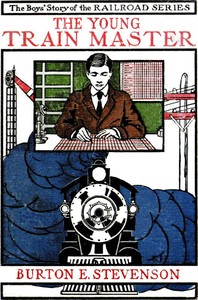
The Young Train Master
Language: en501 downloads on Project Gutenberg
Subjects
In: Adventure·Novels·American Literature
Public-domain ebook sourced from Project Gutenberg #55880.
Public-domain ebook
Language: en501 downloads on Project Gutenberg
Subjects
In: Adventure·Novels·American Literature
Public-domain ebook sourced from Project Gutenberg #55880.
The opening · free to read
NESTLING among the hills of the Scioto valley, in the south-central portion of the state of Ohio, lies the little town of Wadsworth. Venerable in its age, proud of its history, the first capital of its state and the home of men famous in their time, it lives in the past rather than in the present, and life there moves in a quiet and dignified manner, conducive to peace but not to progress.
Its streets, shaded by the elms planted by the pioneers, show traces of those early days; one of the old inns, with its swinging sign still stands; no roar of traffic disturbs its Sabbath stillness. Just to the east of it rises Mount Logan, named for the Indian chieftain known to every train-service, and there is a legend that, standing on the summit of that hill, the day before his death, he cast a spell over the surrounding country, in order that the peace of his grave might never be disturbed. However that may be, certain it is that a dreamy influence pervades the atmosphere and gives to the town an air of leisure and calm deliberateness which nothing can dispel.
It had been founded more than a century before, when the country for a hundred miles around was an unbroken forest, by a little band of pioneers who, acquiring title to unnumbered acres by virtue of their service in the Revolution, pushed their way over the mountains from Virginia. Some of them brought their slaves with them, only to free them when they reached their new home. Other families from Virginia joined the little settlement and lent their hands to the battle with the wilderness. That southern flavour had never been lost, nor the southern deliberateness and dislike of innovation, nor the southern preference for agriculture rather than for manufacture.
By mere chance of geographical position, Wadsworth lies half way between Parkersburg, a hundred miles away to the east, and Cincinnati, a hundred miles away to the south-west; so, when the great P. & O. railway, looking for new fields to conquer, purchased the local line which connected those two cities, and which was fast degenerating into a “streak of rust,” it saw that Wadsworth must be the centre of the new division, since it was the most economical place from which to handle the business of the division and at which to maintain the division shops. All this, however, it carefully concealed from public view, but, expressing a supreme indifference as to whether the shops were placed at Wadsworth or somewhere else, offered to bring them there for a bonus of a hundred thousand dollars. After long delay and hesitation, the town was bonded for that amount, and the shops were formally established at the spot where they must, of necessity, have been placed.
Here also were the division offices, from which the business of the division was handled. They were upon the second floor of the dingy depot building which has been described more particularly in “The Young Train Dispatcher,” and need not be dwelt upon here, except to observe that the passing years had added to its dinginess and disreputable appearance.
From these offices there descended, one bright October evening, lunch-basket in hand, a young man, who, springing lightly across the branching tracks of the yards, reached the street beyond and turned eastward along it. It was noticeable that he seemed to know everyone employed around the yards and that they seemed to know him, and greeted him with a cordiality evidently genuine.
Ten minutes’ walk brought him to a trim cottage standing back from the street, amid a bower of vines. Its grounds were ample, and well-kept. At one side was a little orchard, whose trees showed the glint of ripening fruit. Farther back, near the barn, a cow was grazing, and the busy clatter of chickens came from an enclosure to the right. The place somehow gave the impression that those who lived within were happy and contented people; not rich, but able, by the labour of their hands, to assure themselves a comfortable livelihood—which is, perhaps, the happiest condition vouchsafed to human beings.
Through the gate of this house the young man turned, and went slowly up the walk leading to the door. But as he stretched out his hand to turn the knob, the door flew open and a girl of about sixteen fairly flung herself into his arms.
“Why, Mamie!” he cried. “_Is_ it Mamie?” and he held her off for a moment’s inspection. “When did you get back?”
“On Number Three,” she answered. “I had a notion to wait for you, and then I thought it would be nicer to come home and surprise you.”
The words “Number Three” stamped both speakers as of the railroad. For who but one raised in the atmosphere of the road would know that “Number Three” was the west-bound flier?
“See how brown I am,” she added, holding her face up for his inspection.
“Yes,” he agreed, looking down at her, “you are. Did you have a good time?”
“Only so-so,” she answered, smiling up at him. “I can have the best time of all right here at home.”
“So can I,” he agreed. “It’s been a little lonesome with you away.”
“Has it, Allan?” she asked, quickly, her eyes shining with the glint of sudden tears. “It’s nice of you to say that.”
“Well, it’s true: and it won’t hurt to say it, now you’re back. But I didn’t dare tell you when I wrote. I wanted you to enjoy your visit. I thought you were going to stay till Tuesday.”
“Oh, I couldn’t stay any longer than to-day!” she protested, quickly.
“Why not?” he asked, looking at her in surprise. “What’s going to happen to-day?”
“Come in and you’ll see,” she answered, and led him triumphantly into the house.
Through the hall they went, into the dining-room beyond, where a bright-faced woman, just entering middle-age, was putting the finishing touches to a table immaculately spread.
“Oh, there ye are!” she cried, turning as they entered. “What kept you so long, Allan?”
“I’ve been out here gossiping with Mamie,” he explained, laughing.
“I was afeerd the supper would git stale,” she said. “I don’t like to keep things warmed up; they ain’t got the same taste they have when they’re cooked jest right and served right away.”
“You needn’t wait for me, if there’s company,” he said, seeing that an extra place had been laid.
“Oh, I reckon the company’s willin’ to wait,” she retorted, with a laugh. “Only don’t be no longer than ye kin help.”
“I won’t,” Allan promised and hurried away.
Five minutes later, he opened the door of the dining-room again, and saw who the visitor was.
“Why, Reddy!” he cried, going quickly forward, his hand outstretched. “How are you? I’m glad to see you.”
“The same here, Allan,” answered Reddy Magraw, warmly gripping the hand outstretched to him in his own honest palm. “An’ mighty glad I was when Jack asked me t’ be here t’-day.”
“To-day,” echoed Allan, glancing quickly around at the smiling faces. “Why, what day is it?”
“Don’t you know?” asked Jack, his face all one broad grin. “Don’t you know, boy?”
Mamie’s eyes were dancing, as she looked at Allan’s perplexed countenance.
“Oh, it’s a disgrace, Allan, if you don’t remember!” she cried.
“I’ll tell you what day it is, me boy,” said Reddy, his face beaming. “It’s jist eight year ago t’-day sence a little scalpeen named Allan West come along out there on Section Twinty-one an’ asked the foreman, Jack Welsh, fer a job. We’re meetin’ here t’-night t’ celebrate his good jedgment in givin’ ye one.”
“’Tis the thing in all my life I’m most proud of,” said Jack.
“An’ the thing that has made me happiest,” added Mary.
“And I’d never have forgiven him, if he hadn’t,” cried Mamie, at which they all laughed, a little uncertainly, and sat down, their hearts very tender.
“Can it really be eight years?” asked Allan, after a moment’s silence. “It doesn’t seem possible. And yet when one thinks what has happened—”
“They has a lot happened,” agreed Reddy. “An’ many a happy day we had out there on Section Twinty-one. Not that I don’t like the work now, Jack,” he added. “But my gang don’t seem t’ be loike the old one. Mebbe it’s because I’m gittin’ old an’ don’t see things with quite so much gilt on ’em as I used to.”
The book keeps going
Reading is free forever. Sign up and watch scenes appear while you read.



Scenes Storieta drew for other classics.
New illustrated classics
Once or twice a month: the latest books to get full character casts, scene art, and free comic editions. No account needed.