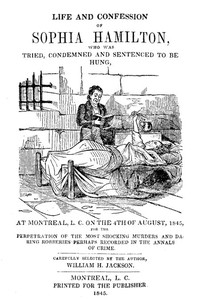
CAREFULLY SELECTED BY THE AUTHOR, WILLIAM H. JACKSON.
MONTREAL, L. C. PRINTED FOR THE PUBLISHER 1845.
LIFE AND CONFESSION OF SOPHIA HAMILTON.
It has probably never fallen to the lot of man to record a list of more cruel, heart-rending, atrocious, cold-blooded murders and daring robberies than have been perpetrated by the subjects of this narrative, and that too in the midst of a highly civilized and Christian community; deeds too, which, for the depravity of every human feeling, seem scarcely to have found a parallel in the annals of crime. And it seems doubly shocking and atrocious when we find them perpetrated by one of the female sex, which sex has always and in all countries been esteemed as having a higher regard for virtue, and far greater aversion to acts of barbarity, even in the most vitiated, than is generally found in men of the same class. We may truly say that the annals of history have never unfolded to the world a greater instance of human depravity and utter disregard of every virtuous feeling which should inhabit the human breast, than the one it becomes our painful duty to lay before our readers in the account of Sophia Hamilton, the subject of this very interesting narrative. We deem it not unimportant to give a brief account of her parentage, in order that our numerous readers may see the source from which she sprung; as also the inestimable and intrinsic value of a moral education in youth, which is a gem of imperishable value, the loss of which many have had to deplore when perhaps too late. The public may depend on the authenticity of the facts here related, as it is from no less a source than a schoolmate of her ill-fated father. The author has spared no exertions to collect every minute and important particular relating to her extraordinary, though unfortunate career.
Richard Jones, the father of the principal subject of this narrative was the only son of a wealthy nobleman residing in Bristol, England; he had in the early part of his life received a classical education. But in consequence of the death of his mother, he of course got an uncontrolled career, which continued too long, until at length he became a disgust to his kind and loving father, whose admonitions he disregarded and whose precepts he trampled upon. At the age of twenty-four, he was a perfect sot, regardless of the kind counsel of his relatives; and at length his character became so disreputable that he was accused of almost every outrage perpetrated in the neighbourhood in which he belonged. This preyed so much upon his aged father that he became ill, and it is thought by many shortened his life. Richard had then attained the age of twenty-five, and seemed so deeply afflicted by the death of his father, that he promised amendment of conduct, so that his uncle took him as partner at the druggist business; but this was to no effect, for in a short time he sought every species of vice and wickedness, which the depravity of human nature could suggest. His uncle and he dissolved, and as he had considerable of the money that his father bequeathed to him, he soon found company to suit his purpose, and became enamored of a woman of low character, who succeeded in making a union with him, and after spending considerable of the money, and seeing the funds likely to be exhausted, immediately scraped up their effects, as she possessed a little property of her own. They then resolved like many others, to emigrate, finding that they could not live in their native country.
They embarked on board a ship bound for St. John, N. B. in the year 1811; remained a short time in the city, when they moved up the St. John river and settled down between Frederickton and Woodstock, where he learned the farming business, and in the course of a little time accumulated means, which enabled him to keep a country store; and as the neighborhood in which he lived was a new settlement, property began to rise, and he commenced speculating in public lands. As he had a good education and bright intellect, he was soon looked upon as a leading man in the neighborhood, and it was thought profitable as well as necessary to establish a tavern in the vicinity, which was strongly recommended by many lumber merchants; and Jones, being considered to be the best adapted for the business, accepted the offer. He at this time was of course prosperous, as he had the whole monopoly and an unbounded concourse of travellers stopping at his house; but an avaricious desire seized him and he at once became fearless, and his first step was to commence smuggling between Frederickton and Calais, Me., which business he carried on for a considerable time unmolested. While things were going on in this style, it so happened that an old acquaintance, whose name was Thomas Murdock, moved from St. John and settled in the same neighborhood in which Jones resided. The acquaintance was soon renewed, though not much to the satisfaction of Jones, as he knew Murdock to be a man of honesty, and it was on this ground and the fear of detection and exposure that Jones dreaded his old acquaintance, for Murdock was yet entirely ignorant of the business Jones was engaged in, for he, Jones, had previously managed to keep up the appearance of honesty and respectability.
As Murdock frequently visited at the house of Jones, he soon began to suspect that all was not right. However, he said nothing on the subject, until one evening he happened to pass the house of Jones, on his way home, at an unusually late hour, and seeing a great stir, he determined to go in and satisfy his doubts as to what he before suspected; and there he found Jones secreting a quantity of broadcloth which had been stolen a few nights previous. Jones then finding that he was at length discovered, begged of Murdock not to expose him, and at the same time offered him fifty pounds, as he said exposure would be the means of bringing his family to disgrace, and final destruction; and at the same time endeavoring to induce Murdock to participate in the capture; but Murdock flatly refused, saying that his duty to his God and his country forbade such an undertaking.
He then begged of Murdock to allow him a little time to settle up his affairs and leave the country, promising in the most solemn manner, and calling upon his God to witness, that if he would grant him this request he would become an honest man. And Murdock, seeing that it would be the utter ruin of Jones's whole family, for his children were then but young, consented, after the most solemn assurance that Jones would reform. But we will now see the value of a promise from such a debauchee as he was. Immediately he collected his consorts around and held a consultation as to what should be done. Meanwhile, they indulged in the use of the inebriate's cup, which was a necessary ingredient to fit them for their hellish purpose; and at length, after consultation, agreed that it would be necessary to murder Murdock. They then separated, resolved upon the death of the unoffending and innocent victim.
It was agreed that they, four in number, should meet the following night at a school-house in the neighborhood of Murdock's house, which was about three miles from the tavern, which they did; but two of them being so much intoxicated that the others felt doubtful of success, they finally separated,--but resolved to execute the deed the following evening, which they did, assisted by Jones. On approaching the house were Murdock resided, unconscious of the cruel conspiracy which he was soon doomed to experience from the hands of one who had often shared of his kind benevolence, Jones stationed two at the back door, while he and one more demanded entrance at the front door. Murdock, on hearing the voice outside, said, "Is that Jones?" who immediately answered, with a coarse voice, "Yes, let me in." Murdock fell alongside of his wife, exclaiming, "they have come to murder me! farewell, my dear and affectionate wife;" and at the moment Jones rushed in as Murdock's wife moved out of the bed, and drove a large knife through Murdock, when the poor afflicted wife screamed aloud, and Jones missing his way through the house, was confused for some time, and was, perhaps, a little intoxicated. Just at that time the Quebec mail stage came along, and hearing the cries of Mrs. Murdock, the driver with six others repaired to the house, where they found Murdock stretched in a bloody gore, and Jones torn limb from limb by a large Scotch dog. On hearing the cries, the others fled, but one of them, whose name we cannot learn, was taken subsequently and hanged in Frederickton, we believe in the year 1822. Thus some means are always left whereby the guilty are sooner or later brought to condign punishment. Thus ended the career of a disobedient son and a cruel, regardless father, and blood-thirsty, cruel man, whose ear was deaf to the cries of the widow and the tears of the bereaved orphans, which he left, both of his own and the ill-fated Murdock, who left six helpless children to weep over the loss of their kind father. After the death of Jones, his wife carried on the business for some time, but in consequence of the disgraceful death of her husband, which was generally understood in that section of the country,--(though many of her friends deny that it was he who was found in the house of Murdock, as he was so much deformed by the dog, and boldly assert that he went to England to see his relatives; but it was pretty generally acknowledged by those best acquainted in the neighborhood,)--the public forsook the house, and Mrs. Jones was obliged to sell out and leave the neighborhood, which she did, and moved to the St. Lawrence River, where she settled about thirty miles from Montreal. As her means of living began to grow rather scanty, she began also to see the urgent necessity of bringing all her artfulness into practice, for she was a very persevering, arbitrary woman. As she had a very heavy family to support, she endeavored to make her house a house of resort for travellers or persons who wished to spend some of the hot summer months in that cool and delightful region of the country, away from the more unwholesome air of a crowded and suffocated city; and in this manner, as may be expected, they formed many new and stylish acquaintances, so that she soon succeeded in marrying her daughters to persons of respectability, although they were any thing but virtuous girls as well as wives.
The youngest daughter whose name was Sophia, and who is the principal subject of this narrative, was at the age of seventeen married to a young man whose name was Hamilton, a respectable mechanic, who happened to be travelling in that section of the country, we believe a native of Kingston, Upper Canada. As he chanced to put up at her mother's house in the summer of 1828, and his health was rather delicate, he determined to stop some time, as his physician recommended a change of climate. However, her mother finding Mr. Hamilton possess considerable money and considerable personal attraction, at once endeavored to bring round a marriage between him and her daughter. Consequently he was treated with the greatest care and attention during his illness, Sophia being his constant and only attendant. She possessed an uncommonly agreeable looking countenance, although rather masculine; she was very fascinating, and seemed to possess a soft, tender, agreeable disposition; at the same time her mother was exercising all her art and influence to induce him. He was not wholly unaware of the real disposition of the daughter, had he only listened to the voice of warning; but to no effect, for he resolved to marry Sophia immediately on his recovery.