Public-domain ebook
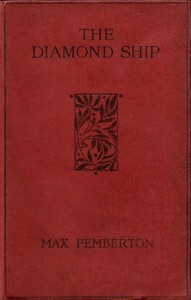
The Diamond Ship
Language: en407 downloads on Project Gutenberg
Subjects
In: Crime, Thrillers and Mystery·Adventure·Novels
Public-domain ebook sourced from Project Gutenberg #55993.
Public-domain ebook
Language: en407 downloads on Project Gutenberg
Subjects
In: Crime, Thrillers and Mystery·Adventure·Novels
Public-domain ebook sourced from Project Gutenberg #55993.
The opening · free to read
THE PREFACE OF TIMOTHY McSHANUS, JOURNALIST.
It would have been at the Fancy Fair and Fête at Kensington Town Hall that my friend, Dr. Fabos, first met Miss Fordibras. Very well do I recollect that he paid the price of it for the honourable company of the Goldsmith Club.
“McShanus,” said he, “if there’s anyone knows his way to a good supper, ’tis yourself and no other. Lead forth to the masquerade, and I follow. Spare no expense, McShanus. Your friends are my friends. I would have this a memorable night—the last I may be in London for many a year.”
There were seven of us who took him at his word and got into the cab together. You must know that he had paid for a little dinner at the Goldsmith Club already, and never a man who did not justice to his handsome hospitality. The night was clear, and there were stars in the heavens. I mind me that a little of the dulce and the desipere moved us to sing “Rule, Britannia” as we went. ’Tis a poor heart that never rejoices; and Ean Fabos paid for it—as I took the opportunity to remark to my good friend Killock, the actor.
“Shall we pay for the cab?” says he.
“Would you insult the most generous heart in Great Britain this night?” says I.
“On reflection,” says he, “the man who does not pay will have no trouble about his change,” and with that we went into the hall. It is true that we were a remarkable company. My old comrade, Barry Henshaw, had come in a velvet shooting coat and a red neckcloth that was not to the taste of the officials at the box-office. Killock himself, the darling of the ladies, God bless him, had diamonds strewn upon his vest thick enough to make a pattern of chrysanthemums. My own cravat would have been no disgrace to the Emperor Napoleon. And there we stood, seven members of seven honourable professions, like soldiers at the drill, our backs to the wall of the dancing room and our eyes upon the refreshment buffet.
“’Tis time for a whisky and soda,” says Barry Henshaw, the famous dramatist, directly his coat was off his back.
“Shame on ye,” says I,—“you that were lapping the poison they call ‘kummel’ not the half of an hour ago. Beware of the drink, Barry—the secret habit.”
“Oh,” says he, “then you’re coming with me, I suppose?”
“If Fabos were a gentleman he would join the procession and pay for it. But that’s the worst of these shows. You always lose the man with the money.”
I passed the observation by as impertinent, and we went to the buffet. What they called the Fancy Fair was in full swing by this time; though devil a wig on the green for all their money. Slips of beauty dressed as shepherdesses mistook me and my friend for their sheep, and would have fleeced us prettily; but our lofty utterance, coming of a full heart and two shillings and tenpence in the purse, restrained their ardour, and sent them to the right-about. ’Twas a fair, be it told, for the sailor boys at Portsmouth; and when you had bought a bunch of daisies for ten shillings, of a maid with blue eyes and cherry lips, you could waltz with the same little vixen at five shillings a time. My friend Barry, I observed, turned very pale at this suggestion.
“Do you not lift the sprightly toe?” asked I.
“Man,” he said, “it’s worse than a Channel passage.”
“But Fabos is dancing,” said I, pointing to our host in the midst of the rabble. “See what comes of the plain living, my boy. He’ll dance until the sun shines and think nothing of it. And a pretty enough five shillings’ worth he has on his arm,” I put in as an after-thought.
’Twas odd how we fell to discussing this same Dr. Ean Fabos upon every occasion that came to us. Was it because of his money—riches beyond dreams to poor devils who must please the public or die dishonoured in the market-place? I venture, no. We of the Goldsmith Club care for no man’s money. Bid the Vanderbilts come among us, and we lift no hats. ’Tis true that in so far as they assist the mighty sons of Homer and Praxiteles to meet their just obligations upon quarter day, they have some use in the world. I have known circumstances when they have kept precious lives from the Underground Railway or the Round Pond in Kensington Gardens. But this is to betray the secrets of my club and of my poor friends Killock and Barry Henshaw and the rest.
What I was saying was that Ean Fabos’s riches made no more mark upon us than a lady’s parasol upon the back of a mule. They said he was a doctor of Cambridge, whose father had made a fortune out of Welsh coal and then joined his ancestors. My homage to his consideration, says I. May the warmth of his discovery glow in many hearts and long blaze in beneficent profusion up the chimneys of the Goldsmith Club! He has bequeathed us a noble son, whose dinners are second to none in the empire. Again I say, hats off. ’Twas a gentleman entirely.
But I speak of his son dancing with the little girl in red at the Fancy Fair at Kensington. Be sure that his six feet one would go bending to sixty-eight inches and whispering soft things in her ear at five shillings the waltz, as the programme told ye. And he such a silent man ordinarily—not to be moved from that rogue of a taciturn smile we see so often upon his face even when the wit of the club is worthy of the name we bear. They call Ean Fabos many names. Some say misogynist; others cynic; a few speak of his lacking heart; there are those who call him selfish. What’s he to do with all his money? Do his friends share it? The sacred shrines of Bacchus know better. He buys diamonds, they say. Just that, great diamonds and rubies and sapphires, not for a woman’s pretty arms or her white shoulders, you must know; but to lock up in his safe at his great house down Newmarket way; to lock up and hide from men and gloat upon in the silence of the night. That’s what the world says. I’d add to it that there’s no true charity in all London which has not benefited secretly by his generous alms. But that is known to few, and was never known to me until I met the daughter of my friend Oscroft, the painter; left an orphan as she was in the same unkind city.
What is it, then, about Ean Fabos that turns all eyes upon him in whatever company he may be? Some, for sure, hope to borrow money of him. So much my great heart for humanity must admit. They hope to borrow money from him and to save him from others who would do likewise. ’Tis their way of friendship. But, mark ye, there are many more, strangers to him, enemies because of the favour he enjoys, and these are on their knees with the rest. What is it, then? I’ll tell you in a word. ’Tis that great power of what they call personal magnetism, a power that we can give no right name to, but must admit whenever we find it. Ean Fabos has it beyond any man I have known. Let him say three words at a table, and the whole room is listening. Let him hold his tongue and the people are looking at him. You cannot pass it by. It grips you with both hands, draws you forward, compels you to give best. And that’s why men gather about my friend Dr. Ean Fabos, as they would about the fine gentlemen of old Greece could they come back to this London of ours. They have no will of their own while he is among them.
Now, this is the very man whom I saw dancing twice (at five shillings a time, though naturally the money would be nothing to him, while much to poor souls who have had their pictures flung into the mud by the sorry Sassenachs who sit at Burlington House), dancing twice, I say, with a black-haired shepherdess in a red cloak; not one that I myself, who have a fine eye for the sex, would have been lavishing my immortal wit upon; but just a merry bit of laughing goods that you can sample in any ball-room. When he surrendered her to her father, a stately old gentleman, stiff as a poker in the back, and one who reminded me of my dead friend General von Moltke, of Prussia—when he did this, I say, and I asked him who she might be, he answered me with the frankness of a boy:
“Timothy McShanus,” says he, “she’s the daughter of General Fordibras, whose ancestor went to America with the Marquis de Lafayette. That is the beginning and end of my knowledge. Lead me forth to the cellar, for I would quench my thirst. Not since I was the stroke of the great Leander boat at Henley did there drop from my brow such honest beads of sweat. Man alive, I would not go through it again for the crown ruby of Jetsapore.”
“Your friend Lafayette was known to my grandfather,” says I, leading him straight to the buffet, “though I do not remember to have met him. As for the labour that ye speak of, I would ask you why you do it if ye have no stomach for it. To dance or not to dance—shall that be the question? Not for such men as we, Dr. Fabos; not for those who dwell upon the Olympian heights and would fly higher if ye could oblige them with the loan——”
He cut me very short, mistaking my words. Not a man who is given to what is called dramatic gesture, I was much astonished when he took me by the arm and, leading me away to a corner, made the strangest confession that ever fell from such a man’s lips.
“I danced with her, McShanus,” said he, “because she is wearing the bronze pearls that were stolen from my flat in Paris just three years ago.”
Be sure that I looked hard enough at him.
“Is there but one bronze pearl in the world?” I asked him after a while of surprise.
He turned upon me that weary smile which intellect may turn upon curiosity sometimes, and rejoined as one who pitied me.
“There are just ten of that particular shape, McShanus,” says he, “and she is wearing four of them in the pendant she has upon her neck. The heart of it is a rose diamond, which once belonged to Princess Marguerite of Austria. There is a sweet little white sapphire in the ring she wears that I fancy I remember somewhere, though the truth of it has gone out of my head. If she will give me another dance by-and-by I will tell you more perhaps. But do not speculate upon my actions any further. You have known me long enough to say that waltzing is not an employment which usually occupies my attention.”
“’Tis true as all the gospels,” cried I; “and yet, what a story to hear! Would you have me think that yon bit of a girl is a thief?”
“Oh,” says he, his clear blue eyes full upon me, “does an Irishman ever give himself time to think? Come, McShanus, use your wits. If she or her father knew that the jewels were stolen, would she be wearing them in a ball-room in London?”
“Why, no, she certainly would not.”
“Wrong every time, Timothy McShanus. She would wear them for mere bravado. That’s what I’ve been telling myself while I danced with her. If she does not know the truth, her father does.”
“What! The military looking gentleman who so closely resembles my friend General von Moltke?”
“No other at all. I have my doubts about him. He knows that his daughter is wearing stolen jewels, but he has not the smallest idea that I know—either that, or he is clever enough to play Hamlet in a tam-o’-shanter. Excuse my unwonted agitation, McShanus. This is really very interesting.”
The book keeps going
Reading is free forever. Sign up and watch scenes appear while you read.



Scenes Storieta drew for other classics.
New illustrated classics
Once or twice a month: the latest books to get full character casts, scene art, and free comic editions. No account needed.