Public-domain ebook
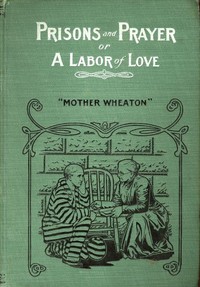
The Man Behind the Bars
Language: en452 downloads on Project Gutenberg
Subjects
In: Biographies·Law & Criminology
Public-domain ebook sourced from Project Gutenberg #56112.
Public-domain ebook
Language: en452 downloads on Project Gutenberg
Subjects
In: Biographies·Law & Criminology
Public-domain ebook sourced from Project Gutenberg #56112.
The opening · free to read
I have often been asked: "How did you come to be interested in prisoners in the first place?"
It all came about simply and naturally. I think it was W. F. Robertson who first made clear to me the truth that what we put into life is of far more importance than what we get out of it. Later I learned that life is very generous in its returns for what we put into it.
In a quiet hour one day it happened that I realized that my life was out of balance; that more than my share of things worth having were coming to me, and that I was not passing them on; nor did I see any channel for the passing on just at hand.
The one thing that occurred to me was to offer my services as teacher in a Sunday-school. Now, I chanced to be a member of an Episcopal church and their Sunday-school was held at an hour inconvenient for my attendance; however, in our neighborhood was a Methodist church, and as I had little regard for dividing lines among Christians I offered my services the next Sunday to this Methodist Sunday-school. My preference was for a class of young girls, but I was assigned as teacher to a class of ten young men, of ages ranging between eighteen and twenty years, and having the reputation of decided inclination toward the pomps and the vanities so alluring to youth.
It was the season of revival meetings, and within a month every member of my class was vibrating under the wave of religious excitement, and each one in turn announced his "conversion." I hardly knew how to handle the situation, for I was still in my twenties, and as an Episcopalian I had never experienced these storm periods of religious enthusiasm. So while the recent converts were rejoicing in the newly found grace, I was considering six months later when a reaction might set in.
Toward the close of the revival one of the class said to me: "I don't know what we're going to do with our evenings when the prayer-meetings are over, for there's no place open every evening to the men in this town except the saloons."
"We must make a place where you boys can go," was my reply.
What the class proceeded to do, then and there, was to form a club and attractively furnish a large, cheerful room, to which each member had a pass-key; and to start a small circulating library, at one stroke meeting their own need and beginning to work outward for the good of the community.
The first contribution toward this movement was from a Unitarian friend. Later, Doctor Robert Collyer--then preaching in Chicago--and Doctor E. E. Hale, of Boston, each gave a lecture for the benefit of our infant library. Thus from the start we were untrammelled by sectarianism, and in three months a library was founded destined to become the nucleus of a flourishing public library, now established in a beautiful Carnegie building, and extending its beneficent influence throughout the homes, the schools, and the workshops of the city.
Of course I was immensely interested in the class, and in the success of their library venture, and as we had no money to pay for the services of a regular librarian the boys volunteered their services for two evenings in the week, while I took charge on Saturday afternoons. This library was the doorway through which I entered the prison life.
One Saturday a little boy came into the library and handed me the charming Quaker love story, "Dorothy Fox," saying: "This book was taken out by a man who is in jail, and he wants you to send him another book."
Now, I had passed that county jail almost every day for years; its rough stone walls and narrow barred windows were so familiar that they no longer made any impression upon me; but it had not occurred to me that inside those walls were human beings whose thoughts were as my thoughts, and who might like a good story, even a refined story, as much as I did, and that a man should pay money that he had stolen for three months' subscription to a library seemed to me most incongruous.
It transpired that the prisoner was a Scotch boy of nineteen, who, being out of work, had stolen thirty-five dollars; taking small amounts as he needed them. According to the law of the State the penalty for stealing any amount under the value of fifteen dollars was a sentence to the county jail, for a period usually of sixty days; while the theft of fifteen dollars or more was a penitentiary offence, and the sentence never for less than one year. I quote the statement of the case of this Scotch boy as it was given me by a man who happened to be in the library and who knew all the circumstances.
"The boy was arrested on the charge of having taken ten dollars--all they could prove against him; and he would have got off with a jail sentence, but the fool made a clean breast of the matter, and now he has to lie in jail for six months till court is in session, and then he will be sent to the penitentiary on his own confession."
Two questions arose in my mind: Was it only "the fool" who had made a clean breast of the case? And if the boy was to go to prison on his own confession, was it not an outrage that he should be kept in jail for six months awaiting the formalities of the next session of the circuit court? I did not then think of the taxpayers, forced to support this boy in idleness for six months.
That night I did not sleep very well; the Scotch boy was on my mind, all the more vividly because my only brother was of the same age, and then, too, the words, "I was in prison and ye visited me not," repeated themselves with insistent persistence until I was forced to meet the question, "Did these words really mean anything for to-day and now?"
Next morning I asked my father if any one would be allowed to talk with a prisoner in our jail. My father said: "Yes, but what would you have to say to a prisoner?" "I could at least ask him what books he would like from the library," I replied. But I could not bring my courage to the point of going to the jail; it seemed a most formidable venture. Sunday, Monday, and Tuesday passed, and still I held back; on Wednesday I was driving with my brother, and when very near the jail the spring of the carriage broke, and my brother told me that I would have to fill in time somewhere until the break was repaired. I realized that the moment for decision had come; and with a wildly beating heart I took the decisive step, little dreaming when I entered the door of that jail that I was committing myself to prison for life.
But we all take life one day, one hour, at a time; and five minutes later when my hand was clasped through the grated door, and two big gray eyes were looking straight into mine, I had forgotten everything else in my interest in the boy. I asked him why he told that he had taken thirty-five dollars when accused only of having taken ten, and he simply said: "Because when I realized that I had become a thief I wanted to become an honest man and I thought that was the place to begin."
Had I known anything of the law and its processes I should doubtless have said: "Well, there's nothing for you to do now but to brace up and meet your fate. There's nothing I can do to help you out of this trouble." But in my fortunate ignorance of obstacles I said: "I'll see what I can do to help you." I had only one thought--to save that young man from the penitentiary and give him a fresh start in life.
I began with the person nearest at hand, the sheriff's wife, and she secured the sheriff as my first adviser; then I went to the wife of the prosecuting attorney for the State, and she won her husband over to my cause. One after another the legal difficulties were overcome, and this was the way the matter was settled: I secured a good situation for Willy in case of his release; Willy gave the man from whom he had taken the money a note for the full amount payable in ninety days--the note signed by my father and another responsible citizen; the case was given a rehearing on the original charge of ten dollars, and Willy's sentence was ten days in the county jail; and this fortunate settlement of the affair was celebrated with a treat of oranges and peanuts for Willy and his fellow prisoners. A good part of that ten days Willy spent in reading aloud to the other men. Immediately after release he went to work and before the expiration of the ninety days the note for thirty-five dollars was paid in full. Now, this was the sensible, fair, and human way of righting a wrong. Nevertheless, we had all joined hands in "compounding a felony."
With Willy's release I supposed my acquaintance with the jail was at an end, but the boy had become interested in his companions in misery and on his first visit to me he said: "If you could know what your visits were to me you would never give up going to the jail as long as you live." And then I gave him my promise. "Be to others what you have been to me," has been the message given to me by more than one of these men.
While a prisoner Willy had made no complaint of the condition of things in the jail, but after paying the note of his indebtedness, he proceeded to buy straw and ticking for mattresses, which were made and sent up to the jail for the other prisoners, while I furthered his efforts to make the existence of those men more endurable by contributing various "exterminators" calculated to reduce the number of superfluous inhabitants in the cells.
At the time I supposed that Willy was an exception, morally, to the usual material from which criminals are made. I do not think so now, after twenty-five years of friendships with criminals; of study of the men themselves and of the conditions and circumstances which led to their being imprisoned.
Willy's was a kindly nature, responsive, yielding readily to surrounding influences, not so much lacking in honesty as in the power of resistance. Had he been subjected to the disgrace, the humiliation, and the associations of a term in the penitentiary, where the first requirement of the discipline is non-resistance, he might easily have slipped into the ranks of the "habitual" criminal, from which it is so difficult to find an exit. I am not sure that Willy was never dishonest again; but I am sure of his purpose to be honest; and the last that I knew of him, after several years of correspondence, he was doing well, running a cigar-stand and small circulating library in a Western town.
From that beginning I continued my visits to the jail, usually going on Sunday mornings when other visitors were not admitted. And on Sunday mornings when the church-bells were calling, the prisoners seemed to be--doubtless were--in a mood different from that of the week-days. There's no doubt of the mission of the church-bells, ringing clear above the tumult of the world, greeting us on Sunday mornings from the cradle to the grave.
I did not hold any religious services. I did not venture to prescribe until I had found out what was the matter. It was almost always books that opened the new acquaintances, for through the library I was able to supply the prisoners with entertaining reading. They made their own selections from our printed lists, and I was surprised to find these selections averaging favorably with the choice of books among good citizens of the same grade of education. There certainly was some incongruity between the broken head, all bandages, the ragged apparel, and the literary taste of the man who asked me for "something by George Eliot or Thackeray."
The book keeps going
Reading is free forever. Sign up and watch scenes appear while you read.



Scenes Storieta drew for other classics.
New illustrated classics
Once or twice a month: the latest books to get full character casts, scene art, and free comic editions. No account needed.