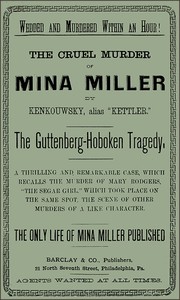
BARCLAY & CO., Publishers, 21 North Seventh Street, Philadelphia, Pa.
AGENTS WANTED AT ALL TIMES.
Entered according to Act of Congress, in the year 1881, by BARCLAY & CO., In the Office of the Librarian of Congress, at Washington, D. C.
THE MINA MULLER MURDER.
MURDERED BY HER HUSBAND OF AN HOUR.
On Friday morning, the 13th of last May, a German, whose purpose was to gather green leaves to sell to florists in N. Y. city, entered the path leading from Bergen avenue, in the district known as Bull’s Ferry, north of Weehawken. He had followed it eastward toward the river about 100 feet, and had turned aside to the right about twenty feet, when he was appalled by almost stepping upon the dead body of a woman. He hurried away to inform the police.
Early in the afternoon Coroner Wiggins, of Hoboken, visited the spot and made a careful examination. He judged that the woman had not been over 25 years old. Along the top of the head, on the left side, was a deep gash, and beneath it the skull was fractured. There was another gash over the right eye. Both of these gashes were apparently made with the edge of a stone. The nose was broken in the middle. The right side of the head had apparently been crushed by a stone. The left ear was injured as if an ear-ring had been torn from it. Search was made for the missing ear-ring, but it was not found. Her face had become blackened by the sun, which shone upon the spot where the body lay. The features were small and symmetrical. She wore number one or number two buttoned shoes.
An investigation was at once begun by the coroner, but without much success.
On the 18th the young woman was completely identified as Mrs. Philomena Muller, the wife of Simon Muller, a tobacconist, at 502 West Thirtieth street, N. Y. Mr. Muller called at the Morgue at 3 o’clock on the afternoon of May 18th, in company with a lady whom he introduced as Miss Maria Schmidt, his wife’s sister. He said they desired to look at the body. They were led into the damp vault, and at sight of the body Miss Schmidt was overcome, and she retired to the adjoining basement. Mr. Muller gazed upon the body calmly. The jewelry and clothing of the dead woman were shown to him, and he positively identified them as the property of his wife. He said that he had given her the cameo brooch. Mr. Muller said that some time ago his wife deserted him, and since then she had not lived with him. Miss Schmidt had seen her sister about two weeks before. Mrs. Muller then informed her that she had found a decent man, who was going to marry her and take her to Germany in the steamer L’Amerique, which was to sail on the 4th of May. When Miss Schmidt told Mr. Muller of this he went to the wharf of the Transatlantic Steamship Company on the morning of May 4th, and remained at the gang plank of the vessel until all the passengers had gone aboard. He was certain that his wife was not among them, but he did not know her paramour.
Before this identification was made, the authorities of Hudson county had obtained conclusive evidence of the fact that the murdered woman was Mrs. Philomena Muller, and that her assassin had married her on the morning of the day on which he killed her, and had taken passage on the following day for Europe. As Mrs. Finck, the wife of an alehouse keeper in Pierce Avenue, West New York, was sitting in her saloon on the afternoon of Tuesday, the 3d of May, a man and a woman entered and sat down at a table. The woman ordered drinks, and called for a glass of beer. Her companion drank soda water. While they were there the woman talked almost incessantly. She said that they came from Morrisania. She seemed to have plenty of money. When she paid for the refreshments, Mrs. Finck noticed a large roll of bank notes in her pocketbook, besides some silver and gold. Before going away, the woman borrowed a corkscrew to open a bottle of Rhine wine which she had with her. She said she had bought the bottle in Union Hill. Mrs. Finck minutely described the woman, and the description tallied exactly with that of the woman who was murdered. Prosecutor McGill was so impressed with the accuracy of Mrs. Finck’s description, that he specially detailed Detectives Swinton and Fanning to trace the movements of the unknown couple. They began their search on Tuesday evening, May 17th, and Wednesday the 18th they submitted to the Prosecutor a circumstantial account of their discoveries.
They began by looking for the person from whom the bottle of Rhine wine had been purchased. Every saloon along the Boulevard and the Hackensack plank road was visited, but to no purpose. Continuing their inquiries, they entered an inn kept by Edward Stabel, on the Weaverstown road. When they questioned him he said he remembered that on the day indicated by them a woman had called at his place and asked for a bottle of Rhine wine. As he did not have any he sent his granddaughter, Lizzie Haas, to Mr. Eberling’s store, in Bergenline avenue, for a bottle of it. While the girl was absent the woman chatted pleasantly with Stabel. She told him, among other things, that she had just been married by the Rev. Mr. Mabon, the pastor of the Grove Reformed Dutch Church, and that she wanted the wine to celebrate the event, and to treat the minister. She also said that she was about to sail for France. When the girl came back with the bottle of wine the woman paid her fifty cents for it, and gave her ten cents additional out of a $5 gold piece that Stabel changed for her. On leaving the saloon the woman was joined by a man. Stabel could not recollect anything in particular about the man, except that he had stood outside on the street while the woman bought the wine. But he gave a very accurate description of the woman and her dress, which tallied both with Mrs. Finck’s description of the woman she had seen, and with that of the murdered woman. Mrs. Stabel furnished additional details. She said the woman came to the saloon on the 3d of May. She was sure of the date, because on the same day there was a burial in the Grove Church Cemetery which is only a short distance from the inn. The woman told Mrs. Stabel of her marriage, and explained that it had been secretly performed, because her brother disliked her husband, and had objected to the match. She also said that she had been married once before, and had attended a cigar store which her former husband kept in N. Y. city. Mrs. Stabel’s circumstantial description of the woman tallied yet more accurately than her husband’s with that of the murdered woman.
The detectives then went to the parsonage of the Grove Reformed Dutch Church, where they found the Rev. Dr. Mabon. He recollected having married a couple on May 3d. The woman, he said, entered his residence alone, leaving the man in the yard, where he paced up and down as if absorbed in meditation. The woman asked Mr. Mabon if he would perform a marriage, and upon being told yes, she went out and returned immediately with the man. As the couple had not provided a witness, the clergyman called in John Schuman, a barber in Union street, Union Hill. The man and woman made satisfactory replies to the usual questions, and they were married in legal form. After the ceremony they subscribed the following record of the marriage, which is now in Mr. Mabon’s possession:
On Tuesday, May 3, 1881, Louis Kettler, single, aged 33, bricklayer by occupation, and residence 1511 Second avenue, New York, married to Mina Schmidt, single, aged 34, residence, 1247 Third avenue, New York. Father of bridegroom, Louis Kettler; father of bride, Anastasius Schmidt. Both of the contracting parties were born in Katenheim, Germany.
The woman did most of the talking, and seemed to be in excellent spirits. She exhibited a bulky pocketbook, and asked Mr. Mabon how much his charge was. He replied that she might pay him whatever she thought proper. As she had no small bills she went out to get change, and came back presently with the money and a bottle of Rhine wine, which she offered to the clergyman. When he refused it she tried to persuade him to take a drink, but he declined, and, after a few more words, the strange couple quitted the parsonage. Mr. Mabon could not recollect anything about the dress of either of the parties, but his colored servant girl told the detectives that she had particularly noticed the man as he was striding up and down the garden, and acting as if his mind was troubled. She said he was stout, with a full face and dark moustache, and wore a high, flat-topped Derby hat.
Mrs. Sarah Rigler, who lives in the neighborhood of the church, saw the couple before their marriage. They came along the road, and the woman stopped and asked Mrs. Rigler:
“Can you please direct me to a priest?”
“Do you want a priest or a minister?” Mrs. Rigler inquired.
“I want a Protestant priest,” the woman responded. “I am going to be married, and I want him to marry us.”
Mrs. Rigler’s description of the woman was almost precisely the same as Mrs. Stabel’s. The man, she said, was quiet, and did not say anything in her hearing. When the couple were last seen by the people in the neighborhood of the church they were walking together toward West New York by a road that led in the direction of Finck’s saloon and the Guttenberg ferry.
The detectives next went to 1247 Third avenue, N. Y. city, the number that had been given to Mr. Mabon by the bride as her residence. There they were unable for a long time to find any trace of Mina Schmidt. Finally the daughter of the janitor remembered that a woman answering Miss Schmidt’s description had been living at service with a family in the house. But the family had moved, and the servant had gone with them. An expressman named Body had taken away her trunks. After a tedious search Body was found. The young woman whose trunks he had removed proved not to have been the murdered woman. But Body said that about the 1st of May a woman whom he knew as Mrs. Mina Muller offered to sell him some articles of furniture, as she was about to move. They were unable to agree on the price. Mrs. Muller returned shortly afterward and left an order to have an express wagon call for her baggage at 1511 Second avenue, where she was then staying. Body sent William Norke, one of his drivers, to the place, and the man received from Mrs. Muller four trunks, a bundle of bedding, and a valise, which, by her directions, he carried to Theodore Scherrer’s Hotel, at 178 Christopher street. Body and Norke described Mrs. Muller, and the detectives were satisfied that she was the woman who, under the name of Mina Schmidt, was married by Mr. Mabon in the Grove Church. A man whom the driver did not know, but who, from his appearance, he believed to have been the murderer, superintended the transfer of her packages, and rode in the wagon with Norke to the hotel. On the way there he told Norke that he intended soon to sail for Europe.
At 1511 Second avenue, whither the detectives next proceeded, they found a German woman named Mrs. Schwan, who keeps a dyeing establishment. She did not know any man named Kettler, but she said that a man who answered in every respect the description of Kettler had lived in the house, but had moved about the first of May. He had lived, she said, with a young widow, to whom she had heard he was married. Mrs Schwan described the woman, and again the description tallied with that of the murdered woman. Mrs. Schwan had been told that the woman had another husband living in Thirty-ninth street. Charles Rost, the landlord, said that on March 3d Mrs. Muller had engaged three rooms, front, on the top floor, and had furnished them comfortably. She told Rost that she was working for Hahn, the butcher, in Third Avenue. Her husband, Mr. Muller, she said, had died of consumption, and had left her $1,000 insurance on his life. She was away all day as a rule, and returned to her apartments in the evening.