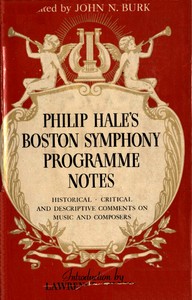
This book, assembling the musical writings of Philip Hale, draws principally upon the programme books for which he wrote descriptive notes for thirty-two years of concerts by the Boston Symphony Orchestra. Since the notes were addressed to audiences approaching the music with, presumably, open minds, the writer judiciously withheld his individual opinion. This opinion he freely expressed in his newspaper reviews of the same concerts, extending over an even longer period, and it has seemed advisable, by combining the two, to bring together the critic and the historian. The editor has found, in the newspaper files, pertinent critical paragraphs which are here used to introduce the programme notes about each particular work. The transition from criticism to descriptive note is indicated by a typographical ornament.
In going through the scrapbooks in the Allen A. Brown Room of the Boston Public Library, wherein the newspaper criticisms of Philip Hale’s forty active years are carefully preserved, the editor came across this observation by him, in the Boston Herald of March 13, 1912: “In 1945 some student in the Brown Room of the Public Library will doubtless be amused by opinions expressed by us all, of works first heard in 1912. Some of us will not then be disturbed by his laughter or by quotations ornamented with exclamation marks of contempt or wonder.”
There is cause for wonder, to a student at a time ten years short of the year Mr. Hale mentioned; wonder, however, at his quick perception of essential values upon first hearing what time has since proved a masterpiece, or considerably less than a masterpiece, as the case may be. Few indeed are the professional judges of music who are not glad to leave undisturbed in the dust of the newspaper files some skeletons of their past—appalling errors of denunciation or proclamation. Again and again, when his fellow critics of another day wrote laughably of a then new tone poem of Richard Strauss or pastel of Claude Debussy, Philip Hale delivered a sane and still quotable judgment.
No attempt has been made to modify by omissions Mr. Hale’s frank expressions of personal preferences among the composers. This writer never spoke as a major prophet, but as one who might be discussing a favorite subject over a demi-tasse. Anyone is privileged to disagree, and those insisting upon their eternal verities are referred to any one of a hundred books where the musical monuments are enshrined in ringing platitudes of praise. When this critic wrote, with the very opposite of solemnity, about Bach, or Brahms, or Wagner, his ridicule was always directed against a certain snobbish element in his public—a genus which sat at the feet of these composers. “There is, it is true, a gospel of Johannes Brahms,” he wrote as long ago as 1896, “but Brahms, to use an old New England phrase, is often a painful preacher of the word.—Brahms is a safe play in Boston. Let me not be unthankful; let me be duly appreciative of my educational opportunities in this town.”
It is a joyful privilege to be the agent of bringing the treasure of Philip Hale’s musical knowledge and commentary within the permanence and general accessibility of two covers. It was at first hoped that the author could assist in the compilation, but, failing in health, he was unable to give more than his whole-hearted assent to the project. His death, November 30, 1934, came before the book was far under way.
The material drawn upon is of vast proportions. From the autumn of 1901 through the spring of 1933, Philip Hale contributed programme notes for everything played by the Boston Symphony Orchestra in its regular concerts—upward of a thousand works. As music critic, Mr. Hale commented upon these and many more. He wrote for the Boston Home Journal from 1889 to 1891; the Boston Journal (like the other publication, long since extinct), from 1891 to 1903; and from then until his retirement in 1933 for the Boston Herald. There were also the editorials on various musical topics which he contributed anonymously to the New Music Review for many years. Acknowledgment is due for the quotations made from all of these publications; in particular the Boston Symphony Orchestra Concert Bulletins, which have provided the bulk of this book, and the Boston Herald, from which by far the larger number of critical paragraphs are drawn. To these should be added the innumerable writers to whom Mr. Hale himself has referred in the course of his programme notes. The helpful advice of Mrs. Philip Hale in the choice of the frontispiece is gratefully acknowledged.
The problem of selecting from the vast accumulation of Philip Hale’s writings became somewhat less formidable when a large number of works now forgotten, and others still current but of lesser importance, were eliminated. One hundred and twenty-five works have been chosen, with the aim of including those most often encountered upon symphony programmes. The works of recent composers were necessarily limited to those which had been played by the Boston Symphony Orchestra, and therefore described in its programmes, up to April, 1933. They are still further limited by the exigencies of space. The quoted reviews have been kept clear, for the sake of continuity, of dates and sources; documentation in the programme notes has been minimized. These notes are given in the form in which they most recently appeared. Their partial curtailment is justified by the readiness of their author to adjust them to the space of the programme in hand. To have used each note in its fullest form would have reduced the number of works which the book could contain. As regards the newspaper quotations, they are largely of recent years, and in any case represent the writer’s reconsidered opinion. A disproportion in the space given to a certain composer or certain work may be set down to the fact that in a few instances Mr. Hale did not happen at any time to write one of his inimitable essays in miniature which could be detached from the discussion of the occasion and the performance.
Some day an inquisitive musicologist will consider the part played in the history of musical education and musical taste by that seemingly indispensable adjunct of the symphonic concert room, the Programme Note. When that time comes, the contributions made by Philip Hale to the musical civilization of his time will appear in their true proportions. For more than a generation, from the beginning of the twentieth century to the fifth year of the Great Depression, Hale provided programme notes for everything played by the Boston Symphony Orchestra in its regular concerts—“upward of a thousand works”, as Mr. Burk informs us in his valuable note to the present collection. The annual issue by the Boston Symphony Orchestra of the bound volumes containing Philip Hale’s annotations was an event in the musical world of America that exceeded in importance and interest the appearance of the average new symphonic work upon the Orchestra’s programmes. A decade ago, in commenting upon the issue of one of those momentous and liberal tomes (sometimes they included more than two thousand pages), I remarked that it provided a musical education in one volume. Those famous annotations—modestly indicated on the title-page, in small and light-faced type, as “historical and descriptive notes by Philip Hale”—constitute a library of musical information the like of which is not to be found elsewhere on this sufficiently book-congested sphere.
Though Hale was a New Englander by birth, he had not the normal New England suspicion of entertainment as an educational ingredient; and he did not scruple to amuse. He was almost indecently readable. He never hesitated to lighten musical instruction with diversion and with wit. He knew much besides music; and he was able to peptonize for the reader his vast and curious erudition. He could tell you about the maceration of Oriental women, and what action is described by the word “tutupomponeyer”, and who invented the first chess-playing automaton, and how locomotive engines are classified, and what Pliny said concerning the bird called penelope. He knew all about the various editions of the singular Commentaires sur les epistres d’Ovide by Claude Gaspar Bachet, Sieur de Meziriac, in which the parentage of Ulysses is discussed. He could tell you why the river Ebro bears that name; and what Louis XIV ate for supper—which, you may like to be reminded, often consisted of four plates of different soups, the whole of a pheasant, a partridge, a heaped-up plate of salad, two huge slices of ham, mutton stewed with garlic, and a plate of pastries topped off with fruit and hard-boiled eggs. As for all the other things that Hale knew, you must turn to his writings if you would appreciate their range and number.
And all this fantastically varied learning—which not only seemed boundless in extent, but which was also incredibly exact and circumstantial—adorned a general culture that was nourishing and humane, and a specifically musical culture which conceived no relevant fact as inconsiderable, no anecdote unimportant, no human aspect unrevealing. The average programme note is a deadly and a stifling thing; but these amazing annotations, traversing all history and the ceaseless tragi-comedy of life, assure us that a programme note may sometimes, if an artist has contrived it, be more rewarding than the music that occasioned it.
Philip Hale transformed the writing of programme notes from an arid and depressing form of musical pedagogy into an exhilarating variety of literary art. The formidable weight of learning which he bore was employed with an ease and finesse, a lightness of touch, a charm of manner, a wit and conciseness and flexibility, which belong among the achievements of distinguished letters. His predecessor as annotator of the Boston Symphony Orchestra’s programmes, the accomplished William Foster Apthorp, had prepared the way for Hale’s achievement. Apthorp’s notes, written between 1892 and 1901, surpassed in brilliance and acumen anything that had come out of Europe or America. But Philip Hale, by reason of his exceptional width of intellectual range, and the well of knowledge which he drew upon, and his insatiable, devouring, delighted curiosity, established himself almost at once as the master of an enlivened order of creative musical scholarship which was a new thing under the tonal sun.
One might justly say of him, as critic, commentator, analyst, what Sir George Grove said of Schubert—a saying that Hale himself was fond of quoting: “There never has been one like him, and there never will be another.” Lawrence Gilman.
PHILIP HALE’S BOSTON SYMPHONY PROGRAMME NOTES
No matter how well old music may be performed by chorus, orchestra, virtuoso, many audiences are bored by it today. There is one exception: the music of Bach. “He is the forerunner, the prophet that foresaw our epoch and our tastes.” This speech is often heard, as is the remark: “There is not one ultra-modern harmonic thought that is not to be found somewhere in Bach’s music.” Bach is one of the great fetishes in music. The late John S. Dwight really believed in the plenary inspiration of the indefatigable weaver of counterpoint. No matter how formal, how dull a page of music looked or sounded, Mr. Dwight was in ecstasy the moment he was told the page was signed with Bach’s name.