Public-domain ebook
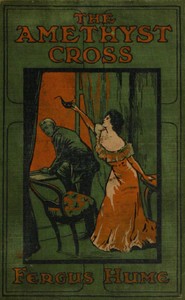
The Amethyst Cross
by Fergus Hume
Language: en494 downloads on Project Gutenberg
Subjects
In: Romance·Crime, Thrillers and Mystery·Novels
Public-domain ebook sourced from Project Gutenberg #56230.
Public-domain ebook
by Fergus Hume
Language: en494 downloads on Project Gutenberg
Subjects
In: Romance·Crime, Thrillers and Mystery·Novels
Public-domain ebook sourced from Project Gutenberg #56230.
The opening · free to read
THE blackbird knew. He had paired for the fifth time in as many years, and esteemed himself wise in the matters, of love. Therefore, from the budding chestnut wherein his nest was built, did he sympathetically watch the bachelor and maid who sat below. They were lovers as he knew very well, for only lovers could have gazed so persistently into one another's eyes, and therein did they behold each other as each wished to be. Which sentence is cryptic to those who are not lovers as these were.
They might have looked at the smoothly-flowing river, singing quietly to itself not a stone-cast away, or round a tangled garden, delicately beautiful with the young greenery of May, or up into the azure depths of a sky, flecked with silvery clouds. But they preferred--wisely it may be--to look into each other's eyes, to clasp hands and to remain silent with that eloquent muteness, which is the speech of true love. Oh! the blackbird knew the meaning of these things very thoroughly, and chuckled with such glee that he finally broke into glorious song concerning the new love, the true love, the old love, the bold love, which comes evermore with the blossoms of spring. But these inhabitants of Paradise did not require the bird to reveal the obvious. Their hearts were also singing the song of the early year.
"It can't last for ever," murmured the maid dreamily, "it is too beautiful to last, since we are but mortal."
"It shall last for ever; it must," corrected the bachelor, wise in that wisdom of the gods, which comes to wooers, "for we love with our souls, dearest, and these cannot die."
She knew that he was right, for her heart told her so. Therefore did they again look into one another's eyes and again become silent, while the fluting blackbird explained more than mere human speech could render. And he, perched on a swaying bough, was only too willing to interpret. He knew: he was wise. And listening Nature heard complacently. To such ends had she shaped her children; for such a reason had she provided their Arcadia.
As Arcadia, like Marlowe's hell, is not circumscribed, it chanced that this especial one was by Thames-side, and those who dwelt therein were up-to-date in looks and dress and manners. Only their feelings were those of classic times, and as he told her the old, old story, which is ever new, she listened with the instinctive knowledge that the tale was wonderfully familiar. She had read it in his eyes, after the manner of maids, long before he dared to speak.
And this river Paradise was not wholly unworthy at so comely an Adam and Eve, although limited in extent and untrimmed in looks. Lord Beaconsfield declared that the most perfect garden is that cultivated to excess by man and then handed over to the caprice of Nature. The owner of this demesne apparently subscribed to this dictum, for the garden, well-filled with expensive flowers and shrubs, had long since relapsed into wildness. On either side of the narrow strip of land, sloping gradually to the stream, extended low walls of mellow red brick overgrown with dark-green ivy. The flowerbeds were luxuriant with docks and nettles and charlock and divers weeds: the pathways were untidy with lush grass, and the tiny lawn at the water's edge was shaggy and untrimmed. A wooden landing-stage floated near shore at the garden's foot, and to this was attached the young man's boat. At the far end of this neglected domain could be seen a thatched cottage with whitewashed walls and oblong lattices quaintly diamond-paned. So rustic and pretty and old-world did it look that it might well have been the fairy-dwelling of a nursery tale. And the lovers themselves were young and handsome enough to deserve the care of the fairies.
He was tall, slim, well-formed, and Saxon in his fairness. His curly hair--so much of it as the barber's shears had spared--was golden in the sunlight, as was his small moustache, and his eyes were bravely blue, as a hero's should be. The white boating-flannels accentuated the bronze of his skin, and revealed the easy strength of an athlete. He looked what the girl took him to be--a splendid young lover of romance. Yet he was but a City clerk of prosaic environment, and his youth alone improved him into Don Juan o' Dreams.
The girl resembled Hebe, maidenly, dainty, and infinitely charming; or it might be Titania, since her appearance was almost too fragile for the work-a-day world. With a milky skin; brown-haired and brown-eyed; with a tempting mouth and a well-rounded chin, she looked worthy of any man's wooing. She was sweet and twenty; he but five years older, so both were ripe for love. And then the spring, joyous and fresh, had much to do with the proposal just made. Her answer to his question had been tunefully commented upon by the irrepressible blackbird, who expressed no surprise when the echo of a kiss interrupted his song.
"But my father will never agree, George," sighed the girl, after this outward and visible sound of acceptance.
"Dearest Lesbia"--he folded her manfully in his arms--"I don't see why your father should object. I am not rich certainly, as a stockbroker's clerk doesn't earn large wages. But for your dear sake I shall work and work and work until I become a millionaire."
Lesbia smiled at this large promise. "We may have to wait for years."
"What does it matter so long as our hearts are true?"
"They may grow sick with waiting," said Lesbia, sighing. Then she proceeded to look on the practical side of their idyll, as the most romantic of women will do at the most romantic of moments. "You earn only two hundred a year, darling, and my father--so far as I know--can give me nothing. He has his pension from Lord Charvington, and makes a small income by his work in the City, but"--here came a depressing pause.
"What does Mr. Hale do in the City?" asked George abruptly.
Lesbia opened her brown eyes. "I don't know, dear. He goes there two or three times a week, and always seems to be busy. I have asked him what his occupation is, but he only laughs, and declares that dry business details would not interest me. I am sure no girl ever knew so little of her father as I do. It's not fair."
"Strange!" murmured the young man meditatively. "I never see Mr. Hale in the City, and although I have asked several people, no one appears to know the name. Of course, darling, the City is a big place, and your father may do business in a quiet way. Still it is odd that no one should know. I wish I did. I might help him."
"In what way?"
"Well, Lesbia, the wages I receive at Tait's office are small, and--and--and"--here George flushed for no apparent reason--"and there are other things to be considered. If I could only get something else to do I should leave Tait's. Your father might be willing to let me enter his office, you know, and then I could work up his business, whatever it might be."
The girl nodded. She was a matter-of-fact young woman. Since Hale's income was limited she was compelled, as housekeeper, very often to consider ways and means. "You might speak to my father."
"And may I mention our engagement?" he supplemented.
"No-o!" Lesbia looked doubtful. "I had better announce that. Father has a temper, and if he grew angry, you might grow angry also."
"Oh no." George was entirely in earnest when he said this. "I should always remember that he was your father and that you love him."
Lesbia again looked doubtful. "Do I love him?" she mused.
"One is supposed to love one's father," suggested George.
She stared at the river. "Yes! I suppose so. Honour your parents, and so forth. I don't honour my father, though--his temper is too bad. I am not quite sure if I love him."
"Oh, my dear." George looked nervous.
"Don't make any mistake, dear boy. I like my father, since we are good friends, and usually he is kind--that is, when he is not in a rage. But then, you see, sweetest," she sighed, "he is nearly always in a rage about some trifle. Look at the garden," she waved her hand vaguely, "I wanted to hire a gardener to make it look more respectable, and father was furious. He declared that he did not want people to come spying round the cottage. Spying! Such an odd word to use."
"Your father is an odd man," said George ruefully, "and he certainly has not been over-hospitable to me. Perhaps he guesses that I have come to steal his jewel, and one can't be hospitable to a robber."
Lesbia pinched his chin. "You silly boy, my father doesn't think so much of me as you do. I sometimes wonder," she went on sadly, "if he loves me at all. I am very much alone."
"He doesn't treat you badly?" demanded George with sudden heat.
"No, dear, no. I shouldn't allow anyone to treat me badly, not even my father. But I fancy he regards me as a necessary trouble, for sometimes he looks at me in a disagreeable way as though he fancied I was spying."
"Why do you use so disagreeable a word?" asked the straightforward clerk.
"My father used it himself in the first instance," she rejoined promptly; "perhaps because he doesn't want anyone else to meet the queer people who come to see him,--generally after dark. Men who smell of drink, who use slang and dress like grooms,--certainly not gentlemen. Of course I never talk to them, for when they appear, my father always sends me to my room. I'm sure," sighed the girl dolefully, "that if it wasn't for old Tim, the servant, I should be quite alone."
George hugged her. "You shall never be alone again!" he whispered, and Lesbia threw her arms round his neck with great contentment.
"Oh, darling, you don't know how good that sounds to me. If it were only true. You see, my father may object."
"He can object until he is tired," cried the ardent lover. "If he does not make you happy I must. And when he sees this----"
"Oh!" Lesbia clasped her hand in delight at the sight of a cheap turquoise ring, "how lovely!"
George frowned at the mean gift. "It was all I could afford," said he.
"It is all I want," she said, as he slipped it on her engagement finger, "it's not the cost, or even the thing. It's what it means. Love and joy to you and me, dearest boy."
The book keeps going
Reading is free forever. Sign up and watch scenes appear while you read.



Scenes Storieta drew for other classics.
New illustrated classics
Once or twice a month: the latest books to get full character casts, scene art, and free comic editions. No account needed.