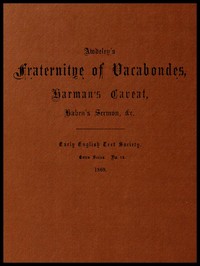
It may be disputed whether this printer’s name were really Sampson, or Awdeley: he was made free of the Stationers’ Company as Sampson, and so he is most frequently termed towards the commencement of the Register; but he certainly wrote and printed his name Awdeley or Awdelay; now and then it stands in the Register ‘Sampson Awdeley.’ It is the more important to settle the point, because . . . he was not only a printer, but a versifier,[2] and ought to have been included by Ritson in his Bibliographica Poetica. (Registers of the Stationers’ Company, A.D. 1848, vol. i. p. 23.)
These verses of Awdeley’s, or Sampson’s, no doubt led to his ‘small bréefe’ being entered in the Stationers’ Register as a ‘ballett’:
“1560–1. Rd. of John Sampson, for his lycense for pryntinge of a ballett called the description of vakaboundes . . . . iiij^d.
“[This entry seems to refer to an early edition of a very curious work, printed again by Sampson, alias Awdeley, in 1565, when it bore the following title, ‘The fraternitie of vacabondes, as well of rufling vacabones as of beggerly, [3]†as well of women as of men, †and as well of gyrles as of boyes, with their proper names and qualityes. Also the xxv. orders of knaves, otherwise called a quartten of knawes. Confirmed this yere by Cocke Lorel.’ The edition without date mentioned by Dibdin (iv. 564) may have been that of the entry. Another impression by Awdeley, dated 1575 [which we reprint] is reviewed in the British Bibliographer, ii. 12, where it is asserted (as is very probable, though we are without distinct evidence of the fact) that the printer was the compiler of the book, and he certainly introduces it by three six-line stanzas. If this work came out originally in 1561, according to the entry, there is no doubt that it was the precursor of a very singular series of tracts on the same subject, which will be noticed in their proper places.]”—J. P. Collier, Registers, i. 42.
[Footnote 2: See the back of his title-page, p. 2, below.]
[Footnote 3: †–† as well and and as well not in the title of the 1575 edition.]
As above said, I take Harman’s ‘fewe yeares’—in 1566 or 7—to point to the 1561 edition of Awdeley, and not the 1565 ed. And as to Awdeley’s authorship,—what can be more express than his own words, {iii} p. 2, below, that what the Vagabond caught at a Session confest as to ‘both names and states of most and least of this their Vacabondes brotherhood,’ that,—‘at the request of a worshipful man, I [‘The Printer,’ that is, John Awdeley] have set it forth as well as I can.’
But if a doubt on Awdeley’s priority to Harman exists in any reader’s mind, let him consider this second reference by Harman to Awdeley (p. 60, below), not noticed by the bibliographers: “For-as-much as these two names, a Iarkeman and a Patrico, bée in the old briefe of vacabonds, and set forth as two kyndes of euil doers, you shall vnderstande that a Iarkeman hath his name of a Iarke, which is a seale in their Language, as one should make writinges and set seales for lycences and pasporte,” and then turn to Awdeley’s Fraternitye of Vacabondes, and there see, at page 5, below:
¶ A IACK MAN.
A Iackeman is he that can write and reade, and sometime speake latin. He vseth to make counterfaite licences which they call Gybes, and sets to Seales, in their language called Iarkes. (See also ‘A Whipiacke,’ p. 4.)
Let the reader then compare Harman’s own description of a Patrico, p. 60, with that in ‘the old Briefe of Vacabonds,’ Awdeley, p. 6:
Awdeley. Harman. ¶ A PATRIARKE CO. there is a PATRICO . . . A Patriarke Co doth make mariages, whiche in their language is a & that is _vntill death priest, that should make depart the maried folke. mariages tyll death dyd depart_.
And surely no doubt on the point will remain in his mind, though, if needed, a few more confirmations could be got, as
Awdeley (p. 4). Harman (p. 44). ¶ A PALLIARD. ¶ A Pallyard. A Palliard is he that goeth in a These Palliardes . . go with patched patched cloke, and hys Doxy clokes, and haue their Morts with goeth in like apparell. them.
We may conclude, then, certainly, that Awdeley did not plagiarize Harman; and probably, that he first published his Fraternitye in 1561. The tract is a mere sketch, as compared with Harman’s Caueat, though in its descriptions (p. 6–11) of ‘A Curtesy Man,’ {iv} ‘A Cheatour or Fingerer,’ and ‘A Ring-Faller’ (one of whom tried his tricks on me in Gower-street about ten days ago), it gives as full a picture as Harman does of the general run of his characters. The edition of 1575 being the only one accessible to us, our trusty Oxford copier, Mr George Parker, has read the proofs with the copy in the Bodleian.
Let no one bring a charge of plagiarizing Awdeley, against Harman, for the latter, as has been shown, referred fairly to Awdeley’s ‘_small breefe_’ or ‘_old briefe of vacabonds_’ and wrote his own “bolde Beggars booke” (p. 91) from his own long experience with them.
Harman’s Caueat is too well-known and widely valued a book to need description or eulogy here. It is the standard work on its subject,—‘these rowsey, ragged, rabblement of rakehelles’ (p. 19)—and has been largely plundered by divers literary cadgers. No copy of the first edition seems to be known to bibliographers. It was published in 1566 or 1567,—probably the latter year,[4]—and must (I conclude) have contained less than the second, as in that’s ‘Harman to the Reader,’ p. 28, below, he says ‘well good reader, I meane not to be tedyous vnto the, but haue added fyue or sixe more tales, because some of them weare doune whyle my booke was fyrste in the presse.’ He speaks again of his first edition at p. 44, below, ‘I had the best geldinge stolen oute of my pasture, that I had amongst others, whyle this boke was first a printynge;’ and also at p. 51, below, ‘Apon Alhol enday in the morning last anno domini 1566, or my booke was halfe printed, I meane the first impression.’ All Hallows’ or All Saints’ Day is November 1.
[Footnote 4: Compare the anecdote, p. 66, 68, ‘the last sommer, Anno Domini, 1566.’]
The edition called the second[5], also bearing date in 1567, is known to us in two states, the latter of which I have called the third edition. The first state of the second edition is shown by the Bodleian copy, which is ‘Augmented and inlarged by the fyrst author here of,’ and has, besides smaller differences specified in the footnotes in our pages, this great difference, that the arrangement of ‘The Names of {v} the Vpright Men, Roges, and Pallyards’ is not alphabetical, by the first letter of the Christian names, as in the second state of the second edition (which I call the third edition), but higgledy-piggledy, or, at least, without attention to the succession of initials either of Christian or Sur-names, thus, though in three columns:
¶ VPRIGHT MEN.
Richard Brymmysh. John Myllar. Wel arayd Richard. John Walchman. Wyllia_m_ Chamborne. Bryan Medcalfe. Robert Gerse. Gryffen. Richard Barton. John Braye. Thomas Cutter. Dowzabell skylfull in fence. [&c.]
¶ ROGES.
Harry Walles with the little mouth. John Waren. Richard Brewton. Thomas Paske. George Belbarby. Humfrey Warde. Lytle Robyn. Lytle Dycke. Richard Iones. Lambart Rose. Harry Mason. Thomas Smithe with the skal skyn. [&c.]
¶ PALLYARDS.
Nycholas Newton carieth a fayned lycence. Bashforde. Robart Lackley. Wylliam Thomas. Edward Heyward, hath his Morte following hym Whiche fayneth y^e crank. Preston. Robart Canloke. [&c.]
This alone settles the priority of the Bodley edition, as no printer, having an index alphabetical, would go and muddle it all again, even for a lark. Moreover, the other collations confirm this priority. The colophon of the Bodley edition is dated A. D. 1567, ‘the eight of January;’ and therefore A. D. 1567–8.
[Footnote 5: ‘now at this seconde Impression,’ p. 27; ‘Whyle this second Impression was in printinge,’ p. 87.]
The second state of the second edition—which state I call the third edition—is shown by the copy which Mr Henry Huth has, with his never-failing generosity, lent us to copy and print from. It omits ‘the eight of January,’ from the colophon, and has ‘Anno Domini 1567’ only. Like the 2nd edition (or 2 A), this 3rd edition (or 2 B) has the statement on p. 87, below: ‘Whyle this second {vi} Impression was in printinge, it fortuned that Nycholas Blunte, who called hym selfe Nycholan Gennyns, a counterefet Cranke, that is spoken of in this booke, was fonde begging in the whyte fryers on Newe yeares day last past, Anno domini .1567, and commytted vnto a offescer, who caried hym vnto the depetye of the ward, which co_m_mytted hym vnto the counter;’ and this brings both the 2nd and 3rd editions (or 2 A and 2 B) to the year 1568, modern style. The 4th edition, so far as I know, was published in 1573, and was reprinted by Machell Stace (says Bohn’s Lowndes) in 1814. From that reprint Mr W. M. Wood has made a collation of words, not letters, for us with the 3rd edition. The chief difference of the 4th edition is its extension of the story of the ‘dyssembling Cranke,’ Nycholas Genings, and ‘the Printar of this booke’ Wylliam Gryffith (p. 53–6, below), which extension is given in the footnotes to pages 56 and 57 of our edition. We were obliged to reprint this from Stace’s reprint of 1814, as our searchers could not find a copy of the 4th edition of 1573 in either the British Museum, the Bodleian, or the Cambridge University Library.
Thus much about our present edition. I now hark back to the first, and the piracies of it or the later editions, mentioned in Mr J. P. Collier’s Registers of the Stationers’ Company, i. 155–6, 166.
“1566–7 Rd. of William Greffeth, for his lycense for printinge of a boke intituled a Caviat for commen Corsetors, vulgarly called Vagabons, by Thomas Harman . . . iiij^d.
“[No edition of Harman’s ‘Caveat or Warning for common Cursetors,’ of the date of 1566, is known, although it is erroneously mentioned in the introductory matter to the reprint in 1814, from H. Middleton’s impression of 1573. It was the forerunner of various later works of the same kind, some of which were plundered from it without acknowledgment, and attributed to the celebrated Robert Greene. Copies of two editions in 1567, by Griffith, are extant, and, in all probability, it was the first time it appeared in print: Griffith entered it at Stationers’ Hall, as above, in 1566, in order that he might publish it in 1567. Harman’s work was preceded by several ballads relating to vagabonds, the earliest of which is entered on p. 42 [Awdeley, p. ii. above]. On a subsequent page (166) is inserted a curious entry regarding ‘the boke of Rogges,’ or Rogues.]
“1566–7. For Takynge of Fynes as foloweth. Rd. of Henry {vii} Bynnyman, for his fyne for undermy[n]dinge and procurynge, as moche as in hym ded lye, a Copye from wylliam greffeth, called the boke of Rogges . . . iij^s.
“[This was certainly Harman’s ‘Caveat or Warning for Common Cursetors’; and here we see Bynneman fined for endeavouring to undermine Griffith by procuring the copy of the work, in order that Bynneman might print and publish it instead of Griffith, his rival in business. The next item may show that Gerard Dewes had also printed the book, no doubt without license, but the memorandum was crossed out in the register.]