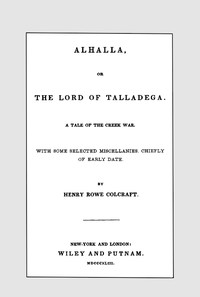
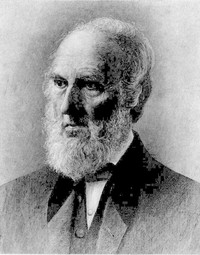
HENRY ROWE COLCRAFT.
New-York and London: Wiley and Putnam. MDCCCXLIII.
Entered according to Act of Congress, in the year 1843, by Henry Rowe Colcraft, in the Clerk’s Office of the District Court of the Southern District of New-York.
John F. Trow, Printer, 33 Ann-street.
TO WILLIAM CULLEN BRYANT, ESQ. OF NEW-YORK.
SIR:—Whatever may be the particular estimate set upon the intellectual character of the American aborigines, or the decision had on the perplexing question of their remote origin, or their actual and varying condition, few will dispute the large share of interest which they have in the public mind. And it is a species of interest which, I think we shall perceive, will be found to assume a higher and more imaginative cast, connected with the advancing state of letters and the fine arts, as we recede from the historical era, when these tribes were confessedly the lords and rulers of the land.
Their name and semblance are, in truth, infiltrated, if I may use a chemical phrase, into the very elements of the American landscape, which can hardly ever be contemplated without bringing out from the latent depths of the imagination, the image of the lithe Indian, with his Robin Hood arms and his picturesque costume. The policy which an enlightened government and people ought to pursue towards them, at all times, is a question that chiefly concerns the statesman and the philanthropist. But there are a hundred subordinate questions which come home for decision to the bosoms of all readers and thinkers, travellers and writers, to whom the race itself, viewed as a broken link in the ethnological chain, is a fruitful theme, both for retrospection and for actual observation. I have indeed, myself, participated largely in this field of observation, and may with truth affirm, that I return to society, after completing a period of but little short of four and twenty years in their territories.
How far the interest of these reminiscences of a noble race are realized, or communicated in the following tale, I cannot pretend to predict. But if I may rely on the American press, and it is an authority which, in this instance, is sustained abroad, there are few persons who are so well qualified to judge of success in this particular as yourself. This consideration would plead a justification for the liberty I take, of addressing the present sketch to you; but it is a liberty which I should hardly venture on, were I not,
Very truly yours, THE AUTHOR.
ADVERTISEMENT.
The treaty of Ghent, concluded in the autumn of 1814, terminated the contest then existing between the United States and Great Britain, although it was not promulgated in time to arrest one of the severest battles of the war. In this contest, as in all prior ones of a general character, subsequent to the settlement of European nations in the new world, the native tribes were deeply involved. Indeed, it was under the influence of an extraordinary prophetic delusion, that it may be said to have commenced, on their part, on the plains of Tippecanoe.
If the opening of this renewed struggle for supremacy by the aborigines in 1811, on the banks of the Wabash, had the effect to bring on the stage of action a noted warrior, in the person of Tecumthe,[1] who certainly has had few equals as a military and political leader, since the era of the prior stand made by the American tribes under Pontiac; its onward events, and its, to them, disastrous close, drew into prominent notice a scarcely less remarkable, and in some traits superior, character, under the name of Tuscaloosa, or the Black Warrior. This man, from his personal courage, skill, and activity, absorbed the full confidence of his tribe; and to him was, in effect, committed the cause of the Indian war in the south, until the date of his voluntary personal surrender to the American commander, after the power of his nation had been crushed in a series of sanguinary battles, and a price set upon his head.
It was the race of the Muscogees, who, under the popular name of Creeks, opposed the most strenuous opposition to the arms of the United States. This nation, in its numerous clans and subdivisions, were, at the period, strong in their numbers, and confident in their strength. These clans, influenced and misled by foreign counsel, were seated in their original vallies, forests, and fastnesses, in the remoter slopes and spurs of the Southern Alleghanies, stretching towards the gulf of Mexico and the Mississippi, but were found to have their chief point of military supply in Florida, then under the dominion of Spain, into which the operations of the war were eventually and necessarily transferred. It was in this manner that the Seminoles, who have since made so protracted a stand, first drew upon themselves the force of the American arms.
The present tale, in which fiction builds itself upon these general facts, turns upon the contest of the Muscogees, their exertions, their discomfitures, and their final fall. It opens at a distant point, many degrees towards the north, within a short period after the close of the Creek war. It occupies two days and two nights in its action. The idea here brought forward of uniting or intermingling the dramatic, with the narrative and descriptive, is believed to be well adapted to topics of this character, in which the natural bent of the natives for declamation and mystic romance may be indulged, while the time of the action, it is conceived, may be thereby curtailed, and verbal description retrenched. The measure is thought to be not ill adapted to the Indian mode of enunciation. Nothing is more characteristic of their harangues and public speeches, than that vehement, yet broken and continued strain of utterance, which would be subject to the charge of monotony, were it not varied by an extraordinary compass in the stress of voice, broken by the repetition of high and low accent, and often terminated with an exclamatory vigor, which is sometimes startling. It is not the less in accordance with these traits, that nearly every initial syllable of the measure chosen, is under accent. This at least may be affirmed, that it imparts a movement to the narrative, which, at the same time that it obviates languor, favors that repetitious rhythm, or pseudo-parallelism, which so strongly marks their highly compound lexicography.
Of the theme itself, nothing further is requisite to be said. The tale was written, as it now stands, in 1826, with a few exceptions of earlier date; and it may be added, that it was among the agremens of the writer’s seclusion, while he was living in a public capacity, within the impressive scenes, and among the manly tribes, in the lake region described. That its publication should have been deferred until the author had seen cause to resume the original orthography of the initial syllable of his patronymic name, may render it proper further to add, in this connection, that the change from School, and resumption of Col, in the adjective syllable of the name, is in strict conformity with family tradition, supported by recent observation in England. In the latter country, however, the name is uniformly written Cal, however it may be pronounced.
[1] A name inveterately recorded in our annals, under the false orthography of Tecumseh—which is not true Shawanoe.
INTRODUCTORY STANZAS.
Stretched on his couch, the Indian warrior lay, His bow and quiver prostrate at his side, Revolving all his fate in still dismay, Dominion lost, skill baffled, power defied. “Shades of my fathers!” thus his reverie ran, “And shall the Red Man thus, in clouds decline, With no memorial of his name or clan, Or only left to point the poet’s line, And tell to other years, the tale of his decline?”
“Oh, is it thus, the noble woodswise race, Shall steal away to an unhonored tomb, Who once were lords of the ascendant chase, And swept the forests in their pristine bloom? Brave were their hearts, and strong in sinewy strength They drew the shaft that fell’d the stately deer, Or spread the craven foeman at his length, And triumphed in the battle’s wild career, A wanderer of the woods—lord of the bow and spear.”
“Ah tell me, Spirit of the Golden West! Say, is it want of knowledge dooms my race? Or the wild passions of an untamed breast, That leaves nor peace nor virtue there a place? Can raging tumults of the mortal soul Prejudge its fate, and lead the wayward mind Through seas of want and poverty to roll, Till in a gloom of fixed despair it find Life’s path without a friend, and even death unkind?”
“Doth human rectitude, in mind and heart, The inward purposes of right and wrong In human acts—so great a boon impart, Or lead, by their neglect, to thraldom strong? And can it be, ye messengers of air! Who know the great high Spirit’s sov’reign will, So vast a detriment he can prepare For those who follow nature’s dictates still, And worship Manitoes on every breezy hill?”
“’Tis wondrous all, and yet there are, I ween, Some inward inklings of the Indian soul That whisper to his mind of things unclean, That taint his rites, and all his life control, Leading the mind—whenever he would do An evil act, or e’en the purpose form, To that High Excellence beyond the view, Who guides the sun and regulates the storm, Dispensing winter winds, or summer breezes warm.”
“And is this conscience? So the white man tells, Pointing to letters as the star-light kind, That man’s own heart to man himself reveals, And warms and renovates the wandering mind, Impels the hand to drop the bloody blade, And seek support from art’s more kindly cares, Where genial fields invite the plough and spade, And industry her golden wreath prepares, And peace and joy and health, the household circle shares.”
“But why—and here my doubts and fears arise— Why are kind precepts of such angel forms All bleared by acts that sunder friendship’s ties, And overcast our atmosphere with storms; Our lands despoiled by arts, we know not how, Erst in the solemn council we convene, But ere we note the hour, the white man’s plough, Driven reckless through each quiet hamlet scene, While steel-armed horsemen, stand as guards between?”
“And whence—if we must acts by precepts try— Whence all the new-found ills that mar our life, The liquid fire of distillation high, That whelms our bands in most unseemly strife, And oft our maddening blood, unruled before, Stains with its purple tide our utmost lands? Is this benignly meant? say, ye who teach— Or be there few that aim to overreach? Ah, do not outward acts most eloquently preach?”
Such is the race, whose deeds of scaith and strife, The muse essays in numbers to review, In that dark hour of opening peril rife, When late to arms the Southern war chiefs flew, Albeit, misguided in their warlike ires, By foreign counsels cast with cruel ken, And war, through all their borders, lit his fires, Transferring ruin to the peaceful glen, And woe to many a band of noble hunter men.
ALHALLA, OR THE LORD OF TALLADEGA.
CANTO I.
TRADITIONARY GLEAMS OF THE CREATION. THE COUNCIL.