Public-domain ebook
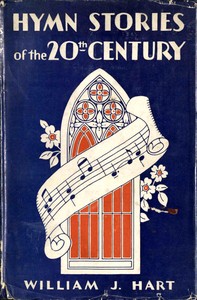
Hymn Stories of the Twentieth Century
Language: en522 downloads on Project Gutenberg
Subjects
In: Music·Religion/Spirituality
Public-domain ebook sourced from Project Gutenberg #56479.
Public-domain ebook
Language: en522 downloads on Project Gutenberg
Subjects
In: Music·Religion/Spirituality
Public-domain ebook sourced from Project Gutenberg #56479.
The opening · free to read
The community Christmas Tree at Washington in 1946 afforded a pleasant occasion when it was illuminated. The scene was outlined for, probably, millions of listeners in all parts of the country. The nation was enjoying an unusually happy season, for though World War II had ended more than a year before, many of the nation's sons and daughters who had taken a part in the terrific struggle had only recently returned to their homes. Wartime restrictions had made a tree impossible for a few years; and so this lighting of the tree at the capital was an enjoyable feature, and Washington, apparently, made the most of it. The evening was fair. The crowds were in attendance, and President Truman delivered an address.
The United States Marine Band played, of course, and the school children, in festive mood, sang, as well as others. The tree was ablaze with lights.
The ceremonies were announced to close with the playing of "The Star-Spangled Banner" by the band, and the musicians began to play. Soon there came over the radio the humming of many voices, then the people began to sing as the band played. Gradually the volume of voices increased. And before the music ceased it sounded as though a mighty chorus expressed their pent-up feelings in the happy strains:
"Oh, say! does that star-spangled banner still wave O'er the land of the free and the home of the brave?"
The joy of freedom was in their hearts and voices at that happy and memorable moment. Band and voices made mighty and glorious music for the many who sat in their homes and listened to the convenient radio.
She was lonesome as she sat in the small parsonage. Her preacher husband had entered the army as a chaplain in World War II, and this little woman, like many others of that period, had several problems to solve. A family of small children had to be looked after. Furthermore, being a lay preacher, she had been asked to care for her husband's church during the period of his service with the armed forces of the United States. Household help was almost impossible to secure; but, with the aid of a high school girl, mostly, she cared for the home, with its three small children, and also the church.
This little woman (for she was really small physically) was a trained musician. She could both play and sing, if need be, as well as preach. Natural was it, therefore, that she should turn to her hymnal as well as her Bible for needed strength of soul. She found it in a comparatively new hymn. Its prayerful spirit expressed the yearning desire of her soul:
"Come! Peace of God, and dwell again on earth, Come, with the calm that hailed Thy Prince's birth, Come, with the healing of Thy gentle touch, Come, Peace of God, that this world needs so much."
She asked to have it sung when I led a devotional service. Then I later wrote her, asking: "What particular association has this hymn with your life?" Her answer was as follows: "It is a favorite hymn with me, partly because of the unusual and beautiful harmony to be found in the music, and partly because the words are my own prayer for the world, and also for myself, now that my husband is serving as a chaplain."
Seeking information concerning the hymn itself, I turned to the informing work of Dr. McCutchen. There I learned that it "was written about 1928, when there was much talk about the peace of the world and a great desire for it amid the unrest of the nations." The author, Miss May Rowland, submitted it in manuscript to the commission preparing the new hymnal of The Methodist Church, "and its inclusion in this book (1935) marked its first publication."
The author of the hymn, and also the composer of the tune ("Pax"), are both residents of England, and each is a prize-winner. When The Hymn Society of America issued an appeal for a "Hymn for Airmen," though there were more than twelve hundred competitors from all parts of the world, Miss Rowland won. Musicians were then invited to furnish a musical setting for the same. This contest was also world-wide, and Miss Lily Rendle was the winner. This was in 1928; and both women were greatly surprised to learn that they each lived in Bournemouth within a mile of each other, though they were born in different parts of the country. "Since that time their artistic association has been close." One of their beautiful joint productions is this:
"The day is slowly wending Toward its silent ending, But 'mid its light declining The evening star is shining: O Father, while we sleep, Thy children keep!"
World War II ended suddenly and dramatically. Soldiers were returning home in large numbers by the latter part of 1945. "Will Daddy be home for Christmas?" the chaplain's children began to ask. "We hope so," was the cheery reply of the anticipating woman. "Perhaps he'll even return for Thanksgiving," she added.
One day early in November Chaplain Donald M. Cobb, of the United States Army, appeared at the parsonage in the little railroad center at Richland, New York. What an unspeakably happy moment for him, his wife, and the three growing children! Thanksgiving and Christmas would both be spent at home. Now a manly voice could blend with the voices of his wife and the growing girls, as that night the family circle gathered around the piano and sang:
"Come! Blessed Peace, as when, in hush of eve, God's benediction falls on souls who grieve; As shines a star when weary day departs, Come! Peace of God, and rule within our hearts."
The annual picnic in many of our American Sunday Schools has some features in common with the annual tea treat in the program of the village Sunday Schools in England. The latter, however, has some more spectacular features, such as the procession through the village streets headed, most likely, by a band as well as the minister and the superintendent. Whit-Monday is a favored time in many sections of the country for this eagerly anticipated event.
For such a day as this a young curate in Horbury, a Yorkshire village, was asked to select a hymn to be sung for the Whit-Monday occasion. He thought of a good marching tune, but he did not like the words. So he sat up late one night, composed his own song, and it was sung the next day for the first time. That was in 1864; and it was published in The Church Times (October 15) that same year as a "Hymn for Procession with Cross and Banners":
"Onward, Christian soldiers! Marching as to war, With the cross of Jesus Going on before. Christ, the royal Master, Leads against the foe; Forward into battle, See His banners go!"
This hymn rates high both in the United States and in England. St. Gertrude is ideally associated with the song. This tune came from Sir Arthur Sullivan; but someone has sagely remarked, "It took Baring-Gould to inspire Sir Arthur." "As a hymn of inspiration it has no superior," said Dr. E. S. Lorenz. More than half a century ago Dr. Charles S. Robinson made this illuminating comment: "It meets an American ideal, mechanically speaking, in that it is simple, rhythmical, lyric, and has a refrain at the end of each stanza."
The little folks like to sing this song whenever they have the opportunity, and this is one of the hymns they often learn before they can read. "It is fundamentally a Sunday School song; but it has grown up and is now sung many more times in the congregation than in the Sunday school."
Gloriously inspiring is it to hear a great company of people of all ages sing:
"Crown and thrones may perish, Kingdoms rise and wane, But the Church of Jesus Constant will remain."
Sabine Baring-Gould, the author (1834-1924) a graduate of Cambridge University, was a man of unusual versatility. Some of his experiences were exceptional. He had means at his disposal, and spent considerable time in his youth in France and Germany. Writing extensively, "it is said that he has more book titles listed in the literary catalogue of the British Museum than any other writer of his times." Various parishes were served by him until 1881. He then exercised his rights "as squire of the estate in Lew Trenchard, Devon," which he inherited from his father, and appointed himself as rector.
This historic incident has been preserved for us by Dr. E. S. Lorenz: "It had been carefully arranged by the Executive Committee of the World's Sunday School Convention, held at Washington, D. C., in 1910, that the hymn 'Onward, Christian Soldiers,' should be sung in Sunday Schools in every part of the world on Sunday, May 22, of that year. For this purpose the hymn was translated and printed in more than one hundred languages and dialects. What a magnificent illustration of the solidarity of the Christian Church in a progressive, aggressive attitude!"
"Before going to our watch-night services many of us heard Sir Harry Lauder singing his old favorite, 'Keep right on to the end of the road,' from 'Though the way be long, let your heart be strong,'" wrote a woman at the beginning of 1947. She was thus reminded that though we take a long look backward at the close of a year, we are also disposed to take a forward look when the New Year dawns.
Then the woman went to the watch-night service at the church. Soon she found herself singing with the others the hymn written for this occasion by Charles Wesley:
"Come, let us anew our journey pursue, Roll round with the year, And never stand still till the Master appear. His adorable will let us gladly fulfill, And our talents improve, By the patience of hope, and the labor of love."
Returning home, she confessed that she found herself with the feeling that the Scotch minstrel and the English hymn writer each had an appropriate message for the human spirit.
"That hymn will be sung when everything else about you is forgotten," the great pulpit orator of Brooklyn, Dr. S. Parkes Cadman, once remarked to the author of the vigorous hymn which both clergymen and laymen sang together on that responsible day.
"Every stanza has at least one exclamation point," remarked Dr. Charles A. Boyd, when he called attention to this peculiar feature of the hymn written by Dr. William Pierson Merrill. In fact, out of the four stanzas in the copy now in front of the writer, two of these have two exclamation points each. The vivid style of this hymn, therefore, is an emphatic call for speedy action. The hymn was written to incite men to "do something," and to do it without delay. Hence the call:
"Give heart and mind and soul and strength To serve the King of kings."
This hymn was written for a definite purpose and a particular occasion. It came to us early in the twentieth century when the Brotherhood movement was one of large proportions in some of the great denominations in the United States; and the large conventions which were held in vital centers of the country were scenes of tremendous enthusiasm. During that period Nolan R. Best, then editor of The Continent, remarked to Dr. Merrill that there was need of a Brotherhood hymn. The suggestion lingered in the mind of the latter. About the same time (1911) Dr. Merrill read an article by Gerald Stanley Lee on "The Church of Strong Men." "I was on one of the Lake Michigan steamers," Dr. R. G. McCutchen quotes him as saying, "going back to Chicago for a Sunday at my own church, when suddenly this hymn came up, almost without conscious thought or effort."
The book keeps going
Reading is free forever. Sign up and watch scenes appear while you read.



Scenes Storieta drew for other classics.
New illustrated classics
Once or twice a month: the latest books to get full character casts, scene art, and free comic editions. No account needed.