THE blackened stumps had been left—perhaps more easily to identify the little clearing about the grave. From the ravine below, where the stage passed, they were still visible, but the two-inch headboard, weather-beaten by a year of sun and rain, was getting lost in a growth of bushes. When pointed out by the driver as marking the “last hangout of Blazer Sam,” who had “died with his boots on, and had two cuss-words in his epitaph,” it could be discerned now with difficulty and there were travelers, men mostly, who prevailed upon the somewhat garrulous official to “let the horses blow a little while” they scaled the mountain for a closer view. The epitaph itself was worth the climb.
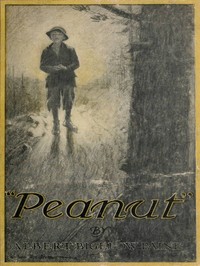
A few of those who had made the steep ascent for that literary treat, and to pay their respects to the grave of the notorious desperado, highwayman, and general outlaw, had seen something dart away into the bushes at their approach. As a rule, they had been too far off to tell whether it was a coyote, a jack-rabbit, or a boy. Those who had obtained the closer view usually agreed that it was a boy—a very thin boy of about ten, with pale hair and no head-covering.
The stage-driver in due time acquired information. Those who had said it was a boy were correct. When Blazer Sam had made his final exit in the abrupt manner noted, and so taken his boots with him, he had left behind the Rose of Texas, acquired long before in a poker game, and a little waif known as Peanut, picked up like a stray kitten during one of the Blazer’s devious wanderings. The name Peanut might have come from the color of his hair, or from his small size and value. The driver did not know. He had heard that the boy had been kindly treated by both the Blazer and the Rose, and with the latter still occupied Sam’s little hut in the woods above the clearing. The waif probably came out into the opening to see the stage pass. Then again he might be “kinder lonesome for Sam.”
The driver was right in at least one of these conjectures. Peanut was indeed “lonesome for Sam.” He could remember very little preceding the day six years before when Sam had brought him home to be company for the Rose, during absences that had grown ever more prolonged as the years passed and the outlaw’s field of labor had been found farther and yet farther away from his cabin on the hillside. What Peanut did remember was that he never had been hungry since that day. Also, the times when Sam had come home. For whatever had been the source of Sam’s gains, he had provided well for the Rose; and if, as was said, the hand of every man was against him and his hand against every man you could not have guessed it to see the small, lean hand of Peanut locked closely in his own, and the two wandering over the mountain together in those days that were now no more and would never more return. There remained to Peanut only their memory and the barren comfort of a grave and an epitaph.
Yet these were much to the lonely child. When he had pushed through the bushes to the grave he felt close to Sam, while the vigor of the epitaph, which he could read, because this much the Rose had taught him, was somehow satisfying. The last line afforded him special comfort. It assured him that no one would ever dare to take Sam away.
It did not occur to him that there was anything objectionable in the lines. He did not know that epitaphs are not so true, as a rule; while as for the emphasis, it was of the sort he knew best. That he did not use those words himself was only for the same reason that he did not chew tobacco yet, or drink whisky. He had been assured by the Rose that these luxuries were not for little boys, and he had been willing to wait. He was glad, however, that Sam, who had indulged liberally in the good things of life, could still have the best on his tombstone.
Portions of the inscription puzzled him. He did not know that there had been a price on the outlaw’s head, and he wondered why the “greaser,” referred to in line three, should want to kill Sam. Neither did he realize that line two doubtless alluded to the Blazer’s slight valuation of life in general, rather than to any disregard of his own particular existence. Peanut failed to understand why it was that Sam had not cared for life when by living he could come home now and then and show him the trout brook, and make whistles for him, and visit the eagle’s nest in the cliff. Why, once they had even found a cave, and in it a shot and dying mother bear, with two little bears, that were now big bears and still came to the cabin to be fed. When it rained they had sometimes run for this cave, to build a fire at the mouth of it and to lie there and watch the blaze and talk and play with the bears until the rain was over. What was the reason, then, that Sam had not cared to live and have all these things when he, Peanut, had cared for them so much?
He cared for them still. He could find his way to the brook and the eagle’s nest, and to the cave where the bears were always glad to see him, especially when he brought food. The innumerable squirrels and birds and other wood-folk were his own; yet from them all he turned each day to Sam’s grave, there to live over again those other days when Sam had taught him the lore and kinship of the mountains, and when, hand in hand, they had pushed through vines and leaves to visit the forest people together.
Often when it was bright and warm he stayed by the grave most of the day, and sometimes, with his face down in the grass, he would talk to Sam. When it stormed he crept under the bushes and felt a deep commiseration for the lonely mound with the rain pelting down upon it. There had been times in winter, when the snow was deepest, that he could not go at all. On these days he moped in the house with the Rose, who since Sam’s death had supplied their meager wants by doing mending and an occasional washing for the mining-camp below. She had grown rather fat and silent and spent most of her days playing solitaire and telling her own fortune with a greasy pack of cards, which diversions did not appeal to Peanut.
But in supposing that Peanut had come out into the clearing to see the stage pass, the driver had been wholly wrong. Sam had never cared for the stage or for people. In fact, he had rather avoided those things, Peanut thought, and he knew Sam always had good reasons for what he did. When the boy saw strangers climbing the steep hill to visit the grave he fled hastily into the bushes, where, lying hid, he watched to see that they did not carry anything away save perhaps an occasional walking-stick or a handful of goldenrod. When they laughed and talked loudly he was fiercely angry, and thought he understood why it was that Sam had preferred the society of the quiet wood-folk.
With those of his own age Peanut had had but one experience. Twice the Rose had prevailed upon him to go with her to the mining-camp, and on the last of these occasions a boy—the only one in the camp—had defrauded him of his best whistle and of such other valuables as had been upon his person at the time. He had received in exchange some yellow ore, which the boy had insisted was gold, but which the Rose declared to be slag, and worthless. It was his first experience with deception.
Peanut had refused to go to the camp again.
------------------------------------------------------------------------
Ii
ONE day in late August the stage stopped to let a woman climb the hill. Women visited the grave now and then, and Miss Cynthia Schofield, age thirty-four, a teacher in a Chicago public institution of learning, was just the one to improve such an opportunity. For Miss Schofield was progressive in the matter of acquiring knowledge. She spent each summer in some elemental region, of which she made numerous photographs and notes. These she used later in certain illustrated evening lectures called “In-gatherings,” given by Miss Schofield for the benefit of persons with fewer opportunities; also for the purpose of adding a trifle to her own modest income. She was “doing the mines” this year, and her present destination was the camp, two miles farther down. The desperado’s grave and history would make a picturesque addition to her collection.
The climb was harder than it appeared from below. Being the only passenger, the driver had told her to take her time, and more than once she leaned against a boulder to look down into the dark ravine made famous by some of Blazer’s earlier exploits. She recognized the artistic value of the fact that his last resting-place overlooked the scene of his former depredations. She must certainly bring this out well in her lecture, and as she toiled upward she was forming in her mind certain phrases, with a view to this result. Then she pushed gently between two small cedars into the opening where the grave was.
At first glance she saw only some bushes and fireweed about the blackened stumps, and the riotous mass of goldenrod which possessed one corner of the little clearing. Then just by the goldenrod she saw the grave, and paused, for, face down upon it, asleep, lay a meager barefoot boy with faded hair.
Miss Schofield was, first of all, the artist. She had anticipated nothing so rich in value as this, and with deft hands she adjusted the camera and secured the range. There came a sharp click, and the outlaw’s grave, the goldenrod, the fireweed, the black stumps, and the faded sleeping boy had been added to her store of choice in-gatherings.
There had been still another result. The snap of the shutter had brought the light figure to its feet, like some spry wood creature as suddenly disturbed. An instant more and he would have darted away into the bushes; only, Miss Schofield spoke just then, and with persuasiveness—the result of long pedagogical training.
“Don’t go! Oh, please don’t!” she pleaded, gently. “_Please_ wait. I want so much to speak to you.”
Peanut had no particular reason for being afraid of women. The only one he had studied at close range had been kind to him to the point of indulgence. There was something in the voice of this one that held him fast. The woman came a step closer. She seemed young and beautiful to Peanut.
“_Please_ tell me your name,” she said.
“Peanut.”
“Oh, that is what they call you, perhaps. Your real name, I mean.”
The boy made no reply at first to this comment. He seemed gathering something from the mists of memory.
“Sam told me that it used to be—longer than that,” he ventured at last, very slowly. “He told me once that it was Philip—Nutt, but he said P. was the same as Philip, and that he thought Peanut fit me better.”
Panic seemed about to return, as the result of this long speech, and once more it required the soothing diplomacy of Miss Schofield to detain him.
“How very nice,” she said. “And now won’t you please tell me where you live, and about Sam and the grave?”
Again Peanut hesitated. Then he pointed behind him.
“I live up there; and Sam, he—why he’s in the grave, and dam the man that moves his bones.”