Public-domain ebook
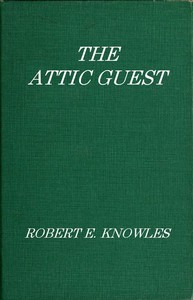
The Attic Guest: A Novel
English456 downloads on Project GutenbergDownload EPUB
Public-domain ebook sourced from Project Gutenberg #56675.
Public-domain ebook
English456 downloads on Project GutenbergDownload EPUB
Public-domain ebook sourced from Project Gutenberg #56675.
The opening · free to read
"That room in the third story is good enough for any elder," my mother was saying as I came into the library; "more than likely they'll send us a country elder anyhow, and he'll never know the difference--he'll think it's the spare room, I reckon."
I was only eighteen then, and I didn't care much where elders slept, or whether they slept at all or not. Besides, it was already nine o'clock, and I was going to a little party where "Tripping the light fantastic" was to be the order of the evening. By the way, I only found out the other day that Milton was the author of that fantastic toe phrase--and the news startled me about as much as if some one had told me Cromwell invented "Blind Man's Buff."
"Has Dinah got me buttoned right?" I asked, backing up to my Aunt Agnes. Aunt Agnes was my mother's sister. I can see her yet, her hands going up in an abstracted kind of way to correct one of Dinah's oversights; for she was still revolving the great question of the elder and the attic, the attic and the elder.
"You're all right now, honey," she said in a moment, giving me a gentle push away, her whole mind reverting to the subject of family concern.
"I'm sure," she went on in the same breath, "it's going to be an elder from the country. Mr. Furvell told me to wait after prayer-meeting last night; and he said the billeting committee sat till two in the morning trying to divide the ministers and elders as fairly as they could--and he thought we were going to get an elder from Pollocksville."
"Let us hear what Henry thinks about it," my mother suddenly interrupted, her face turned towards the door as she spoke. "Sit here, Henry," as she made room on the sofa for my uncle; "sister Agnes thinks it will be dreadful to send our delegate to the attic if he's to be a minister--but she doesn't mind a bit if he's an elder."
My uncle smiled as he took his place beside my mother. And the face that was turned in fondness upon his wife at the other side of the room had a look of kindly drollery. For uncle was the tenderest of men, and his countenance reflected the purity and gentleness of his heart. He was a gentleman of the old school, was uncle. His great-grandfather before him had been born in our quaint little Virginian town, and the gracious culture of a century and a half had not been for nothing. The mist of years lies between me and that April evening when we discussed the approaching Presbytery that was to honour our little town by convening in our midst, pondering our approaching guests as solemnly as though they had been envoys from a royal court; but I can still see the tall athletic form, not yet bowed with age--he was less than fifty--and the careless-fitting, becoming clothes that wrapped it in sober black, and the easy dignity of his poise as he held out his hands to the fire--above all, there rises clear before me the grave and noble face, strength and gentleness blending in the mobile mouth and aquiline nose, while the large gray eyes looked out with the loving simplicity of childhood upon the little circle that was so dear to him and to which he was so dear. Yet there was latent fire in those gentle eyes; when in complete repose, they looked out like two slumbering furnaces that needed only to be blown--and any one familiar with the best type of Southern gentlemen would have descried the old Virginian looking through them, the native courage, the inborn anger against meanness, the swift resentment of a wrong, the reverence of womanhood, the pride of family, that were such salient features of the old-time patrician of the South.
"What's your say on the subject, Uncle Henry?" my mother asked again, breaking the silence. For my uncle's gaze had wandered from his wife's face and was now fixed upon the fire. It was April, as I have said, but a generous flame was leaping on the hearth. So generous, indeed, that the back window whose tiny panes looked towards the west was open; this is a form of conflicting luxuries which only Southern folks indulge in.
"I just think the other way round," Uncle Henry finally responded; "different from Agnes, I mean," his eyes smiling as they met his wife's. "I'd send him to the attic if he's a preacher; a minister wouldn't be so apt to misunderstand, because they're trained to sleep anywhere at a moment's notice--and they know what it is to have to stow their own company away in every nook and corner. Besides, it's those same preachers that make heaps o' folk sleep sitting right bolt up in church. But an elder," Uncle Henry went on reflectively, "an elder kind o' wants to make the most of it when he's visitin'--it's more of an event to him, you see; they look on going to Presbytery as a kind of rehearsal for going to heaven."
"Then they ought to be glad to get the highest place," broke in my Aunt Agnes triumphantly, for she had a ready wit.
"Depends on how you get there," retorted Uncle Henry after a very brief but very busy pause; he had no mind to be worsted in an argument if he could help it. "Everything depends on how it's given to you. There's all the difference in the world between being lifted and being hoisted--I saw a fellow tossed by a bull one day out at Cap'n Lyon's farm; he got the highest place, all right, but he didn't seem to relish the promotion."
My mother, who was accustomed to act as umpire in these little contests, turned a humorous eye towards Aunt Agnes. The latter, we all knew, was fumbling frantically for some response which seemed to elude her; my mother's pose reminded me a little of the man who had held the watch the week before, down at Jacksonville, when two gentlemen of the ring had paid their respects to each other. I knew all about how they're counted out if they don't show up within a certain time; yet it isn't likely I'd have known anything about it if Mr. Furvell hadn't warned us from the pulpit that we mustn't read the account of the affair--he said the details were shocking. So I had to wait till Aunt Agnes was finished with the paper.
I really do not know how the argument concluded, for at this juncture a very sable face appeared suddenly at the door and a liquid voice announced: "Please, Miss Helen, Misteh Slocum's waitin' fo' yeh in de parluh."
I was ready for the intimation, for I had heard the old brass knocker muttering a minute or two before--and I was just at the age when I knew the different knocks of different gallants. And not a few of these latter were wont to lift that frowning brass face on our front door and let it fall again--the wonderful thing about it was, that the oftener they came the more gentle grew the knock--but this is the way with all knockers at all Southern homes that shelter comely maidens. And I am neither modest enough nor untruthful enough to deny that I deserved the adjective aforesaid--especially as this story may never see the light till my eyes give it back no more.
"I'm hoping he'll be a minister," I volunteered, as I turned a moment at the door.
"Why?" cried my mother.
"What for?" chimed my Aunt Agnes.
"Well," I answered, "elders pray too long--I went to sleep one night at worship when that elder from Hickory was here at the Synod. And he said I was a devout worshipper, don't you mind, when I kept kneeling after you all got up. I don't think that was very nice for a religious man to say," I averred, tugging at a reluctant glove.
"He wouldn't think so if he saw you now--starting for a dance," suggested my Aunt Agnes. "But you look mighty sweet, honey--though I don't believe you've got enough on for a chilly night like this. Be sure you have something round you when you're coming home."
"Mr. Slocum will see to that," assured Uncle Henry, his expression interpreting his words.
"Hush," said my mother chidingly; "the child doesn't know what you mean." Every word of that evening's conversation is vivid to me yet, as it well might be; and I have often wondered why my mother held such a sanguine view of my simplicity.
I don't remember much about the succeeding frivolities of that April evening. Sometimes I catch again a few fugitive snatches of the melody that inspired the mazy throng; I remember what I wore--it served long years of umbrageous usefulness as a lamp shade after I was through with it; and I think I danced nearly every dance, no foreboding of soberer days chastening the gladness. And I forgot all about the elder question, wondering no more where he might lay his devoted head. But before Mr. Frank Slocum bade me good-night as I disappeared within the heavy oaken door of my uncle's house, he unwittingly recalled the subject.
"You're expecting a visitor to-morrow, aren't you?" he said.
"Oh, yes," I answered, suddenly remembering. "Yes, we're going to have one of the men attending the Presbytery; I think it's to be an elder--and I'm afraid it's him for the attic," I concluded. It was half-past two and I was too tired to bother about grammar.
"I wasn't thinking about the Presbytery," returned Mr. Slocum, and he smiled in the moonlight. "Somebody else is coming, isn't he?"
Whereat I hope I blushed; it was the time for that mystic operation. For I knew he referred to Charlie, dear old Charlie, who made his pious pilgrimage once a month--and I was the shrine.
"Yes, he's coming," I said, toying with the knocker as I spoke.
"You don't seem as jubilant about it as you ought to be," ventured Mr. Frank.
"You don't know how I feel," said I; "maybe I'm jubilant inside."
"Then you shouldn't sigh," pursued my escort.
"I didn't know I sighed--but, even if I did, perhaps sighs are like dreams, and go by contraries," I returned, making the best stand I could. "A maiden's heart is an unknown sea," I affirmed, quoting from some distant poem.
"Besides," Frank went on, disdainful of all poetry, "if you really cared like you ought to, you wouldn't be out so late the night before; you'd be having your beauty sleep right now, just to be lovely when he came--or, at least, to be even lovelier," he amended; for Frank was a Southern gentleman.
"I never had it bad enough to go to bed over it," I admitted; "but he'll be here to-morrow--he'll be here to-morrow," I chanted, as ecstatically as I could. Yet I felt at the time that the words didn't ring much; it was a little like trying to peal a chime on a row of pillows. Then, before I knew it, I yawned, yawned brazenly into the face of the brass knocker on the door.
"Exactly!" said Frank, his hand moving to his hat, "that's just about the size of it--Miss Helen, you're a little idiot," and his honest eyes shone bright with their candour of affection.
"Sir!" said I, employing a splendid intonation. And I gave a little stamp on the stone step beneath me--all true Southern girls love to stamp. "Sir!" I repeated, "you forget yourself."
"But I don't forget you," Frank retorted swiftly, his face quivering a little; "though I wish I could, a little more. And I know you don't care anything about him, the way he thinks you do--or the way he wants you to. And God help him--and you too--if something doesn't happen; you have either gone too far, or not far enough, Miss Helen," he declared boldly, looking straight into my eyes in the moonlight. And I couldn't help gazing back, for his look and his words both had a kind of fascination for me; I reckon I knew they both were true. So I didn't get angry--only a lot of things, all connected with the past, rushed like a flood before me. But I will tell them all in another chapter. I had no mind to discuss them with Frank just then.
The book keeps going
Reading is free forever. Sign up and watch scenes appear while you read.



Scenes Storieta drew for other classics.
New illustrated classics
Once or twice a month: the latest books to get full character casts, scene art, and free comic editions. No account needed.