Public-domain ebook
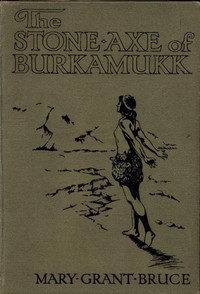
The Stone Axe of Burkamukk
Language: en387 downloads on Project Gutenberg
Subjects
In: Adventure·Novels·Mythology, Legends & Folklore
Public-domain ebook sourced from Project Gutenberg #56699.
Public-domain ebook
Language: en387 downloads on Project Gutenberg
Subjects
In: Adventure·Novels·Mythology, Legends & Folklore
Public-domain ebook sourced from Project Gutenberg #56699.
The opening · free to read
The camp lay calm and peaceful under the spring sunlight. Burkamukk, the chief, had chosen its place well: the wurleys were built in a green glade well shaded with blackwood and boobyalla trees, and with a soft thick carpet of grass, on which the black babies loved to roll. Not a hundred yards away flowed a wide creek; a creek so excellent that it fed a swamp a little farther on. The blacks loved to be near a swamp, for it was as good as a storehouse of food: the women used to go there for lily-pads and sedge-roots, and the men would spear eels in its muddy waters, while at times big flocks of duck settled on it, besides other water-fowl. Burkamukk was a very wise chief, and all his people were fat, and therefore contented.
As blacks count wealth, the people of Burkamukk were very well off. They had plenty of skin rugs, so that no one went cold, even in the winter nights; and the women had made them well, sewing them together with the sinews of animals, using for their needles the small bone of a kangaroo's hind-leg, ground to a fine point. It was hard work to sew these well, but the men used to take pains to get good skins, pegging them out with tea-tree spikes and dressing them with wood-ashes and fat, which they rubbed in until the skins were soft and supple; and so the women thought that the least they could do was to sew them in the very best way. Being particular about the rugs made the women particular about other things as well, and they had a far better outfit than could be found in most camps. Each woman had a good pitchi, a small wooden trough hollowed out of the soft wood of the bean-tree, in which food was kept. When the tribe went travelling the pitchi was as useful as a suit-case is to a white Australian girl; the lubras packed them with food, and carried them balanced on their heads, or slung to one hip by a plait of human hair, or a fur band; and sometimes a big pitchi was made by a proud father and beautifully carved with a stone knife, and used as a cradle for a fat black baby. Then the women used to weave baskets made of a strong kind of rush, ornamented with coloured patterns and fancy stitches, and each one had, as well, a bag made of the tough inner bark of the acacia tree, or sometimes of a messmate or stringy bark, in which she kept food, sticks and tinder for starting a fire, wattle-gum for cement, shells, tools, and all sorts of charms to keep off evil spirits. They had a queer kind of cooking-pot, in which they used to dissolve gum and manna. These pots were made out of the big rough lumps that grow out of old gum-trees, hollowed out by a chisel made of a kangaroo's thighbone. The women used to put gum and manna in these and place them near the fire, so that the water gradually heated without burning the wood. There was no pottery among the blacks, and so they could never boil food, but they contrived to make pleasant warm drinks in these wooden pots.
When it came to baking, however, the women of the tribe were well able to turn out toothsome roasts. Their ovens were holes in the ground, plastered with mud, and then filled with fire until the clay was very hot. When the temperature was right the embers were taken out, and the holes lined with wet grass. The food--flesh, fish, or roots--was packed in rough rush baskets and placed in the ovens, and covered with more wet grass, hot stones, gravel, and earth, until the holes were quite air-tight. The women liked to do this in the evening, so that the food cooked slowly all night; and often all the cooking was done in a few big ovens, and next morning each family came to remove its basket of food. And if you had come along breakfastless just as the steaming baskets were taken out, and had been asked to join in eating a plump young bandicoot or wallaby or a fat black fish--well, even though there were no plates or knives or forks, I do not think you would have grumbled at your meal.
The men of Burkamukk's tribe were well armed. Their boomerangs, spears and throwing-sticks were all of the best, and they had, in addition, knives made of splinters of flint or sharpened mussel-shell, lashed into handles. Some had skinning knives made of the long front teeth of the bandicoot, with the jaw left on for a handle; and they worked kangaroo bones into all kinds of tools. But Burkamukk himself had a wonderful weapon, the only one in all that district--a mighty axe. It was made of green stone, wedge-shaped, and sharply ground at one edge. This was grasped in the bend of a doubled piece of split sapling, and tightly bound round with kangaroo sinews; and the handle thus formed was additionally strengthened by being cemented to the head by a mixture of gum and shell lime. It was not a very easy matter to make that cement. First, mussel shells were burned to make the lime, and pounded in a hollow stone. Then wattle-gum was chewed for a long time and placed between sheets of green bark, which were laid in a shallow hole in the ground and covered with hot ashes until the gum was dissolved, when it was kneaded with the lime into a tough paste. The blacks would have been badly off without that cement, but not all of them would go to the trouble of making it as thoroughly as did the men of Burkamukk's tribe. All the best workmanship had gone to the manufacture of Burkamukk's axe, and the whole tribe was proud of it. Sometimes the chief would lend it to the best climbers among his young men, who used it to cut steps in the bark of trees when they wanted to climb in search of monkey-bears or 'possums; or he would let them use it to strip sheets of bark from the trees, to make their wurleys. Those to whom the axe was lent always showed their sense of the honour done them by making payment in kind--the fattest of the game caught, or a finely-woven rush mat, would be laid at the chief's door. If this had not been done Burkamukk would probably have looked wise next time some one had wished to borrow his axe, and would have remarked that he had work for it himself.
Even though he occasionally lent the axe, Burkamukk never let it go out of his sight. It was far too precious a possession for that. He, too, went hunting when the axe went, or watched it used to prise great strips of thick bark off the trees, and he probably worried the borrower very much by continually directing how it should be handled. Not that the young men would have taken any risks with it. It was the chief's axe, but its possession brought dignity upon the whole tribe. Other chiefs had axes, more or less excellent, but there was no weapon in all the countryside so famous as the axe of Burkamukk. I doubt whether the Kings of England have valued their Crown Jewels so highly as Burkamukk valued his stone treasure with the sapling handle. Certainly they cannot have found them half so useful.
On this spring afternoon Burkamukk was coming up from the swamp where he had been spearing eels. He had been very successful: Koronn, his wife, walked behind him carrying a dozen fine specimens, and thinking how good a supper she would be able to cook, and how delighted her little boy Tumbo would be; for of all things Tumbo loved to eat eel. Just at the edge of the camp Burkamukk stopped, frowning.
A hunting-party of young men had evidently just returned; they were the centre of a group in the middle of the camp, and still they were carrying their spears and throwing-sticks. They were talking loudly and gesticulating, and it was clear that those who listened to them were excited and distressed; there were anxious faces and the women were crying "Yakai!" (Alas!). The chief strode up to the group.
"What is the matter?" he asked.
The men turned, saluting him respectfully.
"We have fallen upon evil times, Chief," their leader answered. "Little game have we caught, and we have lost Kon-garn."
"Lost him! How?"
"There is a great and terrible beast in the country to which we went," answered Tullum, the young warrior. "The men of the friendly tribe we passed told us of him, but we thought they were joking with us, for it seemed a foolish tale, only fit to make women afraid. They told us of a great kangaroo they call Kuperee, larger than a dozen kangaroos and fiercer than any animal that walks on the earth; and they warned us not to go near his country."
"A kangaroo as large as a dozen!" said Burkamukk. "Ky! but I would like to see such a beast The whole tribe could feed on him."
"Ay, they might, if one had the luck to be able to kill him," said Tullum sorrowfully. "But a kangaroo of that size is no joke to encounter."
"What!" said Burkamukk. "Do you mean me to believe that there is truly such a kangaroo?"
"There is indeed," Tullum answered. "We also did not believe. We went on, thinking that the other tribe merely wished to keep us away from a good hunting-ground. We took no precautions, and we came upon him suddenly."
"And he was a big kangaroo, do you say?"
Tullum flung out his hands.
"There are no words to tell you of his bigness, O, Chief!" he said--and his voice shook with terror. "Never has such an animal been seen before. Black is he, and huge, and fierce; and when he saw us he roared and rushed upon us. There was no time to do battle: he was on us almost before one could fling a spear. Kon-garn was nearest, and he went down with one blow of the monster's foot, his head crushed. Me he struck at, but luckily for me I was almost out of his reach. Still, he touched me--see!" He moved aside his 'possum-skins, and showed long wounds, running from his shoulder to his wrist--wounds that looked as though they had been made by great claws.
Burkamukk looked at them closely.
"No small beast did that," he said. "You are lucky to be alive, Tullum."
"Ay," said Tullum briefly. "Indeed, I thought for a while that I was as dead as Kon-garn. But I managed to dodge behind a tree, and the bush was thick, so that by great good fortune I got away. Kuperee gave chase, but we all scattered, and luckily the one he chose to follow was Woma, who is the swiftest of us all; and Woma gave him the slip without much trouble, for Kuperee is so great that he cannot get through the trees quickly. So we came together again after a day and a night, and travelled home swiftly."
"And none of you went back to avenge Kon-garn?" the chief asked, sternly.
Tullum looked at him with a curious mixture of shame and defiance.
"Nay," he said. "None of us have ever been reckoned cowards--and yet we did not go back. An ordinary enemy would not have made us afraid, but there is something about Kuperee that turns the very heart to water. We hated ourselves--we hate ourselves still--for not going back. The blood of Kon-garn cries out to us for vengeance on his slayer, and in our sleep we see our comrade, with his head crushed by that terrible foot. And yet we could not turn. We have come home to you like frightened children, and shame is on our heads. We know not how to face Kon-garn's wife, who sits there and cries 'Yakai!' before her wurley."
Another of the warriors, Woma the Swift-footed, spoke up, with sullen anger in his voice.
The book keeps going
Reading is free forever. Sign up and watch scenes appear while you read.



Scenes Storieta drew for other classics.
New illustrated classics
Once or twice a month: the latest books to get full character casts, scene art, and free comic editions. No account needed.