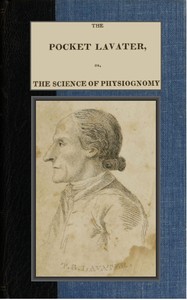
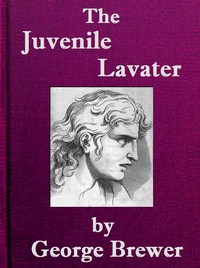
“The Pocket Lavater, or, the Science of Physiognomy. To which is added, An Inquiry into the Analogy existing between Brute and Human Physiognomy, from the Italian of Porta. Embellished with 14 Copperplate heads.”
IN CONFORMITY to the act of Congress of the United States, entitled, “An act for the encouragement of learning, by securing the copies of maps, charts, and books, to the authors and proprietors of such copies, during the times therein mentioned,” and also, to an act entitled, “An act, supplementary to an act, entitled, an act for the encouragement of learning, by securing the copies of maps, charts, and books, to the authors and proprietors of such copies, during the times therein mentioned, and extending the benefits thereof to the arts of designing, engraving and etching historical and other prints.”
THERON RUDD.
Clerk of the Southern District of New-York.
ADVERTISEMENT.
The public are here presented with a translation from the French of the “Pocket Lavater,” a work which has become highly popular in France, and which has run through successive and repeated editions.
The attention which the French have, of late, paid to Physiognomy, may be ascribed not only to the infatuating nature, and intrinsic excellence of that science, but, also, to adventitious circumstances. France, or, more properly, its metropolis, has, within a few years, become, as it were, the immense stage on which all the varieties of human aspect and action have been exhibited. Their painters, at present, employ the pencil, not on pieces of ancient history or mythological fiction, but in designating the various national physiognomies, costumes, and conformation of body, which Paris now presents, assembled from all Europe, and from some parts of Asia. The Physiognomist has there an ample scope for the study and enlargement of his Science: the Briton melancholy amidst success--the Frenchman happy amidst adversity--the phlegmatic German, the choleric Russian, the proud Spaniard, the vain Pole, and the grave and jealous Turk; these parading her streets and gardens, or thronging her Caffées, must present a group, whose motley and various character mocks both narrative and description. All of these are distinguished from each other by a difference of countenance, language, dress, habits, customs, and manners; yet the philosopher observes in all these but one being under different modifications.
This edition is enriched by an ingenious inquiry into the existing analogy between brute and human physiognomy, from the Italian of Porta, whose observations on national character, although written three centuries ago, are found correct at the present day.
The plates which accompany this work, are designed, and faithfully executed, after those which accompany the Paris edition.
The Publishers, in submitting this work to the public, will be influenced by its success to the publication of the “Female Lavater,” a work of established merit, and which forms a counterpart to the present volume.
PREFACE.
Nothing is more common than to hear the study of physiognomy condemned as being calculated to mislead men in their judgments of each other, and the impossibility of its being reduced to a science; yet, nothing is more universally prevalent, in all classes of society, than forming judgments from the appearances of the face. How often do we hear these observations--“He has an open countenance”--“His countenance is forbidding”--“That man has an honest face”--“His looks are enough for me”--“Rogue is depicted in his countenance,” “That bewitching eye”--“That stupid face,” and many other expressions of the kind. This proves that, although differences of opinion may be entertained respecting physiognomy, all men are, in the true signification of the term, physiognomists. We shall here proceed to point out some of its advantages.
Whether a more certain, more accurate, more extensive, and thereby, a more perfect knowledge of man, be, or be not profitable; whether it be, or be not, advantageous to gain a knowledge of internal qualities from external form and feature, is certainly a question deserving of inquiry.
It may be asked, Is knowledge, its extension and increase, of consequence to man? This question, it is presumed, can receive but one answer from all unprejudiced persons: for, as certainly as man is possessed of corporeal strength, so certain is it that to exercise strength is necessary. As certainly as he has the faculties, power, and will, to love, so certain is it that it is necessary he should love. Equally certain is it, that if man has the faculties, power, and will, to obtain wisdom, that he should exercise those faculties for the attainment of wisdom.
Mutual intercourse is the thing of most consequence to mankind, who are destined to live in society. The knowledge of man is the soul of this intercourse--that which imparts to it animation, pleasure, and profit. This knowledge is, in some degree, inseparable from, because necessary to, all men. And how shall we, with greater ease and certainty, acquire this knowledge than by the aid of physiognomy, understood in its most extensive sense, since, in so many of his actions, man is incomprehensible?
Physiognomy unites hearts, and forms the most durable, the most divine friendships; nor can friendship discover a more solid foundation than in the fair outlines and noble features of certain countenances.
Physiognomy is the very soul of wisdom, since it elevates the mutual pleasures of intercourse, and whispers to the heart when it is necessary to speak--when to be silent; when to forewarn--when to excite; when to console--when to reprehend.
But to enumerate all the advantages that are derived from the study of physiognomy would require a volume. We shall, therefore, conclude these prefatory remarks by adding testimonies, from the highest authorities, in favour of that science, which Lavater, in his essay, introduces in the following manner:
“To support the feeble among my readers, and to furnish the strong with such arguments as are most convenient to their disputes with the feeble, I shall produce witnesses, of more or less importance among the learned and wise, in the company of whom I shall deem it an honour to be despised. They will be few, and not conclusive; but, however, may to many appear of consequence, and be unexpected:
“The countenance of the wise sheweth wisdom, but the eyes of a fool are in the ends of the earth.”--PROV. xvii. 24.
“Though the wicked man constrain his countenance, the wise can distinctly discern his purpose.”--PROV. xxi. 29.
“The heart of man changeth his countenance, whether it be for good or evil; and a merry heart maketh a cheerful countenance.”--ECCL. xiii. 25.
“A man may be known by his look; and one that hath understanding, by his countenance, when thou meetest him.”--ECCL. xix. 29.
“We know that nothing passes in the soul which does not produce some change in the body; and particularly, that no desire, no act of willing, is exerted by the soul without some corresponding motion, at the same time, taking place in the body. All changes of the soul originate in the soul’s essence, and all changes in the body in the body’s essence. The body’s essence consists in the conformation of its members; therefore, the conformation of the body, according to its form, and the form of its constituent members, must correspond with the essence of the soul. In like manner must the varieties of the mind be displayed in the varieties of the body. Hence, the body must contain something in itself, and in its form, as well as in the form of its parts, by which an opinion may be deduced concerning the native qualities of the mind. I repeat, native qualities; for the question here does not concern those qualities derived from education, or by instructive conversation. Thus considered, the art of judging man by the form of his members, and of his whole body, usually called physiognomy, is well founded.
“The lines of the countenance constitute its expression; which expression is always true when the mind is free from constraint: these lines, therefore, must discover what the natural inclinations are, when seen in their true and native position.”--WOLF.
“What is the fairest countenance, disfigured by the hateful vices of lust, anger, falsehood, envy, avarice, pride, and discontent? What can external marks of decorum effect when an ignoble and insignificant mind is depicted in the countenance? The most certain means of rendering the face beautiful, is to beautify the mind, and to purify it from vice. He who would make his countenance intelligent must so first make his mind. He who would impart to the face its most fascinating charms, must store the mind with religion and virtue, which will diffuse over it every expression of sublime content.”--GILLERT.
“Where is the hand that shall grasp that which resides beneath the skull of man? Who shall approach the surface of that now tranquil, now tempestuous, abyss! Like as the Deity has ever been adored in sacred groves, so is the Lebanon, the Olympus of man, that seat of the secret power of the divinity, overshadowed. We shudder at contemplating the powers contained in so small a circumference, by which a world may be enlightened, or a world destroyed.
“Through those two inlets of soul, the eye and ear, how wonderful are the worlds of light and sound, the words and images that find entrance!
“How significant are the descending locks that shade this mountain, this seat of the gods! their luxuriance, their partition, their intermingling!
“The head is elevated upon the neck. Olympus resting upon an eminence in which are united freedom and strength, compression and elasticity, descriptive of the present and the future. The neck it is that expresses, not what man was originally, but what he is, by habit or accident, become; whether erect in defence of freedom, stretched forth and curbed in token of patient suffering, rising a Herculean pillar of fortitude, or sinking between the shoulders, the image of degradation; still it is incontestably expressive of character, action, and truth.
“Let us proceed to the countenance, in which shine forth mind and divinity.
“On the front appear light and gloom, joy and anxiety, stupidity, ignorance, and vice. On this brazen table are deeply engraved every combination of sense and soul. I can conceive no spectator to whom the forehead can appear uninteresting. Here all the graces revel, or all the Cyclops thunder! Nature has left it bare, that, by it, the countenance may be enlightened or darkened.
“At its lowest extremities, thought appears to be changed into act. The mind here collects the powers of resistance. Here reside the cornua addita pauperi. Here headlong obstinacy and wise perseverance take up their fixed abode.
“Beneath the forehead are its beauteous confines the eyebrows; a rainbow of promise, when benignant; and the bent bow of discord, when enraged; alike descriptive, in each case, of interior feeling.
“I know not any thing which can give more pleasure, to an accurate observer, than a distinct and perfectly arched eyebrow.