Public-domain ebook
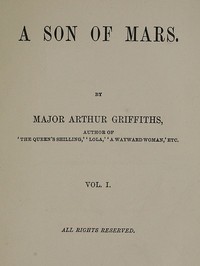
A Son of Mars, volume 1
Language: en270 downloads on Project Gutenberg
Subjects
Public-domain ebook sourced from Project Gutenberg #57195.
Public-domain ebook
Language: en270 downloads on Project Gutenberg
Subjects
Public-domain ebook sourced from Project Gutenberg #57195.
The opening · free to read
IN THE MILITARY CRADLE.
To the right, under the arch leading to the casemate barracks at Triggertown, dwelt Jonadab Larkins, a deserving public servant who had enjoyed the proud position of barrack sergeant for some years. He was like the old lady who lived in the shoe. He had more children than he could do with comfortably, so he gave it up as a bad job, and let them do for themselves. Mrs. Larkins, what with cooking, cleaning, and the family washing, had no spare time on her hands; and except to yell out shrill cautions which no one heeded, or threats of corporal punishment which were forgotten as soon as uttered, allowed her brood to risk their lives as freely as they pleased. They had many outlets of this kind; one favourite amusement was to hang themselves to the chains of the drawbridge leading to the barracks; another to walk along the brick edge of the counterscarp; but that which all enjoyed most was to watch the approach of vehicles in the main thoroughfare, and to rush madly across the road right under the horses’ feet. It was often a very near thing; and the nearer they went to self immolation the better they were pleased. But the pitcher goes once too often to the well. One fine day there was a tremendous disturbance in the street; a crowd gathered quickly, and presently a message reached Mrs. Larkins that one of her bairns had been driven over and was killed.
‘Which on ’em is it?’ shrieked the red-armed but pleasant-visaged dame. ‘Not Rechab, nor yet Sennacherib, nor yet Jemimer Ann?’
No; it was Hercules Albert, the eldest of the family, who was just then carried in and laid upon the bed.
A lady--a middle-aged lady, with silver white hair and a worn emaciated face--followed, and looking round with a strange wild look in her eyes, asked almost hysterically:
‘Is he much injured? Will he live? Where are the people who call themselves his parents?’
The lad was only stunned, and a little water quickly brought him to.
‘I should have been so grieved had he come to harm,’ went on the lady. ‘It was my coachman’s fault. It has been a terrible shock to me; quite terrible. But tell me--’
She looked hastily round, then whispered to Larkins--
‘How did you come by this child?’
The Sergeant stared at her in amazement--
‘Honestly! Why, it’s our own--leastways it’s the mother’s.’
‘Do you mean that you are its mother?’ she asked of Mrs. Larkins.
‘Certainly I do! Do you dispute it?’
‘Mother? Yes. It may be so. But you, you man, you are not his father? You cannot be. It is impossible, simply impossible. Why, the child has his eyes; his own dear eyes, I could swear to them among a thousand. You cannot, you shall not deceive me. How came you by this child?’
‘He’s not my own son, that I won’t deny,’ said the Sergeant. ‘But he is my missus’s; she was a widow when I married her, and--’
‘I must have the boy. You cannot refuse him to me. I will buy him of you; will pay you any price you please. But he must leave this place. It is no place for him.’
And she gazed scornfully at the humble surroundings. The little dark vaulted room with its one deep recessed window, its inner space curtained off to form a second bedroom, the litter and mess about the floor.
‘This is no place for--’
She paused suddenly, and a wild scared look came over her face. A footman, one of her own people, a tall, black-whiskered and pompous Jeames, was standing in the doorway, and the sudden apparition seemed to put a seal upon her tongue.
‘The horses, m’lady,’ said the man respectfully enough, although there was an accent of authority in his voice. ‘The horses have been standing nearly half an hour, m’lady, and the coachman says--’
‘Yes, yes, I’ll come at once--at once, Robert. Good people, you will understand my anxiety for the boy. The blame rested so entirely upon us. It is an immense relief to know that he is not injured.’
Then watching her opportunity, she hissed out with frenzied eagerness--
‘Not a word to a soul; not a syllable, as you value his future and my peace. I will come again to-morrow, or sooner, unattended. H--sh, for heaven’s sake, h--sh,’ and she hurriedly left the room.
‘Well, I’m blowed,’ said the Sergeant, drawing a long breath. ‘If that ain’t the rummest game. What does it mean, missus? Can you tell?’
Mrs. Larkins met his inquiring eyes quite steadily, and if she was conscious of any mystery no suspicion of it could be traced in her voice and manner.
‘She must be off her head--that’s my notion--clean, stark, staring mad.’
‘And mine too. Yon flunkey was her keeper, I expect. Bound to look after her and keep her out of mischief. It’ll make a fine talk in the barracks, this will.’
‘I don’t see why it should. I wouldn’t let on if I was you; don’t gossip about it at the canteen, Sergeant, or at the sergeants’ mess. What’s the good?’
A docile and obedient husband was Sergeant Larkins, who, through all the years of his married life, had accepted his wife’s will as law. Mrs. Larkins was a buxom, bright-eyed dame, who made a man’s home comfortable for him, so long as he allowed her to rule.
‘You’re right. It’s a folly always to talk, leastways when you’ve nothing to talk about, and the freaks of a mad woman don’t amount to much. We shan’t hear no more about her.’
Nor did they for days, nay, weeks, but months, and the episode was fading from their memories, at least from that of the Sergeant, when the lady suddenly re-appeared unattended and alone.
She looked suspiciously about her as she entered the room.
‘I could not come before. I have been watched. Even now I fear they are on my track. Quick! Where is the boy?’
Hercules Albert was where he and his brothers generally were--in mischief.
‘I must see him; my heart yearns for him. And to think that I should find him thus! How inscrutable are the ways of Providence! My sweet, my pet, it is balm to my wounded heart!’ And she kissed and fondled the boy, regardless of the mud with which his dirty face was encrusted, and of his own evident perturbation and objection to these endearments.
‘But I must not waste time. I may be disturbed before I have said my say. Listen: you will let me have the child? You shall name your own price. I will ask no questions. Keep your own counsel. You shall not divulge your secrets.’
‘There ain’t no secrets to divulge,’ said the Sergeant stoutly. ‘And you shan’t buy a brat of mine, as though he were a full-blooded Congo on the West coast.’
‘Wait, Larkins--let’s see what the lady means,’ the practical wife interposed. Mrs. Larkins was quite quiet and self-possessed, as she looked her strange visitor full in the face. ‘Perhaps she will explain. Do you wish to adopt the child?’
‘I do--and more. I wish to educate him to be worthy of his birth, and of that position which he must some day come to, in spite of all. He shall have all my love while I live, all my possessions after death. They are his by right, indefeasible. Has he not Herbert’s eyes? Is he not my--?’
The book keeps going
Reading is free forever. Sign up and watch scenes appear while you read.



Scenes Storieta drew for other classics.
New illustrated classics
Once or twice a month: the latest books to get full character casts, scene art, and free comic editions. No account needed.