Public-domain ebook
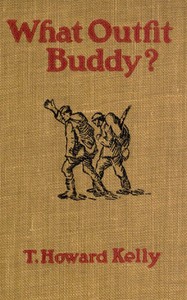
What Outfit, Buddy?
Language: en286 downloads on Project Gutenberg
Subjects
In: Novels·American Literature·History - Modern (1750+)
Public-domain ebook sourced from Project Gutenberg #57271.
Public-domain ebook
Language: en286 downloads on Project Gutenberg
Subjects
In: Novels·American Literature·History - Modern (1750+)
Public-domain ebook sourced from Project Gutenberg #57271.
The opening · free to read
“‘Take That Hat Off. It Isn’t Regulation,’ Says the Second Looey to Me”
“Make Friends with the Cooties. Then You’re All Set”
“I Want to Get a Picture of O. D.’s Grave”
“A Bearded Poilu Came Tearing Out of a Ruined House, Waving a Bottle Over His Head”
A great many impressionable young men who become soldiers overnight and go to war feel strongly inspired to write books about their adventures. I felt the same way before the newness of the life on the western front had been rubbed away by constant friction with some of the more monotonous things of war, such as hunger, cold, mud, cooties, and other romance-destroying agents. I buried the idea of writing a book just before my division was called upon to stand between the Boches and Paris during the trying days of July and August of 1918. It is very good for me that I detached myself from the desire to write a war book about that time. Experience proved that it was necessary to give all my available time to the business of fighting the guerre.
The book-bug never came my way again, for I do not look upon What Outfit, Buddy? as the result of answering some insistent, invisible summons to write a war book. I did not intend writing a war book when I started the first line of What Outfit, Buddy? I merely hoped to let Jimmy McGee, a real, regular fighting Yank who has seen his share of la guerre, tell the story of the things that he encountered as a member of the American Expeditionary Force. I sincerely trust that my original intentions have carried.
If I have allowed Jimmy McGee to tell you his story, then I have fulfilled my hopes, for I believe that Jimmy McGee’s story of the war is merely the universal version of the great adventure as held by legions of his comrades.
In my effort to let Jimmy tell his story I have not tried to use book language. I have used to the best of my ability the speech of men who became a real integral part of the guerre.... To do that it was necessary to let Jimmy and his comrades speak French in the manner of American soldiers. I tried to register the true value of their struggles with the difficult French language by resorting to phonetic spelling in the case of practically all French words which have become a part of the American Expeditionary Forces’ vocabulary. Students of the beautiful, musical language of France will, I trust, grant me this indulgence, as I have taken the liberties only in the desire to tell America how its fighting men overcame the difficulties presented by living side by side with a people who spoke a foreign language.
T. Howard Kelly.
CHAPTER I—“WHAT OUTFIT, BUDDY?”
Jimmy McGee, hanging on to a long, lean loaf of brown bread with his left hand and swinging a heavy, dangerous-looking cane in his right grip, moved leisurely over a white road of France toward the four-year-old battlelines that stretched between Verdun and Saint-Mihiel.
McGee, himself, was camouflaged beneath an assortment of things and stuff that would have made Panhandle Pete of funny-paper fame look like a smartly dressed gentleman in comparison. His make-up was not calculated to allow observers much chance to criticize his own physical attributes or failings.
A bit of reddish-brown hair managed to crop up in sundry places outside the distorted corners of the clownish thing that had been issued him in the name of an overseas cap. The part of his shirt collar that almost swallowed his ears and chin came very near hiding his freckled snub nose. But it didn’t. The nose insisted on protruding enough to be seen. Jimmy’s eyes, alone, were open and ready for inspection. Any one might have guessed the nationality of his ancestors by the laughing blue of his eyes. What could be seen of his features hinted that he owned a strong, good-looking face. Perhaps his long length of wide limb would have given him some individuality among a gang of six-footers, for he was exceptionally tall. Unfortunately his height was lost in the bulk of war-like paraphernalia that jangled from countless straps, ropes, and belts. Otherwise his identity was completely blanketed.
Nobody, except one of his own kind, would have ever recognized him as an American soldier. He was a sad departure from all that Army regulations and magazine covers had insisted upon as a typical member of the “best dressed and best fed army” in the world. Most likely Jimmy’s own mother would have passed him up as a straying peddler. Perhaps Sergeant George Neil, McGee’s pal and bunkie, might have recognized him by the stout, strong-muscled legs which were swathed in muddy war-putees,—that ended in a final strip of thin raglings below his knees,—and moved in an easy-going stride peculiar to his own ideas of speed.
However strange and disillusioning, Private, 1st Class, Jimmy McGee may have appeared to the men who designed the uniform and equipment of American soldiers, there was nothing about the boy to distinguish him apart from thousands of comrades in soiled and torn olive-drab, who had come out of the Chateau-Thierry rackett with their appreciation for neatly made packs and dress-parade tactics all shot to hell.
Appearances had long since ceased to count in his young life. He had forgotten all of the old O. D. stuff, after discovering that “squads right” and saluting could never win a guerre. Consequently Jimmy ambled along, loaded down to the hubs under a confusion of equipment and souvenirs that he had collected from three fronts during the past eight months, without a thought of anything, except the height of the hill that he was climbing and the emptiness of his stomach. The fact that he didn’t know just exactly where he was, or where his outfit might be, wasn’t causing him any worries. He had been separated from the battery too many times already and this latest separation was only twenty-four hours old,—a mere trifle to Jimmy McGee.
“Lost—strayed—and stolen—Guess I’m all three of ’em—_tous ensemble_, as the Frogs would rattle in that darn machine gun language of theirs,” muttered McGee as he shifted the weight of a blanket roll that looked as if it contained a Baby Grand piano and a fat-legged stool.
“Well, I’ll find the outfit before the guerre encores, anyhow. If I don’t I’ll turn myself in for salvage—anythin’ to keep from bein’ an M. P. or gettin’ in the Quartermaster Corps. Those guys don’t——”
Honk!... Honk!... Honk!...
Jimmy shut his mouth and got himself off of the road, just in time to miss being pressed into an old-fashioned pancake under the wheels of a truck that whizzed by like an Austrian 88.
“Great Gods! I’d rather promenade along the top of a trench in broad daylight than leave my life in the hands of those fool truck-drivers. They ain’t got a bit of respect for a man’s body—ought to let ’em drive a tank across No Man’s Land under a barrage once or twice—maybe then they’d quit tryin’ to kill us poor guys that’s fightin’ this guerre.”
McGee thought some pretty hard things about truck drivers in general after getting that load off his chest and started to make another hill, being careful to hang close to the side of the road.
“What outfit, Buddy?”
Jimmy McGee stopped still in his tracks, steadied himself against his cane to keep from rolling back down the steep hill, and shook himself so roughly before answering that the tinware, brass, steel and other whatnots which were a part of his baggage made a noise like the cows coming home.
“Twenty-Sixth Division, Jack,” he shot back, as if he were putting over a little barrage all by himself.
Then he advanced cautiously to inspect the strange-looking person who had asked him the old familiar question. For a passing moment Jimmy was pretty sure that the old gas had got to his eyes at last, or that his thoughts were getting the best of him. Surely the man who sat on the grass and was all rigged up like the soldiers in the Sunday papers and popular monthlies, must be a model—A sort of guide or index for his kind, thought Jimmy.
At last, after what seemed ten years to the waiting, strange one, the dust-sprinkled Yank said outloud, more to himself than anyone else, “_Oui_—it moves and breathes—guess it’s real—take a chance, anyhow.” Then to the object of his remarks: “What outfit, yourself, old man?”
“None—that is, so far,” was the astonishing answer, made in a voice that hadn’t taken on the tone of confidence which Jimmy knew well could only be found out where he and a bunch of his side-kickers had been living during the past few months.
“Well—that’s a hell of a good outfit to belong to. Guess you ain’t bothered with second lieutenants much then, eh?” queried Jimmy, pushing his shapeless roll over his head and letting it fall to the earth with a thud.
“How do you mean—worried?” asked the wondering man, whose appearance brought back memories of the hated O. D. days to Jimmy.
“Oh, you never had many of ’em hangin’ around you for salutes, givin’ foolish commands that ought to be listed with dead letters in the office at Washington. That’s what I’m gettin’ at.... Get me, now?”
A gas-mask, two bulging musettes, the bottom of a mess-kit, and a French canteen were thrown to the ground. McGee’s great height began to assert itself. He stretched his long arms and shook a case of field-glasses and a German luger aloose from their insecure attachments to his left shoulder straps.
“Yes, I see now. No, can’t say that I’ve minded them so much as I haven’t been in the Army long,” replied Jimmy’s roadside find.
“So,” muttered Jimmy reflectively. “Say, when in hell did you enlist anyway?”
“I didn’t—I was drafted,” answered O. D., as McGee had already mentally nicknamed the man in front of him.
“_Oui_—_Oui_—I compree,” said the product of eight months in the mud and rain of the Western Front, nodding his head affirmatively.
Silence for a moment and then Jimmy said what was on his mind.
“Say, how does it feel to be that way buddy? It don’t bother you at nights does it?”
“Don’t quite understand you,” stammered the product of General Crowder’s machine.
“_Pas compree_, eh? Just like a Frenchman when he don’t want to give you what you want,” answered Jimmy. “Well I’ll try to shoot away the camouflage this time. Don’t you ever wish that you’d enlisted?”
The book keeps going
Reading is free forever. Sign up and watch scenes appear while you read.



Scenes Storieta drew for other classics.
New illustrated classics
Once or twice a month: the latest books to get full character casts, scene art, and free comic editions. No account needed.