Public-domain ebook
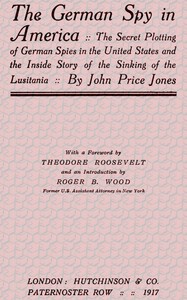
Fighting Germany's Spies
Language: en394 downloads on Project Gutenberg
Subjects
In: History - American·History - Modern (1750+)·History - Warfare
Public-domain ebook sourced from Project Gutenberg #57307.
Public-domain ebook
Language: en394 downloads on Project Gutenberg
Subjects
In: History - American·History - Modern (1750+)·History - Warfare
Public-domain ebook sourced from Project Gutenberg #57307.
The opening · free to read
Twenty-five days after the Kaiser touched the button which publicly notified the world that Germany at last had decided that “The Day” had come--to be exact, on August 25, 1914--Ambassador Bernstorff wrote a letter effusively addressed to “My very honoured Mr. Von Wedell.” (Ruroede had not yet appeared on the scene.) The letter itself was more restrained than the address, but in it Bernstorff condescended to accept tentatively an offer of Wedell’s to make a nameless voyage. The voyage was soon made, for on September 24th Wedell left Rotterdam, bearing a letter from the German Consul-General there, asking all German authorities to speed him on his way to Berlin, because he was bearing dispatches to the Foreign Office. Arrived in Berlin, Wedell executed his commission and then called upon his uncle, Count Botho von Wedell, a high functionary of the Foreign Office. He was aflame with a great idea, which he unfolded to his uncle. The idea was approved, and right after the elections in November he was back in New York to put it into execution, incidentally bearing with him some letters handed him by order of Mr. Ballin, head of the Hamburg-American Steamship Company, and another letter “for a young lady who goes to America in the interest of Germany.” If unhappy Wedell had let this be his last voyage--but that belongs later in the story.
Wedell’s scheme was this: He learned in Berlin that Germany had at home all the common soldiers she expected to need, but that more officers were wanted. He was told that Germany cared not at all whether the 100,000 reservists in America got home or not, but that she cared very much indeed to get the 800 or 1,000 officers in North and South America back to the Fatherland. Nothing but the ocean and the British fleet stood in their way. The ocean might be overcome. But the British fleet----? Wedell proposed the answer: He would buy passports from longshoremen in New York--careless Swedes or Swiss or Spaniards to whom $20 was of infinitely more concern than a mere lie--and send the officers to Europe, armed with these documents, as neutrals travelling on business. Once in Norway or Spain or Italy, to get on into Germany would be easy.
For a few weeks Wedell got along famously. He bought passports and papers showing nativity from Norwegian, Swedish, Danish, and Swiss longshoremen and sailors. Meantime, he got in touch with German reserve officers and passed them on to Europe on these passports.
This telegram is from Haniel von Haimhausen, the counsellor of the German Embassy in Washington, and was sent in response to an inquiry from Bernstorff for the name of the man who had offered to act as a messenger to Germany for him. The message reads:
Count Bernstorff, care Ritz Carlton. Hans Adam von Wedell attorney fifteen William Street, New York he has been introduced by consul Hossenfelder, Haniel.]
But he was not content with these foreign passports. In the case of a few exceptionally valuable German officers he wished to have credentials that would be above all suspicion. Consequently, he set about to gather a few American passports. Here his troubles began, and here he added the gravest burden to his already great load of culpabilities. For Von Wedell was an American citizen, and proud of it. But he was prouder still of his German origin and his high German connections, and in his eagerness to serve them he threw overboard his loyalty to the land of his adoption.
Von Wedell applied to a friend of his, a certain Tammany lawyer of pro-German sympathies, who had supplied him with a room belonging to a well-known fraternal organization as a safe base from which to handle his work in passports. What he wanted was an agent who was an American and who had political acquaintanceship that would enable him to work with less suspicion and with wider organization in gathering American passports. Through the lawyer he came in contact with an American, who for the purposes of this story may be called Mr. Carrots, because that is not his name but is remotely like it. Carrots seemed willing to go into the enterprise and at a meeting in Von Wedell’s room Von Wedell carefully unfolded the scheme, taking papers from a steel cabinet in the corner to show a further reason why the American passports he already had would soon be useless. This reason was that the Government was about to issue an order requiring that a photograph of the bearer should be affixed to the passport and that on this photograph should appear half of the embossing raised by the impression of the seal of the Department of State. He agreed to pay Carrots $20 apiece for all genuine passports he would supply to him. Carrots accepted his proposal and departed.
Instead of going out to buy passports, he went at once to the Surveyor of the Port of New York, Mr. Thomas E. Rush, and told him what Wedell was doing. Mr. Rush promptly got in touch with his chief in the Treasury Department at Washington, who referred the matter to the State Department, and they, in turn, to the Department of Justice. The result was that Carrots went back to Wedell about a week later and told him he would not be able to go on with the work but would supply someone to take his place. This was satisfactory to Wedell.
In the meantime, Wedell had introduced Carrots to a fellow-conspirator, Carl Ruroede, a clerk in the ship forwarding department of Oelrichs & Company--a man of little position, but fired by the war with the ambition to make a name in German circles that would put him in a position to succeed Oelrichs & Company as the general agent of the North German Lloyd in New York.
About this time Wedell lost his nerve. He was a lawyer and realized some of the possible consequences of certain of his acts. He had had occasion to forge names to two passports; and also he found out that he had reasons to suspect that he was under surveillance. These reasons were very good: he had arranged for the transportation to Italy of a German named Doctor Stark, using the passport of a friend of his in the newspaper business named Charles Raoul Chatillon. Wedell got wind of the fact that Stark had been taken off the steamer Duca de Aosta at Gibraltar, and was being detained while the British looked up his credentials.
Wedell by this time was in a most unhappy plight. Bernstorff and Von Papen had no use for him because he had been bragging about the great impression he was going to make upon the Foreign Office in Berlin by his work. If any impressions were to be made upon the Foreign Office in Berlin by anybody in America, Bernstorff and Von Papen wanted to make them. Wedell was so dangerously under suspicion that Von Papen, Von Igel, and his Tammany lawyer friend had all warned him he had better get out of the country. Wedell took their advice and fled to Cuba.
The substitute whom Carrots had promised now entered the case, in the person of a man who called himself Aucher, but who was in reality a special agent of the Department of Justice. Aucher was not introduced to Ruroede, the now active German, and so, when he began his operations, he confronted the very difficult task of making his own connections with a naturally suspicious person.
Carrots had been dealing with Ruroede after Wedell’s disappearance; and, by the time he was ready to quit, Ruroede had told him that “everything was off for the present,” but that if he would drop around again to his office about January 7, 1915, he might make use of him. Aucher, now on the case, did not wait for that date, but on December 18th called on Ruroede at his office at room 204 of the Maritime Building, at No. 8 Bridge Street, across the way from the Customs House.
In this plainly furnished office Aucher appeared in the guise of a Bowery tough. He succeeded admirably in this rôle--so well, indeed, that Ruroede afterward declared that he “succeeded wonderfully in impressing upon my mind that he was a gangman, and I had visions of slung shots, pistol shots, and holdups” when he saw him. Aucher opened the conversation by announcing:
“I’m a friend of Carrots.”
“That’s interesting,” was Ruroede’s only acknowledgment.
“He’s the guy that’s getting them passports for you,” went on Aucher, “and all I wants to know is, did you give him any cush?”
“What do you mean?” asked Ruroede.
“Nix on that!” Aucher exclaimed. “You know what I mean. Did you give that fellow any money?”
To which Ruroede replied: “I don’t see why I should tell you if I did.”
“Well,” retorted Aucher, “I’ll tell you why. I’m the guy that delivers the goods, and he swears he never got a penny from you. Now did he?”
It was at this point that Ruroede had his visions of slung shots, so he admitted he had paid Carrots $100 only a few days before.
“Well,” demanded Aucher, “ain’t there going to be any more?”
“Nope. Not now,” Ruroede replied. “Maybe next month.”
“Now see here,” said Aucher. “Let’s cut this guy out. He’s just nothing but a booze fighter, and he’s been kidding you for money without delivering the goods. What’s the matter with just fixing it up between ourselves?”
Ruroede now tried to put Aucher off till Christmas, having recalled meanwhile that the steamer Bergensfjord was to sail on January 2d, and that he might need passports for officers travelling on that ship. But Aucher protested that he was “broke,” and further impressed on Ruroede that he had gotten no money from Carrots or Wedell for his work for them. He also produced six letters written by the State Department in answer to applicants for passports, and finally convinced Ruroede of his good faith and that he ought to start him to work right away. They haggled over the price, and finally agreed on $20 apiece for passports for native-born Americans and $30 apiece for passports of naturalized citizens--the higher price for getting the latter because they involved more red-tape and hence more risk. Aucher was to come back on December 24th and bring the passports and get some money on account.
On that day Aucher called at Ruroede’s office, and after further quarrelling about Carrots and his honesty, Ruroede declared that he was ready to do business. Aucher objected to the presence of a young man in the room with them, and Ruroede replied:
“Oh, he’s all right. He’s my son, and you needn’t be afraid to talk with him around.”
Aucher then produced an American passport, No. 45,573, made out in the name of Howard Paul Wright, for use in Holland and Germany. It was a perfectly good passport, too, as it had been especially made out for the purpose by the Department of State at the request of the Department of Justice. It bore Mr. Bryan’s genuine signature, and a photograph of “Wright,” who was another agent of the Bureau of Investigation. Aucher also declared he was on the way toward getting the other five passports. Ruroede threw the Wright passport on his desk and said:
“I’ll keep this. Go ahead and get the others.”
“What about money?” demanded Aucher.
“I’ll pay you $25 for it--no, I’ll do better than that. To show you I mean business, take that,” and he threw a $100 bill on the table. Ruroede also gave Aucher photographs of four German officers, and begged him to get passports right away to fit their descriptions, because he wanted to get these men off on the Norwegian Line steamer Bergensfjord, sailing January 2d. He added that the officers of the Norwegian Line had all been “smeared” (otherwise “fixed”) and that they would “stand for anything.” He also said that he would take at least forty more passports from Aucher, and that he would want them right along for six months or a year, depending on the length of the war.
The book keeps going
Reading is free forever. Sign up and watch scenes appear while you read.



Scenes Storieta drew for other classics.
New illustrated classics
Once or twice a month: the latest books to get full character casts, scene art, and free comic editions. No account needed.