Public-domain ebook
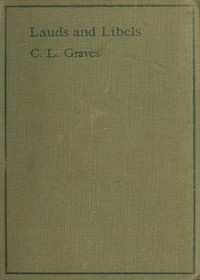
Lauds and libels
Language: en295 downloads on Project Gutenberg
Subjects
In: Poetry·Humour·British Literature
Public-domain ebook sourced from Project Gutenberg #57467.
Public-domain ebook
Language: en295 downloads on Project Gutenberg
Subjects
In: Poetry·Humour·British Literature
Public-domain ebook sourced from Project Gutenberg #57467.
The opening · free to read
Two Irish cousins greet us here From BUSHE “the silver-tongued” descended, Whose lives for close on thirty year Were indistinguishably blended; Scorning the rule that holds for cooks, They pooled their brains and joined their forces, And wrote a dozen gorgeous books On men and women, hounds and horses.
They superseded Handley Cross; They glorified the “hunting fever”; They purged their pages of the dross, While bettering the fun, of LEVER; With many a priceless turn of phrase They stirred us to Homeric laughter, When painting Ireland in the days Before Sinn Fein bewitched and “strafed” her.
With them we watched good Major Yeates Contending with litigious peasants, With “hidden hands” within his gates, With claims for foxes and for pheasants; We saw Leigh Kelway drop his chin— That precious English super-tripper— In shocked amazement drinking in The lurid narrative of Slipper.
Philippa’s piercing peacock squeals, Uttered in moments of expansion; The grime and splendour of the meals Of Mrs. Knox and of her mansion; The secrets of horse-coping lore, The loves of Sally and of _Flurry_— All these delights and hundreds more Are not forgotten in a hurry.
Yet the same genial pens that freight Our memories with joyous magic Gave us the tale of Francie’s fate— So vulgar, lovable and tragic; Just to the land that gave them birth They showed her smiling, sad and sullen, And turning from the paths of mirth Probed the dark soul of Charlotte Mullen.
Alas! the tie, so close, so dear, Two years ago death rent asunder; Hushed is the voice so gay and clear Which moved us once to joy and wonder; Yet, though they chronicle a loss Whose pang no lapse of time assuages, The spirit of brave “MARTIN ROSS” Shines like a star throughout these pages.
Here in her letters may one trace The generous scorn, the gentle pity, The easy unaffected grace, The wisdom that was always witty; Here, mirrored in a sister soul, One sees the comrade, strong yet tender, Who marched unfaltering to her goal Through sacrifice and self-surrender.
(Professor of Political Economy at McGill University, Montreal, and author of “Further Foolishness” and other notable works of humour.)
The life that is flagrantly double, Conflicting in conduct and aim, Is seldom untainted by trouble And commonly closes in shame; But no such anxieties pester Your dual existence, which links The functions of don and of jester— High thoughts and high jinks.
Your earliest venture perhaps is Unique in the rapture intense Displayed in these riotous Lapses From all that could savour of sense, Recalling the “goaks” and the gladness Of one whom we elders adored— The methodical midsummer madness Of ARTEMUS WARD.
With you, O enchanting Canadian, We laughed till you gave us a stitch In our sides at the wondrous Arcadian Exploits of the indolent rich; We loved your satirical sniping, And followed, far over “the pond,” The lure of your whimsical piping Behind the Beyond.
In place of the squalor that stretches Unchanged o’er the realist’s page, The sunshine that glows in your Sketches Is potent our griefs to assuage; And when, on your mettlesome charger, Full tilt against reason you go, Your Lunacy’s finer and Larger Than any I know.
The faults of ephemeral fiction, Exotic, erotic or smart, The vice of delirious diction, The latest excesses of Art— You flay in felicitous fashion, With dexterous choice of your tools, A scourge for unsavoury passion, A hammer for fools.
And yet, though so freakish and dashing, You are not the slave of your fun, For there’s nobody better at lashing The crimes and the cant of the Hun; Anyhow, I’d be proud as a peacock To have it inscribed on my tomb: “He followed the footsteps of LEACOCK In banishing gloom.”
Although the movements of the sea Have always been a grief to me And still at times disastrously Affect my corpus vile, Sailors of high and low degree I long have honoured highly.
But now we honour them far more Than ever in the days of yore For all they’re doing in the War To guard and shield and free us; And this is where the man on shore Can learn from “BARTIMEUS.”
For lately, when I couldn’t stick A “fearless” book which made me sick And positively long to kick The author to the ceiling, By luck I chanced on your Long Trick And found immediate healing.
Relentless realists protest You only have one type—the best, Drawn from the Islands of the Blest— Of comrades, sons and mothers; They’d rather see you foul your nest Than praise the “band of brothers.”
No matter; leave their ink to flow; It cannot work you weal or woe; The verdict of the men who know The truth in its essentials Should make the armchair critic slow To challenge your credentials.
The naval officer you paint Is not at all a plaster saint; He doesn’t always brook restraint; He isn’t prim or stolid; But still he’s void of any taint That’s mean or low or squalid.
And then you write of wondrous things That pluck our hearts’ most secret strings— The tender grace that childhood flings On scenes of stern endeavour; The news that joy and comfort brings Or chills the heart for ever.
So when young writers, void of ruth, Portray the flower of England’s youth As ill-conditioned and uncouth— In short as Huns might see us— I turn for solace and for truth To you, good “BARTIMEUS.”
In days when Bellona less madly The wheels of her chariot drave, To you, Father Anthony, gladly My doggerel homage I gave; And again uncontrollably yearning For solace in desolate hours I find a brief respite in turning To Barchester Towers.
How good are the women, how various, As slowly their natures unfold!— The feudal Miss Thorne; the gregarious And amiable Eleanor Bold; Mrs. Quiverful, dauntless though dowdy, With fourteen young ravens to feed, Who managed to melt Mrs. Proudie, So great was her need.
Mrs. Proudie, of course, is prodigious, A terror to friends and to foes, Ambitious, correctly religious, Yet leading her lord by the nose; Very far from an angel or jewel, Very near to a feminine Pope, And priceless in waging the duel That smashed Mr. Slope.
And who would not willingly linger With you, O Signora, who twirled Round the tip of your white little finger Staid clerics and men of the world! Commanding the spells of a Circe; Bewitching, though crippled and lame; Redeeming your malice with mercy And playing the game.
The clergy—Tractarian, Erastian, Low Churchmen—you faithfully paint Reveal to our view no SEBASTIAN, No martyr, and hardly a saint; Though perhaps, by so freely discarding Preferment and riches and fame, The guileless and good Mr. Harding Is worthy the name.
You looked upon country and city With kindly and tolerant eyes; You never set out to be witty, Though seldom you failed to be wise; You were neither ornate nor elliptic, But most unaffectedly shrewd, For the art that is consciously cryptic You strictly tabooed.
Your outlook is certainly narrowed To lives that are never sublime; Our hearts are not haunted or harrowed With desperate anguish or crime; But a mutual trust is for ever ’Twixt author and reader maintained, And we know all along we shall never Be wantonly pained.
“BLEAK HOUSE”
There was a time when, posing as a purist, I thought it fine to criticize and crab CHARLES DICKENS as a crude caricaturist, Who laid his colours on too thick and slab, Who lacked the temper of a judge or jurist And made life lurid when it should be drab; In short I branded as a brilliant dauber The man who gave us Pecksniff and Micawber.
True, there are blots—like spots upon the sun— And genius, lavish of imagination, In sheer profusion always has outrun The bounds of strict artistic concentration; But when detraction’s worst is said and done, How much remains for fervent admiration, How much that never palls or wounds or sickens (Unlike some moderns) in great generous DICKENS!
And in Bleak House, the culminating story That marks the zenith of his swift career, The sovereign qualities that won him glory, As writer and reformer, all appear: Righteous resentment of abuses hoary, Of pomp and cant, self-centred, insincere; And burning sympathy that glows unchecked For those who sit in darkness and neglect.
Who, if his heart be not of steel or stone, Can read unmoved of Charley or of Jo; Of dear Miss Flite, who, though her wits be flown, Has kept a soul as pure as driven snow; Of the fierce “man from Shropshire” overthrown By Law’s delays; of Caddy’s inky woe; Or of the alternating fits and fluster That harass the unhappy slavey, Guster?
And there are scores of characters so vivid They make us friends or enemies for life: Hortense, half-tamed she-wolf, with envy livid; The patient Snagsby and his shrewish wife; The amorous Guppy, who poor Esther chivvied; Tempestuous Boythorn, revelling in strife; Skimpole, the honey-tongued artistic cadger; And that tremendous woman, Mrs. Badger.
No wonder then that, when we seek awhile Relief and respite from War’s strident chorus, Few books more swiftly charm us to a smile, Few books more truly hearten and restore us Than his, whose art was potent to beguile Thousands of weary souls who came before us— No wonder, when the Huns, who ban our fiction, Were fain to free him from their malediction.
Weary of MACAULAY, never nodding, Weary of the stodginess of STUBBS, Weary of the scientific plodding Of the school that only digs and grubs; I salute, with grateful admiration Foreign to the hireling eulogist, CHESTERTON’S red hot self-revelation In the guise of England’s annalist.
Here is no parade of erudition, No pretence of calm judicial tone, But the stimulating ebullition Of a sort of humanized cyclone; Unafraid of flagrant paradoxes, Unashamed of often seeing red, Here’s a thinker who the compass boxes Standing most at ease upon his head.
Yet with all this acrobatic frolic There’s a core of sanity behind Madness that is never melancholic, Passion never cruel or unkind; And, although his wealth of purple patches Some precisians may excessive deem, Still the decoration always matches Something rich and splendid in the theme.
Not a textbook—that may be admitted— Full of dates and Treaties and of Pacts, For our author cannot be acquitted Of a liberal handling of his facts; But a stirring proof of Britain’s title, Less in Empire than in soul, of “Great,” And a frank and generous recital Of “the glories of our blood and State.”
The book keeps going
Reading is free forever. Sign up and watch scenes appear while you read.



Scenes Storieta drew for other classics.
New illustrated classics
Once or twice a month: the latest books to get full character casts, scene art, and free comic editions. No account needed.