Storieta
Sign up

About this book

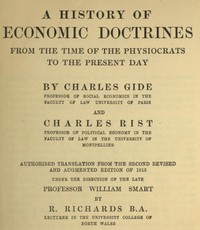
This work is a scholarly survey of the evolution of economic thought from the physiocratic era to the early twentieth‑century debates. The authors begin by lamenting the scarcity of English‑language treatments of the subject, then launch into a comparative appraisal of national traditions, particularly the French emphasis on doctrinal history, the German dominance in research, and the English preoccupation with “pure doctrine.” Their preface outlines a deliberately selective approach, acknowledging omissions and the difficulty of presenting a complete picture within a single volume. By anchoring each school of thought to its historical context, they aim to show how ideas such as Ricardo’s pessimism or the Fabian Society’s revival of Ricardian economics fit into a broader intellectual landscape.

Written in a measured, academic tone typical of early‑1900s French‑influenced scholarship, the text interweaves extensive footnotes, citations, and occasional self‑reflexive commentary. Readers who appreciate meticulous historical analysis, enjoy tracing the genealogy of economic theories, or are interested in the interplay between national academic cultures will find the book rewarding. It is especially suited to students of the history of economics, historians of ideas, and scholars seeking a nuanced, period‑specific perspective on the development of economic doctrines.
Opening lines

The remarkable dearth of literature of this kind in English may be pleaded in further extenuation of the attempt to present the work in an English garb, and readers of the Preface will be able to contrast the position in this country with the very different condition of things prevailing across the Channel. The contrast might even be carried a stage farther, and it would be interesting to speculate upon the historical causes which have made Germany supreme in the field of economic research and history, which influenced France in her choice of the history of theory, and which decreed that England should on the whole remain faithful to the tradition of the “pure doctrine.” Can it be that something like a “territorial division of labour” applies in matters intellectual as well as economic?

Keep reading free · chapter 1 needs no account

More like this

Cover of Hegel's Lectures on the History of Philosophy: Volume 3 (of 3)

Hegel's Lectures on the History of Philosophy: Volume 3 (of 3)

Georg Wilhelm Friedrich Hegel

The work is the third and final volume of Hegel’s “Lectures on the History of Philosophy,” in which the…

Cover of The Interesting Narrative of the Life of Olaudah Equiano, Or Gustavus Vassa, The African Written By Himself

The Interesting Narrative of the Life of Olaudah Equiano, Or Gustavus Vassa, The African Written By Himself

Olaudah Equiano

The work is an autobiographical narrative by Olaudah Equiano, an African who was enslaved and later freed,…

London and the Kingdom - Volume 2 A History Derived Mainly from the Archives at Guildhall in the Custody of the Corporation of the City of London.

London and the Kingdom - Volume 2 A History Derived Mainly from the Archives at Guildhall in the Custody of the Corporation of the City of London.

Reginald R. Sharpe

London and the Kingdom – Volume 2 is a scholarly history that draws chiefly on the Guildhall archives, the…

Napoleon's Letters to Josephine, 1796-1812 For the First Time Collected and Translated, with Notes Social, Historical, and Chronological, from Contemporary Sources

Napoleon's Letters to Josephine, 1796-1812 For the First Time Collected and Translated, with Notes Social, Historical, and Chronological, from Contemporary Sources

Emperor of the French Napoleon I

The volume presents, for the first time, a complete collection of Napoleon I’s letters to his wife Joséphine,…

The Philippine Islands A Political, Geographical, Ethnographical, Social and Commercial History of the Philippine Archipelago, Embracing the Whole Period of Spanish Rule

The Philippine Islands A Political, Geographical, Ethnographical, Social and Commercial History of the Philippine Archipelago, Embracing the Whole Period of Spanish Rule

Foreman, John, F.R.G.S.

John Foreman’s work is a sweeping survey of the Philippines under three centuries of Spanish rule, presented…

Cover of Simple Sabotage Field Manual

Simple Sabotage Field Manual

United States. Office of Strategic Services

The Simple Sabotage Field Manual is an official wartime pamphlet produced by the United States Office of…