Public-domain ebook
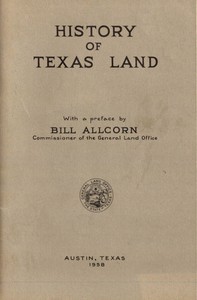
History of Texas Land
Language: en306 downloads on Project Gutenberg
Subjects
In: History - American·History - Modern (1750+)·History - Schools & Universities
Public-domain ebook sourced from Project Gutenberg #57544.
Public-domain ebook
Language: en306 downloads on Project Gutenberg
Subjects
In: History - American·History - Modern (1750+)·History - Schools & Universities
Public-domain ebook sourced from Project Gutenberg #57544.
The opening · free to read
The Old General Land Office Building, pictured (above) as it appeared about 1890, is located at the southeast corner of the Capitol grounds in Austin. It is one of the oldest remaining buildings in the Capitol City.
It was designed in December, 1854, by a draftsman in the General Land Office, Professor Doctor C. C. Stremme, who enjoyed considerable prestige in Europe before his emigration to Texas. In addition to other honors, Professor Stremme held a title at the Court of Emperor Nicholas I of Russia.
Maps prepared by Professor Stremme suggest his German homeland, and he poured his rich background into the Old Land Office Building. This structure is German Romance in style.
It was built in 1856 and 1857.
Thirty years after its construction, the building was the working home of William S. Porter, who was later to gain fame as a short story writer under the name of O. Henry. He was a draftsman in the General Land Office, and there he turned out numerous maps of rare beauty.
Later, O. Henry used the Old General Land Office Building in one of his stories, entitled “Bexar Scrip Number 2692”.
Statistically, the old building is 62 by 94 feet, outside dimensions. It has 11,656 feet of floor space in its two floors. Its exterior walls are two feet in width. It is characterized by star-transomed windows.
Moving into the Old General Land Office Building shortly after its completion, the General Land Office occupied the structure until 1918, when it moved into its present building.
A new building to be occupied by the General Land Office and the State Library and Archives is now in the planning stage.
More information about the historic Old General Land Office Building can be obtained from Mr. August Watkins Harris, an Austin architect, 13 Niles Road, Austin, who created the picture (below) and with whose permission it is printed.
And the story of Texas land is the story of Texas. This history begins with the Spanish in Texas, goes through the period of the Mexican occupation, tells about a courageous people who forced their independence, set up a republic, and ten years later joined the United States. The story of Texas oil development is also pertinent to the history of Texas land.
Through the whole account shines the far-sightedness, honesty, and devotion of early Texas leaders. By their efforts we enjoy much that would not otherwise be ours, not the least of which are our two great educational funds, the Permanent School Fund and the Permanent University Fund.
Does it not seem proper that we treat the educational future of our young people with at least as much respect as our ancestors? We should continue to help these educational funds grow as much as possible now while resources still exist on which to build them. Otherwise we run the future risk of emaciated funds and no resources with which to develop them further.
Section III of this booklet lists items of interest which may be found in the General Land Office. We extend you a personal invitation to visit the Land Office to see these historical treasures of Texas and the other files which, collectively, spell out in detail the story of Texas land.
BILL ALLCORN Commissioner General Land Office
Page PREFACE vii I. HISTORY OF TEXAS LAND 1 II. DISPOSITION OF TEXAS LAND 8 III. ITEMS OF INTEREST TO BE FOUND IN THE GENERAL LAND OFFICE 17 APPENDIX 19 Table A.: DISPOSITION OF THE PUBLIC DOMAIN OF TEXAS UNDER THE REPUBLIC AND THE STATE. Table B.: MINERAL ESTATE, LEASED MINERAL ESTATE, PRODUCING ACREAGE, ANNUAL ROYALTY.
When Christopher Columbus stepped ashore in the West Indies in October, 1492, he drew the curtain to an immense area of land, some fertile and some desert—land of all types and for all purposes.
So vast was this discovery that land-conscious European powers who sponsored New World exploration were soon giving away large areas with a surprising disregard for their value. However, when rival powers disputed their claims to specific territories in the New World, they were quick to argue. The effect was that nations which matured in the Western Hemisphere grew up with a high regard for land.
From this it may be inferred that the history of any nation or state has been and continues to be largely a history of land. The political, social, and economic superstructure of a people is traceable to the land they control. Especially is this true of western nations and of Texas.
In what is now Southwestern United States there were several settlements of Mexicans and Indians on both sides of the Rio Grande as early as 1750. These people held no title to their land. They had assembled for reasons of economics and security.
Agents of the King of Spain finally arrived in the New World in 1767, surveyed the river lands, and issued titles. With the exception of Laredo, there was little colonization until 1815, when the Spanish governor began to feel the French encroachment on the east. Before then, Spain’s main effort had been directed toward the erection of missions, which required constant support and defense, rather than toward establishing civil settlements that could defend and support themselves.
Thus, the vast area of the Southwest was sparsely populated and lay as a wilderness to American settlers who had pushed to its borders from the United States. A grant to colonize was made to Moses Austin in January, 1821, to settle 300 families in Texas; this was the first deviation from the Spanish policy of maintaining a predominately native population.
Later in 1821, the Spanish yoke was thrown off by Mexico, and the Mexicans continued the policy of granting land to Americans. A liberal colonization policy brought an immediate and widespread response. By 1835 it is estimated that there were over 30,000 people in the Texas colonies—people who had come to Texas not as adventurers or speculators, but to establish new homes. The fourteen-year period had wrought many changes. Texas was no longer a complete wilderness. Many areas had been cleared and turned into small agricultural districts where the people were both industrious and self-reliant.
Because of the differences in the background and heritage of the Anglo-Americans and the Mexicans, it was inevitable that conflicts would develop. Differences in political views, religion, language, and mode of living all served to kindle and feed the flames of the Texas Revolution.
At the very beginning of hostilities, Texans closed the colonial land offices and assumed control of the land problems under one agency. This was the foundation and beginning of the General Land Office, as it is known today.
In separating from Mexico, Texans recognized the valid titles to land which had been made by Spain and Mexico, but all vacant land within the borders of the new republic became the property of Texas. These borders were defined by the Congress of Texas in an Act of December 19, 1836, and included all land within the present boundaries of the state (and out to three marine leagues in the Gulf of Mexico), more than half of the present State of New Mexico, and parts of Kansas, Colorado and Wyoming. The first commissioners of the General Land Office, who were given the momentous task of administering this huge domain, were John P. Borden (who served from 1837 to 1841) and Thomas Wm. Ward (whose tenure of office was 1841 to 1848). On December 29, 1845, the Republic became a state.
Events leading to the annexation of Texas by the United States were significant in the land history of the state. Relations between the Republic of Texas and the United States during this time may be separated into three periods, each of which lasted about three years.
During the first period, Texas sought annexation. Partly as a result of the slavery controversy then raging in the United States and partly in fear of war with Mexico, the United States refused annexation.
In the second period, Texas altered her attitude, withdrew her application for annexation, and made plans to perpetuate her republic. During this period, Texas was recognized by powers such as Great Britain, France, Holland, and Belgium. Americans, laboring under the influence of what they considered a Manifest Destiny, feared the influence of foreign powers in Texas.
This led to the third phase, which was characterized by renewed U. S. interest in Texas. On June 8, 1844, a treaty of annexation was defeated in the United States Senate, largely by partisan politics. This treaty stipulated that the United States would pay Texas debts up to ten million dollars, but that Texas would have to surrender title to all public lands.
Texas was fortunate that this treaty was not approved, because only a small part of the land that she would have traded for ten million dollars has since put more than 625 million dollars in the Permanent School and University Funds. Later that year, President John Tyler of the United States proposed that the treaty of annexation be adopted by a joint resolution of Congress, and this maneuver succeeded, the treaty receiving approval on February 28, 1845.
Provisions of the treaty as confirmed by the joint resolution allowed Texas to retain her public domain and provided also that the new state should keep her debts, which amounted to about 13 million dollars at that time. All in all, it was a better arrangement than the earlier treaty which had been defeated.
Congressional approval was greeted in Texas by considerable enthusiasm.
The initiative in annexation proceedings now lay with Texas. President of the Republic Anson Jones called a convention to meet at Austin on July 4, 1845, to decide whether or not Texas should accept the proposal. The decision being in the affirmative, the State of Texas was admitted into the Union on December 29, 1845, and the State government was formally installed on February 19, 1846. Thomas Wm. Ward, who had been Commissioner of the General Land Office under the Republic, assumed the same position in the State government. His duties remained essentially the same.
Shortly after Texas was annexed by the United States, war broke out between Mexico and the Union over the newly-acquired territory. Mexico had never relinquished her claim to Texas, and had repeatedly warned the United States that annexation of what she considered a rebellious province would mean war. From the beginning of hostilities, however, the United States experienced a minimum of difficulty in subduing her southern adversary. Less than two years after the war began, it came to a conclusion with the Treaty of Guadalupe-Hidalgo, signed February 2, 1848. Among other provisions, Mexico gave up her claim to Texas.
Hardly had the war come to an end than a dispute arose between the United States and Texas over 78,892,800 acres of land claimed by Texas. When Mexico concluded the Treaty of Guadalupe-Hidalgo, she sold this and other land to the United States for $15,000,000. Mexico had never recognized Texas’ claim to the land in question, which included parts of what is now New Mexico, Kansas, Colorado, and Wyoming.
The book keeps going
Reading is free forever. Sign up and watch scenes appear while you read.



Scenes Storieta drew for other classics.
New illustrated classics
Once or twice a month: the latest books to get full character casts, scene art, and free comic editions. No account needed.