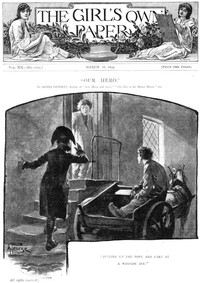
ROY BARON A FUGITIVE.
On the edge of a little clearing in the centre of the wood stood a small square charcoal-burner’s cottage, built of stone. Near behind might be seen a good-sized outhouse or woodhouse; and to one side was the pile of slowly-burning charcoal. Round and about were heaps of unsightly rubbish and of blackened moss.
Nobody seemed to be within or at hand. Jean opened the cottage door without difficulty; and when they had passed through, he bolted it in their rear.
Then in the darkness he found his way to a corner, struck a light with flint and steel, made a “dip” to burn, and groped anew. The one window was closely shuttered.
Roy flung himself upon a small bench, glad to get his breath, and watched the other’s doings curiously.
“Are we to stop here?” he asked. “But if the gendarmes come?”
“We must circumvent them, M’sieu.”
“How? What are you going to do?”
Jean was too busy to reply. He produced a blouse, such as would be worn by a French labouring lad, with shirt and trousers to match, and brought them to Roy. “M’sieu must change his clothes,” he said. “Rest afterwards.”
“All right,” once more assented Roy, though the cottage was swimming and his ears were buzzing with fatigue. He stood up, and promptly divested himself of what he wore, to assume a different guise. Jean brought from the same corner a small bottle of dark liquid, which he mixed with a little water in a basin, and then dyed Roy’s hair and eyebrows, thereby altering his look to such an extent that even his mother might almost have passed him by. Roy laughed so much under this operation, as to discompose the operator.
“Tenez, M’sieu! Taisez-vous, donc, s’il vous plait! M’sieu, I entreat. I assure Monsieur it is no matter for laughter.”
“If you knew what it is to be free again, you’d laugh too,” declared Roy, and then his merriment passed into a big yawn. “But I’m awfully sleepy.”
“Deux minutes, and Monsieur shall rest. Monsieur is hungry.”
Monsieur undoubtedly was, though the craving to lie down was even greater than the craving to eat. Jean handed him a hunch of bread and cheese and a glass of milk; and while Roy was occupied with the same, he proceeded to array himself in holiday costume. He donned an old and shabby but once gorgeous coat, with standing collar and gay buttons, which, as he informed Roy, had many long years before been the best holiday coat of his esteemed grandfather.
“I go to the wedding of my niece,” he remarked, with so much satisfaction that, for a moment, Roy really thought he meant it. “Does Monsieur perceive? And Monsieur will be the boy—Joseph—who goes with me in the little cart.”
“But where is the little cart?”
“All in good time, M’sieu. Now we have for the moment to get rid of these things.”
Jean rolled the discarded clothes into a bundle, with which he disappeared out of the cottage for a few minutes. Roy conjectured that he might have buried it in the bushes, or under heaps of black rubbish, abundance of which lay ready to hand. Jean then took Roy into the outhouse, which was more than two-thirds full of heavy logs and faggots of wood—the winter supply—piled together.
“Am I to get underneath all that, Jean?”
“Oui, M’sieu. The gendarmes will not easily find you there.”
“And you too?”
“Non, M’sieu. I betake myself to the soupente.”
The soupente in a French cottage is a kind of upper cupboard, a small corner cut off from the one room, near the ceiling, descending only half-way to the ground, and reached by a ladder.
“And if they find you there——”
“M’sieu, if they find me, they will not know me—see, in this dress! I am not like the Jean who chopped wood at Bitche. And I hope then to draw their attention from M’sieu! Voyez-vous?”
Roy wrung his hand. “I don’t know what makes you so good to me,” the boy said huskily. “I—I don’t think it’s fair upon you, though. And—I can’t think why!”
“It is not difficult to tell M’sieu why!” Jean looked abstractedly at the roof of the wood-hut. “It is for the sake of my mother—for the sake of that kind Monsieur le Capitaine, who would not leave her unhappy. Does M’sieu remember—how Monsieur le Capitaine regarded my mother that day?”
Roy remembered—and understood.
“Now, Monsieur! We may not lose time. The light grows fast.”
Jean pulled down and hauled aside logs and masses of wood, making a kind of little cave or hollow far back, where Roy could creep in and lie close to the wall. Jean wrapped round him an old coat, for warmth; and then, when he had laid himself down, threw light black rubbish over him as an additional security, before carefully heaping up anew the logs and faggots, till not the faintest sign remained of any human being beneath. Jean did his utmost to deface all tokens that the wood-pile had been disturbed.
“M’sieu must lie still,” he said. “On no account must M’sieu move or speak. If by chance I should have to go away, M’sieu must wait till nightfall, when the cart will come to take M’sieu elsewhere.”
“But I say, Jean—you must not get into trouble for me,” called Roy, his voice sounding far and muffled.
“Bien, M’sieu. Trust Jean to do his best. Can M’sieu breathe easily?”
“Rather stuffy, but it’s all right.”
“Au revoir, M’sieu. I go to the soupente. M’sieu will remain in the bûcher, till I or my friend come again.”
Then silence. Jean returned to the cottage, where he rinsed the basin which had been used for dyeing purposes, put things straight, unbolted the front door, climbed up into the little soupente, drawing the ladder after him, and there laid himself flat, under a pile of loose rubbish. Soon he was or pretended to be asleep.
Roy’s sleep was no pretence. Despite his hard bed, and the “stuffiness” of the limited atmosphere which he had to breathe, despite fear of gendarmes and risks of discovery, he was very soon peacefully sound asleep, and knew no more for the next two hours.
Something roused him then. In a moment he was wide awake; his heart thumping unpleasantly against his side.
The gendarmes had come.
Roy of course could see nothing; he could only hear; and he heard a good deal more than might have been expected from his position, since his senses were quickened by the exigency of the moment. Also, the men made a good deal of noise, after the manner of gendarmes. Roy imagined that three or four of them must be there.