Public-domain ebook
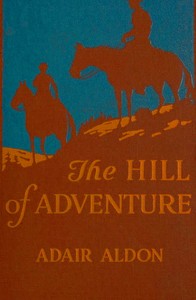
The Hill of Adventure
Language: en265 downloads on Project Gutenberg
Subjects
Public-domain ebook sourced from Project Gutenberg #57833.
Public-domain ebook
Language: en265 downloads on Project Gutenberg
Subjects
Public-domain ebook sourced from Project Gutenberg #57833.
The opening · free to read
It was with feelings of doubt that were not very far from dismay that Beatrice Deems watched her new acquaintance, Dan O’Leary, saddle her recently acquired horse. She had ridden before, of course, in the tan-bark ring of the riding-school or on shady bridle-paths in the park, always on well-broken steeds whose beauty and grooming were equaled only by their good manners. But now, as she stood in her short khaki riding-skirt and her high boots, waiting outside the great dilapidated shed that, in this little Montana town, did duty as a livery-stable, she was beginning to wonder whether she really knew anything about horses at all. Certainly she had never thought of riding anything like this plunging creature who stood straight up on his hind legs one moment, then dropped to his forefeet and stood on them in turn, with the ease of a circus performer.
She had spent only two days in Ely, the little town planted beside Broken Bow Creek, in the foot-hills of the Rocky Mountains. At first she had thought that the village, with its scattered box-like houses and dusty, shadeless street, was disappointingly unlike the West of the pictures-books and the movies. The antics of her new horse, however, were disturbingly like what she had witnessed in Wild West shows.
“’Name’s Buck,” volunteered the man who was struggling with the saddle, and added, though in a tone that seemed to indicate the explanation as quite unnecessary, “It’s on account of his color, you know.”
“Oh!” returned Beatrice, a little blankly. For the life of her, she could think of nothing else to say. She had yet to learn that all Western ponies of that golden buckskin shade of coat bear the same name. At the moment she was tempted to believe that the title had something to do with the way in which the horse was humping his back like a gigantic cat and jumping up and down on his nimble white forefeet.
“Your father went out on the range and chose the horse himself when he was out here getting your house ready,” Dan went on. “He couldn’t have found another pony in the valley that could go like this one.”
“Did he—did he try him?” Beatrice wished to know.
Her feelings in the matter were oddly mixed, for she dreaded the moment when she must actually mount to the big, unfamiliar saddle, and yet she was all on fire to try the horse’s speed.
“No, he didn’t try him,” was the answer. “He just said he wanted a safe horse for his daughter, liked the looks of this one—and well he might,—and took my word for it that the horse would suit and would go like greased lightning, besides. There, now, the saddle’s firm. You mustn’t think anything of the way he acts when you pull up the cinch; they all do that!”
For all her misgivings, Beatrice was no coward. She stepped forward, discovered in one violent second that a Western pony sets off the moment he feels the rider’s weight on the stirrup, then flung herself, somehow, into the saddle and was away.
“I did not do that very well,” she was thinking. “Another time—oh, oh!”
For her very thought was interrupted by the sudden rush of wordless delight as the horse beneath her stretched himself to that long easy lope that is like nothing else in the world. The fresh mountain wind, sweeping down from the clean, high peaks above, sang in her ears; the stony road swung past below; the motion was as easy as a rocking-chair but seemed as swift as thought itself. Motoring she had always loved, but she confessed with sudden disloyalty that it was bumpy business compared to the measured swaying of this living creature between her knees. Buck’s personal prejudices seemed, indeed, to be directed solely against the cinching of the saddle. That process once over he was as eager and happy as she to clatter across the bridge, pass the last of the ugly little houses and the high-fronted store buildings, and turn his white-blazed face toward the mounting trail that led out of the valley.
Beatrice drew rein when they had breasted the first rise, and paused a moment to look back. The houses strewn haphazard across the slope below her made more of a town than she had thought. There was the packing-box railroad station where she and her sister, Nancy, and their Aunt Anna had arrived so recently; there was the house where they were living, a little larger than the others, but square, hideous, and unshaded like the rest.
“We mustn’t care for architecture,” Nancy had said when they first surveyed their dwelling rather ruefully, “when the Rocky Mountains begin in our back yard.”
There was also the winding stream with its abrupt bend that warranted the title of Broken Bow Creek, a mere trickle of water just now, in that wide, dry valley down which the thin line of the railroad stretched away, with the straight parallel of the rails seeming to bend and quiver in the hot clearness of the sunshine. South of the town was a portion of Ely that she had not seen before, a group of warehouses, some office buildings, and a huddle of workmen’s bunk-houses. She could see the cobweb lines of temporary railroad, a steam-shovel moving on a flat-car, and innumerable men toiling like black ants along the sides of the raw cut that had been made in the red soil of the valley.
“That must be the irrigation ditch that Dan O’Leary was telling us about,” she reflected. “How hot it looks down there! I did not dream they had so many men. And how clear the air is! Oh, surely, surely, Aunt Anna will get well here as fast as we hope!”
The wind lifted Buck’s yellow mane and her own brown hair, while the horse pawed the stony ground impatiently. She let him go on, for she was in truth as eager as he. This was the first day that she had found time to go far from their own house, and she had now a most fascinating goal before her. What girl of sixteen would not feel excited over the prospect of exploring a tract of mountainside woods of which she was sole owner?
Beatrice had never quite understood how her father had come to purchase that stretch of land above Ely; she had not, indeed, thought to ask. She had come into his study one Sunday morning when he was going over his papers and had surprised him with the announcement that she was sixteen that day. Having no other present ready, he had brought out some dusty title-deeds and had made them over to her.
“It will never be of the least use to you, my dear,” he said, “so do not consider it much of a present. Twenty-three acres with timber, cabin, and a waterfall, so the description reads, but you must not think they are worth anything. I have never seen the place myself.”
She had believed that it was on account of this talk about Ely that they thought of the town again when the doctors had prescribed for Aunt Anna “a change of climate—some dry, bracing place in the West.” She was their only aunt, Mr. Deems’s younger sister, and she had cared for his household ever since the death of the two girls’ mother years ago. She was a slim, frail person of indomitable spirit, and had begun to look as though she were far more spirit than body ever since the influenza epidemic had swept through the family. Beatrice had always thought that going to Ely was her own suggestion, though she could not deny that it was Aunt Anna who had carried the plan through in the face of some rather unaccountable opposition from her father. Mr. Deems had finally given in, and had made a flying trip to Ely to be sure that the air and climate were what they wanted, to choose a house, engage a Chinese cook, and make all preparations for a summer’s stay for his sister and the two girls.
“I did not have time to visit your estate on the hill, Beatrice,” he said on his return. “You will have to explore it yourself. Dan O’Leary has charge of it and said he rented it to some engineers who were surveying the mountain, but it is unoccupied now. The place may prove to be a good picnic ground but I fear it has no other possibilities.”
He might say what he chose, Beatrice was thinking, but he could not destroy her eagerness to see the place. The trail ran crookedly upward before her, disappeared in some dense pine woods, then slanted across the spur of the mountain and vanished again. Higher above rose the bare, rocky slopes of the tall peak that dominated the whole valley, Gray Cloud Mountain, on one of whose lower, rugged shoulders lay her land and her cabin. After climbing for a quarter of a mile, she was obliged to hesitate at a fork in the way, uncertain which of the steep paths she was to take.
A little cottage clung to the bare hillside by the road—a shabby place with no paint and a patched roof. The door was swinging open as she passed and a man just going in, a short-set, foreign-looking person, who scowled at her over his shoulder when she asked the way.
“That one,” he said briefly, pointing to the right-hand fork and speaking with a heavy foreign accent. “Up toward John Herrick’s house, only not so far.”
He went in and shut the door abruptly. Beatrice could hear his voice inside calling roughly, “Christina, Christina!”
He had a roll of large papers in his hand, posters that he had evidently been putting up along the way, for she had observed them on trees and fence-posts nearer town. They seemed to announce a meeting of some sort, with English words at the top and odd foreign printing at the bottom in more than one language. She had felt a hot flash of indignant anger at the man’s surly tone, but in a moment she had forgotten him completely, as she and Buck went scrambling up the steep and difficult road.
She came at last to a tiny bridge. Broken Bow Creek, which was little more than a series of pools in the parched stream-bed in the valley, was here a singing rivulet, flowing below the rude crossing amid a group of silvery aspen-trees. At the left of the trail she could see a gate, a set of bars hung between two rough posts. It was with a beating heart that she dismounted to take them down for Buck to pass. Once inside she would be on her own ground.
The agility of a mountain-bred pony was so new to her that she was much astonished, after she had removed two of the bars, to have Buck step over the remaining three as neatly as a dog would have done. She slipped into the saddle again, making a greater success than at the first attempt, and followed the nearly invisible path. The huge straight pine-trees stood in uneven ranks all about her, their branches interweaving overhead, the ground covered with their red-brown needles that muffled the sound of the horse’s hoofs. Up they went, with the splash of falling water sounding louder and ever louder. Here at last was the place she sought, a square, sturdy cabin of gray logs chinked with white plaster, with a solid field stone chimney and a sloping roof drifted over with pine-needles. She slid from the saddle and stood upon the rugged doorstep. Here was her house, her very own!
It was a larger dwelling than she had expected and very solidly and substantially built. She found that wooden bars had been nailed across the doors and windows, and she had, moreover, forgotten to obtain the keys from Dan O’Leary, so that she could not go in. She could, however, peep through the easement windows and see the low-ceilinged rooms, the rough stairs, and the wide fireplace. The big trees nodded overhead, the roar of the waterfall came from beyond the house, the creek, rushing and tumbling, slid away down the mountainside. Somebody had planted pansies on both sides of the step, pansies that crowded and jostled each other as they only can in the cool air of the high mountains, spreading sheets of gleaming color over the barren soil. With a quivering sigh, Beatrice sat down upon the step.
The book keeps going
Reading is free forever. Sign up and watch scenes appear while you read.



Scenes Storieta drew for other classics.
New illustrated classics
Once or twice a month: the latest books to get full character casts, scene art, and free comic editions. No account needed.