TO hold the vicious up to odium and contempt should be at all times a particular care of the Press; but when every powerful engine is exerted to veil the vices of the privileged ranks, and to make it appear that crime is peculiar to those who constitute what are called the lower classes, it becomes a sacred and imperative duty.
We know there are some who, from a pretended regard to religion, would suppress every fact that exposes the licentious conduct of its ministers, but, nine times out of ten, this is mere hypocritical cant to support those who “bind heavy burdens, and grievous to be borne, and lay on men’s shoulders.” The mistaken infidel may connect religion with the conduct of its professors, but the truly religious person makes no distinction of vice but its comparative enormity, and the more he venerates the doctrine of Christianity, the greater abhorrence he feels towards the wretch who violates every principle of the religion which it is his duty to inculcate.
We see a certain Association evincing a most scandalous partiality, by SELECTING the objects of their prosecution from those most unable to defend themselves! we participate in the general feeling of censure against them, and believe that they have done more injury to the cause they profess to support, than the united efforts of the persecuted parties could possibly have effected. This will ever be the case when exertions are influenced only by feelings of policy instead of principle, for if as much pains were taken to keep improper characters without the pale of the church, as there is art exerted to defend them through thick and thin, when they have entered it, the CLOTH would probably never have been disgraced by the “Rev. Father in God,” whose notoriety promises to eclipse that of all former brothers in divinity.
The name of the Prelate may have appeared in the subscription columns of a newspaper, the only place where the charity of many is heard of. Nay, we have little doubt but it might be found in the list of subscribers to the highly respectable association the “_Bridge street gang_” or the “_Society for the suppression of vice_.” We would not rob him of any action of merit on this score, or them of any claim to respectability in the eye of the public; for ourselves we would say, “Woe unto you, Scribes and Pharisees, hypocrites, for ye—also outwardly appear righteous unto men, but within ye are full of hypocrisy and iniquity.” Any comment on the case itself must be superfluous, we therefore give it to the reader as extracted verbatim from the Statesman.
From the Statesman.
July 22, 1822.
OUR readers have often had to oblige us by their attention to what we have said of the blessed THING. We are now going to trouble them upon an extraordinary occasion indeed, and are going to give an instance of the baseness and infamy of the London newspapers, such as we never before had it in our power to give; and such as we are quite sure will, before we have done with it, implant the character of everlasting infamy upon that corrupt press, which has so long been boasting of its independence and its honour. What a deal we have heard about the press being the guardian of public morals! What volumes have we read about its powers of correction of evil! We have, indeed, heard a part of it condemned, the unstamped part of it; that part of it has been pointed out the refuse part; as the vile part; as the part which required laws to restrain it, to cramp it, to load it, to destroy it if possible. We have heard honourable Members in the honourable House, make a distinction between the respectable part of the press and another part, which they denominated disrespectable. We have heard volumes upon volumes of commendation, praise and puffery, about this respectable part of the press. We have always denominated it infamous; we have always said that that part of it which was not absolutely in the pay of Corruption was engaged in a sham warfare, quite as serviceable to Corruption as the efforts of her own hirelings; and that with perhaps a trifling exception or two, it was a mass of infamous fraud carried on under the name of impartiality; sending forth lies, endless in number, and boundless in magnitude, vomiting forth calumnies on the defenceless, and suppressing, through the means of bribes, directly or indirectly received, every fact that could tend to expose the thing, and give the common people their fair chance in society. This has been the character of this infamous press ever since we have known it; but we shall presently have to show our readers, that it has now surpassed even its own infamy, and done a deed so black as to make its former infamies turn pale.
We have first to insert an article from the weekly paper called The Observer; to which paper the public will be in great part indebted for the knowledge of the horrible affair which the article describes. We shall then offer a few observations, that may serve just for the present on the manner in which the thing has been and is likely to be illustrated by the circumstances of the transaction alluded to; and then we shall lay before our readers an account of the conduct of the “respectable” and infamous part of the press, upon this occasion; naming the several papers; and making them as notorious; as it is in our power to make them.
From the Observer Sunday Newspaper, July 21, 1822.
HORRIBLE OCCURRENCE.—SATURDAY.
“It is our painful and disgusting task this day to notice a charge which has been made against a Right Reverend Bishop, at Marlborough-street police office, at which human nature revolts. The circumstances are of such public notoriety at the west end of the town, that it would be in vain, if any delicacy were due to the party accused, to attempt to keep them from general observation. The individual to whom we allude was recently promoted to an Irish bishopric, and is nearly related to a Peer in Parliament. He is an elderly man, and we understand was much respected in that class of society to which he belonged. On Friday night it appears that he was detected in a back room of the White Lion public-house, in St. Alban’s place, St. James’s, in a situation with a _private __in the Foot Guards_, to which we will not more minutely allude, but which led to his instant apprehension and removal with his companion to the watch house. There were not fewer than seven witnesses to the fact; and it would seem that the Reverend Prelate with difficulty escaped the vengeance of the populace, who, if not prevented by the peace-officers, would have sacrificed him to their indignation on the spot. As it was, he was severely beaten. On being secured in the watch-house, he offered bail any amount for his liberation; but this was very properly refused, and he remained locked up in the cell during the night in a state of mind which may be more easily imagined than described. Yesterday morning he was conveyed in a hackney-coach to Marlborough street, and was soon afterwards followed by the soldier. They were both pursued by the execrations and revilings of the crowd which had been collected on so extraordinary an occasion. Mr. Dyer, the presiding magistrate, determined on a private examination, at which Mr. Alley, who attended for the Bishop, was present. The witnesses were called in separately, but their testimony was in all respects consistent, and the case established was to a certain extent of the clearest nature. Mr. Alley, however, submitted that as the capital charge had not been borne out, his client was entitled to bail; a proposition to which we understand Mr. Dyer was obliged to accede; and the wretched offender was permitted, in the course of the day, to go at large, upon finding sureties to the amount of one thousand pounds. The soldier, not so fortunate, was committed to take his trial.—For reasons which are obvious, we decline entering more minutely into the details of this most shocking affair; but we ought in justice to a worthy prelate, whose name has unfortunately been mentioned by mistake, in connection with the charge, to request our readers to reflect before they come to a positive determination as to the party really implicated.”
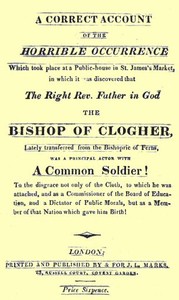
When our readers have gone through this article, and have heard us declare our perfect conviction of its truth; when they have heard us say, that it is agreeable, as far as it goes, with the enquiries which we have made, when they have further heard, that the scene of the brutal transaction was in a back room of the public-house above mentioned; that the parties had drawn the curtains of the room, but had left a part that the curtains did not cover but that might be seen through; that a little girl (vindicatress of her sex!) happening to go into the back court into which the window looked, wondering to see the curtains drawn, had the curiosity to look in, where she saw the parties engaged in that way not to be described, that the little girl (better guardian of public morals than the respectable part of the press) ran to the landlord, who came out with other persons with him, who were all witnesses of the fact, to that certain extent, at least, of which the Observer speaks; that after this, the landlord and others laudably went, dashed in the door, took the parties in the state of Achilles as far as nakedness was necessary to their intentions; that they then dragged them to the watch-house, in that very same state: when our readers have heard all this, they will naturally cry aloud, “why is the name of this Bishop suppressed?” It is a Bishop the article says. It is a “venerable prelate;” it is a Right Reverend Father in God; and why then, is his name suppressed? The Observer informs us that another “worthy prelate” has been named; and unfortunately named; and the Observer requests its readers to reflect before they come to a positive determination as to who the party is. What, are all the Bishops then, to live under this imputation or suspicion? Are all the Bishops to be suspected for the sake of this wretch, as the Observer itself justly calls him? This would be injustice towards the Bishops in general, equal to that which the most respectable and most infamous part of the press has been guilty. We shall do our duty. And we here inform our readers: without anticipating the decisions of courts of justice; without pretending to know whether the alledged crime can be proved or not; without pretending to anticipate any thing of this sort, we inform our readers of that which they all ought to know, that the person, who was taken from the White Lion public-house above-mentioned to the watch-house, and who was afterwards taken from the watch-house to Marlborough-street, and who was held to bail as above-mentioned; we here inform our readers that that person who was so taken along with the soldier of the guards was the Honourable and Right Reverend Father in God, PERCY JOCELYN, Lord Lord Bishop of Clogher, (lately translated to that Bishopric from the Bishopric of Ferns,) a Commissioner of the board of Education (“education of the country!”) brother of the late Earl of Roden.