Public-domain ebook
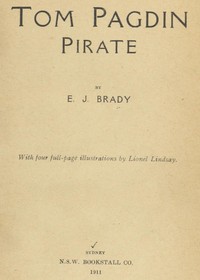
Tom Pagdin, Pirate
by E. J. Brady
Language: en298 downloads on Project Gutenberg
Subjects
In: Children & Young Adult Reading·Humour·Adventure
Public-domain ebook sourced from Project Gutenberg #58132.
Public-domain ebook
by E. J. Brady
Language: en298 downloads on Project Gutenberg
Subjects
In: Children & Young Adult Reading·Humour·Adventure
Public-domain ebook sourced from Project Gutenberg #58132.
The opening · free to read
PIRATES ALL.
The Broadstream punt was grating gently on the pebbles at the South Side. Morning, gowned in silver grey, with trimmings of gold, still slept voluptuously on her divan in the Orient East. The mists were slowly lifting from the river, but hung yet lovingly along the creeks and upon the reedy lagoons.
Tom Pagdin, with his bare legs hanging over the rails of the punt, watched the cork floater of his fishing line sleepily. His bamboo rod cast a clear shadow in the water of the deep Broadstream. It was a new rod, cut some days before from the lower boundary of Henry Dobie’s garden. Old Tom Pagdin was not on speaking terms with Dobie, hence young Tom had taken that rod; at dusk, knowing that the particular commandment relating to the case was temporarily suspended.
Old Tom (cheerfully so-called by roystering fishermen) rented the Broadstream punt from the Government, which he regarded as his natural enemy. It was only at election times that Pagdin, senior, got anything like even with the Government, exercising the right of secret ballot against the sitting member behind his back, while pretending absolute fealty to his face. On these occasions the puntman invariably came home to the little shanty by the riverside glorious, and next day young Tom was usually too sore to sit down with any degree of comfort.
But the life of a boy on the Broadstream could not possibly be dull for long, and the thrashings which Tom Pagdin so regularly received at the hands of the ‘old man’ possibly gave greater relish to his pleasures.
In the Northern streams the perch bite best in the early morning, but it happened that the fish were dainty, or shy, and even the black cricket still kicking on the hook did not draw them.
So, when a waterhen came out on the broad green leaves of the lilies, which were just opening their purple flowers to the rising sun, Tom Pagdin let his rod drop gently in the water, drew his catapult from the pocket of his frayed trousers, fitted a carefully-chosen pebble in the sling, and let fly.
“Hit ’m!” he shouted, triumphantly, flicked the line out of the water, sprang to the handle of the windlass, and commenced to work the punt with all speed to the opposite side.
He was about midway across when the wheels of a milk-cart, en route to the creamery with full cans, grated down the edge, to an accompaniment of complaining brake echoes.
A red-headed boy, with a heavy cartwhip in his hand, was standing up in front throwing as much style into the driving as he knew.
“Ere!” he shouted, indignantly, “where y’ goin’ with that punt?”
Tom heard the hail, and looked back over his shoulder.
“Hold on a minute, can’t yer,” he howled. “I just peppered a coot; I’m goin’ acrost for him.”
The red-headed boy was interested immediately.
“Where is ’e, Tom?” he cried. “I can’t see ’im.”
“Can’t y’ see ’im kickin’?” shouted Tom, working vigorously at the handle; “’e’s in the lilies over ’ere.”
“Which side?” demanded the red-headed boy, excitedly. “Which side of the punt is he on?”
“Right-hand side. I’ve wounded him bad.”
“I spot ’im,” cried the boy in the cart. “I spot ’im. Hurry up, Tom; he’s goin’ to dive.”
“No he ain’t. He’s wounded too bad.”
“Yes he is. He’s going to dive. He’ll get away from yer.”
“’E can’t get away,” shouted Tom, perspiring violently.
The banks of the Broadstream at the crossing were not far apart, but the punt was heavy and slow.
“He will get away!” cried the red-headed boy in a pained voice. “You’ve only broke his leg.”
Whereat he jumped out of the cart, picked up a handful of pebbles, and began shying them across stream.
“Let up!” yelled Tom Pagdin. “Let ’im alone; ’e’s my coot!”
A hunter who has mortally wounded an old man lion with his last cartridge could not have claimed possession with greater emphasis.
“He’ll get away,” pleaded the red-headed boy in extenuation. “You’ve only broke his leg.”
“’E won’t get away,” shouted Tom. “’E’s mortal wounded. You let up, Dave Gibson, or I’ll punch yer ’ead when I get acrost.”
The punt swung in close to the bank. Tom Pagdin let go the handle, stripped off pants and shirt, and plunged in after his quarry.
Now this was a dangerous thing to do, inasmuch as the water was not only deep enough to drown a boat’s crew, but the long brown stalks of the giant lilies growing up from the bottom in netted confusion might tangle the stoutest swimmer. Many a good swimmer, in sooth, has lost his life in that fashion by the banks of the Northern rivers.
But young Tom Pagdin thought not of depth nor danger; the wounded coot was a prize of as great importance at the moment as a kingdom to Alexander. All the primal instincts of the chase were aroused in him. He floundered and kicked and splashed among the flat leaves, turning up their red undersides, making many bubbles, and frightening the perch and eels from their feed. At last, puffing and almost exhausted he got within reach of his game, grabbed it triumphantly by the neck, and turned about to swim back. And just then old Tom Pagdin, with his pipe in his mouth, stepped on to the punt. The old man had been thrice wakened out of his sleep the previous night to go across stream and bring late travellers over and even the solace of the extra sixpences over and above his legitimate toll had not soothed his anger.
The animosity of Pagdin, senior, to men and things was chronic. His grievance was general. The world was against him, as it is against all puntmen, and, like all puntmen, he was against the world.
In the first place he proclaimed loudly that the Government gave him no chance—the yearly rent exacted by the Department for the right of the crossing was too high; it was an imposition, an outrage, a robbery. The victim wailed cursefully at the windlass from morn to eve. The Member for the district had promised him that the yearly charge should be reduced. He was convinced in some indefinite way that the Member was in the conspiracy against him—that he personally pocketed some of the plunder. Then the tolls which the Department allowed him to exact from travellers were too low. Threepence a head for foot travellers, sixpence for horsemen, and ninepence for vehicles did not pay. Then he never got his proper night’s rest, mainly because the public house was on the North Side, and the fellows who went across in the evening never thought about him. They hardly ever thought about bringing him a toothful, either. They could come and hail angrily across the water at one and two o’clock in the morning for the punt, but they seldom remembered when they were leaving the Rising Sun that the puntman had a mouth on him.
The fishermen who came down to the Broadstream on Saturdays and Sundays were no better. The picnic crowds were worse, and, as for the swagmen and fellows looking for work along the river, they were an utter abomination—a poor, struggling cove—to take them over for nothing, and sometimes even swimming the Broadstream to avoid paying toll—taking the bread directly out of a poor cove’s mouth.
When old Tom reached this climax he usually spat in the water and looked up and down the bank with a smouldering eye to see if young Tom was doing anything that merited punishment.
And as young Tom usually was, his dad would entertain the passing fare for the rest of the passage with a detailed account of the unregenerateness and general cussedness of that youth, to whom he was trying to be both father and mother, and bring up in the way he ought to go. The old man would explain wrathfully that whereas his only son and heir ought to be a blessing and a comfort to him, he was nothing but a trial, and generally before the fare had got to the top of the long, steep bank the yells of young Tom resounding through the bush indicated that the way of the evil-doer, if sometimes pleasurable, was also hard.
So Tom would rather have seen the devil step on the punt that morning than his father.
The latter seized the situation with angry gratitude. The Lord had set him a pleasant duty to perform. He set about it with the air of a Roman dictator who had been called upon to pass judgment on a conspirator after a bad night.
The old man looked in the water and saw Tom. Tom had already seen the old man, and was “treading water”—and thinking. He still held the coot firmly by the neck.
The book keeps going
Reading is free forever. Sign up and watch scenes appear while you read.



Scenes Storieta drew for other classics.
New illustrated classics
Once or twice a month: the latest books to get full character casts, scene art, and free comic editions. No account needed.