Public-domain ebook
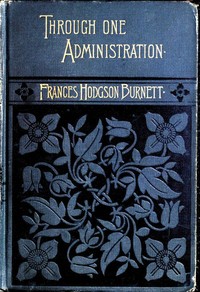
Through One Administration
Language: en334 downloads on Project Gutenberg
Subjects
In: Novels·American Literature
Public-domain ebook sourced from Project Gutenberg #58325.
Public-domain ebook
Language: en334 downloads on Project Gutenberg
Subjects
In: Novels·American Literature
Public-domain ebook sourced from Project Gutenberg #58325.
The opening · free to read
Eight years before the Administration rendered important by the series of events and incidents which form the present story, there had come to Washington, on a farewell visit to a distant relative with whom he was rather a favorite, a young officer who was on the point of leaving the civilized world for a far-away Western military station. The name of the young officer was Philip Tredennis. His relative and entertainer was a certain well-known entomologist, whom it will be safe to call Professor Herrick. At the Smithsonian and in all scientific circles, Professor Herrick's name was a familiar one. He was considered an enviable as well as an able man. He had established himself in Washington because he found men there whose tastes and pursuits were congenial with his own, and because the softness of the climate suited him; he was rich enough to be free from all anxiety and to enjoy the delightful liberty of pursuing his scientific labors because they were his pleasure, and not because he was dependent upon their results. He had a quiet and charming home, an excellent matter-of-fact wife, and one daughter, who was being educated in a northern city, and who was said to be as bright and attractive as one could wish a young creature to be.
Of this daughter Tredennis had known very little, except that she enjoyed an existence and came home at long intervals for the holidays, when it did not happen that she was sent to the sea or the mountains with her mother instead.
The professor himself seemed to know but little of her. He was a quiet and intensely studious person, taking small interest in the ordinary world and appearing always slightly surprised when his wife spoke to him; still, his manner toward her was as gentle and painstaking as if she had been the rarest possible beetle, and the only one of her species to be found in any known collection, though perhaps the interest she awakened in him was not so great as it might have been under such exceptionally favorable circumstances. She was not a brilliant or far-seeing woman, and her opinions of entomology and, indeed, of science in general, were vague, and obscured by objections to small boxes, glass cases, long pins, and chloroform, and specimens of all orders.
So, observing this, Tredennis felt it not at all unnatural that he should not hear much of his daughter from the professor. Why his relative liked him the young man was not at all sure, though at times he had felt the only solution of the mystery to be that he liked him because his tendency was toward silence and books and research of all kinds. He thought he was certain that the professor did like him. He had invited him to visit him in Washington, and had taken him to the Smithsonian, and rambled from room to room with him, bestowing upon him tomes of information in the simplest and most natural manner; filled with the quietest interest himself and entirely prepared to find his feeling shared by his charge. He had given into his hands the most treasured volumes in his library, and had even seemed pleased to have him seated near him when he sat at work. At all events, it was an established fact that a friendly feeling existed between them, and that if it had been his habit to refer to his daughter, he would have spoken of her to Tredennis. But Tredennis heard nothing of her until he had been some days in Washington, and then it was Mrs. Herrick who spoke of her.
"Nathan," she said one evening at dinner, "Bertha will be home on Tuesday."
The professor laid his spoon down as if he had rather unexpectedly discovered that he had had enough soup.
"Bertha," he said. "Indeed! Next Tuesday. Well, of course, we must be ready for her. Do you want any money, my dear? But, of course, you will want money when she comes, if she has finished school, as I think you said she had."
"I shall want money to pay her bills," answered Mrs. Herrick. "She will bring them with her. Her aunt has had her things made in New York."
"Yes," said the professor, "I dare say they will be more satisfactory. What kind of things, for instance, Catherine?"
"Dresses," replied Mrs. Herrick, "and things of that sort. You know she is to come out this season."
"To come out," remarked the professor, carefully giving the matter his undivided attention. "I hope she will enjoy it. What sort of a ceremony is it? And after a young person has 'come out' does she ever go in, and is there any particular pageant attached to such a--a contingency?"
"When she comes out," answered Mrs. Herrick, taking a purely practical view of the affair, "she begins to go to parties, to balls, and receptions, and lunches; which she does not do when she is going to schools. It isn't considered proper, and it wouldn't give her any time for her studies. Bertha hasn't been allowed to go out at all. Her aunt Maria has been very particular about it, and she will enjoy things all the more because they are quite new to her. I dare say she will be very gay this winter. Washington is a very good place for a girl to come out in."
After dinner, when they retired to the library together, it occurred to Tredennis that the professor was bestowing some thought upon his paternal position, and his first observation proved that this was the case.
"It is a most wonderful thing that a few brief years should make such changes," he said. "It seems impossible that so short a time should change a small and exceedingly red infant into a young person returned from school in the most complete condition, and ready to 'come out.' She was not interesting as an infant. I tried to find her so, but failed, though it was insisted that she was an unusually intelligent baby, and I have not seen much of her of late years. When she was growing it was thought that the climate of Washington was not good for her. I am really a little curious about her. My views of girls are extremely undefined. I have always been a bookworm. I have not known girls. They have not come within my radius. I remember one I once knew years ago, but that is all. It was when I was a younger man. I think she was a year or so older than Bertha. She was very interesting--as a study. She used to bewilder me."
He walked over to the table, and began to turn over some papers.
"She had gray eyes," he said, in a rather lower voice,--"gray eyes."
He was so quiet for some time that Tredennis thought he had forgotten what he had been talking about; but, after a pause of at least three minutes, he spoke again.
"I would not be at all sorry," he said, "if Bertha was a little like her. I suppose," he added,--referring seriously to Tredennis,--"I suppose they are all more or less alike."
"I think"--faltered Tredennis, "perhaps so."
He did not feel himself an authority. The professor stood still a moment, regarding the fire abstractly.
"_She_ had gray eyes," he said again,--"gray eyes!" and immediately afterward returned to his table, seated himself, and fell to work.
The next week Bertha arrived, and to her distant relative her arrival was a revelation. She descended upon the quiet household--with her trunks, her delight in their contents, her anticipation of her first season, her fresh and rather surprised exultation in her own small powers and charms, which were just revealing themselves to her--like a young whirlwind. Her mother awakened to a most maternal interest in the gayeties into which she was to be drawn; the very servants were absorbed in the all-pervading excitement, which at length penetrated to the professor's study itself, and aroused him from his entomological reveries.
After she had been in the house a week, he began to examine the girl through his spectacles with great care and deliberation, and, having cheerfully submitted to this inspection through several meals, one day at dinner its object expressed herself with charming directness concerning it.
"I do hope you'll like me, papa," she said, "when you have classified me."
"Classified you!" said the professor, in some bewilderment.
"Yes," answered Bertha. "You know I always feel as if you might turn me over gently with your finger at any moment, and watch me carefully while I struggled until you knew all about me, and then chloroform me and stick a pin through me with a label on it. I shouldn't like the chloroform and the pin, but I should take an interest in the label. Couldn't I have the label without the pin, papa?"
"I don't know," said the professor, examining her more carefully than ever. "I am afraid not."
After that it became his custom to encourage her to reveal herself in conversation, which it was very easy to do, as she was a recklessly candid young person, given to the most delightfully illogical partisanship, an endless variety of romantic fancies, and a vivid representation of all facts in which she felt interest. It must be confessed that, for the sake of hearing her talk, the professor somewhat neglected, for the time being, both Coleoptera and Lepidoptera, and, drifting into the sitting-room upon many sunny mornings, allowed himself to be surrounded by innocent frivolities in the way of personal adornments. And it must also be added that he fell into the habit of talking of the girl to Tredennis, as they sat together by the study fire at night.
"She is an attractive girl," he said once, seriously. "I find myself quite absorbed in her at times. She is chaotic, illogical, unpractical--oftener than not she does not know anything of what she is talking about, but her very absurdities have a kind of cleverness in them. And wit--there is wit in her nonsense, though she is scarcely conscious of it. I cannot help thinking of her future, and what its needs will develop in her. It all depends upon the needs. You never know what will be developed, but you know it depends upon the needs."
"I--hope there will be no painful needs," said Tredennis, looking at the fire. "She is very happy. I never saw any one so happy."
"Yes, she's very happy," admitted the professor. "At present she is not much more than a joyous, perfectly healthy young animal. She sings and laughs because she can't help it, and she adorns herself from instinct. She'll be different in a year or two. She'll be less happy, but more interesting."
"More interesting!" said Tredennis, in a low voice.
"Yes, more interesting," answered the professor, looking at the fire himself, with an air of abstractedly following a train of thought. "She will have made discoveries about herself. It is a pity she can't make them without being less happy--but then, none of us are happy." He paused, rubbed his forehead a second, and then turned suddenly on Tredennis.
"Are you happy?" he demanded.
Tredennis started and hesitated.
"Y-yes--n-no," he answered, unsteadily. He would have said yes unreservedly a short time ago; but within the last few days he had been less sure of himself, and now, being confronted with the question unexpectedly, he found that he must answer with a reservation--though he could not at all have given a reason for the feeling that he must do so.
The book keeps going
Reading is free forever. Sign up and watch scenes appear while you read.



Scenes Storieta drew for other classics.
New illustrated classics
Once or twice a month: the latest books to get full character casts, scene art, and free comic editions. No account needed.