Public-domain ebook
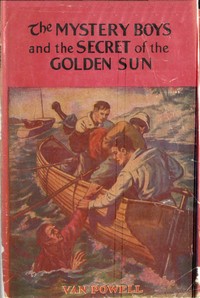
The Mystery Boys and the Secret of the Golden Sun
by Van Powell
Language: en346 downloads on Project Gutenberg
Subjects
In: Crime, Thrillers and Mystery·Adventure·Novels
Public-domain ebook sourced from Project Gutenberg #58420.
Public-domain ebook
by Van Powell
Language: en346 downloads on Project Gutenberg
Subjects
In: Crime, Thrillers and Mystery·Adventure·Novels
Public-domain ebook sourced from Project Gutenberg #58420.
The opening · free to read
“That fellow is watching us again!” whispered Tom Carroll to his companions, Nicky and Cliff, as he adjusted a pack strap on the Mexican burro behind which he sheltered his face as he spoke.
“If he keeps on, I’m going over and ask him what’s next!” Nicky said, “I’ll find out what he means by it or know the reason why.”
Nicky was impulsive and quick: he preferred action to reasoning, and was usually more willing to meet trouble than to avoid it. Tom, who was generally as cool and as level headed as Cliff, the oldest of the trio, seemed inclined to agree with the youngest chum; but Cliff, cinching up his pony’s saddle, shook his head at Nicky.
“We came out here to try to learn something about Tom’s sister, not to court trouble,” he urged. “I guess that chap is simply curious about us and is watching to see that we saddle up properly.”
“Is it any of his business?” demanded Nicky. “He’s just one of the miners having his lunch. What business is it of his what we do or how we do it?”
“He looks pretty mean,” Cliff admitted.
Tom, having taken a moment to consider, as he generally did, came to a conclusion. “I’m not so sure that he is mean,” he told his two friends. “That scar across his face, and his bleary eyes, make him look pretty fierce; but he may be perfectly innocent of any wrong thoughts. As long as he only watches, he isn’t breaking any law or hurting us. Are you fellows ready?”
“All set!” answered Cliff, patting his pony’s flank.
“Then, let’s not bother about a rough looking miner who has hardly taken his eyes off us since we came here this morning. Nicky, run over to the mine office building and tell Mr. Gray we’ve got everything ready to start back.”
Nicky dropped his own pony’s rein over its head, while Tom, with his lithe movements apparent in the ease with which he mounted his own animal, caught the bridle of an extra mount and Cliff took the burro’s leading rope. Nicky ambled across the flat ground toward a zinc sheathed shack at a little distance.
Cliff and Tom sat on their ponies, watching covertly as the man they had been discussing finished the remnants of his chili con carne, wiped his mouth on a ragged coat sleeve, rose and strolled with a seemingly aimless air toward the upper level on which stood the engine house, the mouth of the mine and other timbered and metal covered buildings.
Nicky, on his return, looked around, saw that the man was gone and voiced a proposal.
“Mr. Gray says he won’t be ready to go for more than an hour,” he informed his chums. “The mine superintendent is telling him about some old Aztec curios he owns, and you know how that will chain Cliff’s father in his chair. What do you say if we take a little gallop down the trail—a race, maybe?”
Tom vetoed the race: they had a good ride before them and he did not want to start on winded ponies: however, he agreed to a short ride on a trail that they had not explored and the trio rode off, tying their burro to await their return.
The extra pony, also left standing, may have wondered why his own rider, the older one, had not come; but he waited with the patience of a well trained animal.
As the boys rode along, the trail became rapidly steeper and the small plateau narrowed into a rough, rocky coulee.
“It certainly is too bad,” Nicky said, with a sidewise glance of rueful sympathy toward Tom. “After we came all the way to Mexico City and then rode out here to the old mine, it is too bad that we can’t get even a trace of your missing sister.”
Tom nodded.
“Yes,” he agreed. “You’d think the authorities would know something, after all these years, or that we could pick up some clues.”
“It would have been different in the United States,” said Nicky, with a sense of pride in his native land. “Our detectives don’t let the grass grow under their feet.”
“And yet,” broke in Cliff, “many girls, and men and women, too, disappear in America and never are found.”
“There were no eye-witnesses, except the ones they found dead, after the bandits made their raid—that’s why there were no clues,” Tom added.
“Well,” he finished, sadly, “I guess my own private mystery will never be solved.”
“You can’t tell,” Nicky said, with his usual optimism. “You know, it seemed as though Cliff’s father would never be heard from again, after he went to Peru—but we got a letter, or Cliff did, and we went down there with Mr. Whitley, our history instructor—and not only rescued Mr. Gray from the hidden Inca city, but we saw a lot of adventure and got some of the Inca treasure.”
“And your mystery seemed as though it would never be solved, Nicky,” Cliff reminded his friend. “With only half of a cipher message left to your family by Captain Kidd, it was possible for us to find the hidden treasure in the Florida keys and have a lot of excitement in the bargain.”
“And both adventures started out very tamely,” Nicky was trying hard to brighten up his comrade; but Tom only shook his head.
“This is different,” he said.
Nicky and Cliff referred to two exciting escapades in which all three had participated. Because each of them had had a mystery in his life the three had drawn very close in the bonds of friendship, and had formed themselves into a secret order which they called the Mystery Boys. They had secret gestures by which they could communicate with one another in the presence of others without divulging the fact that they did so: also, they had initiation rites and binding oaths and strict codes which held them together and bound them to help each other in every way to solve their individual mysteries.
Cliff’s mystery, as Nicky said, had been cleared up in the summer past: the following winter the trio, while in Jamaica, had run onto some information which had begun the adventure through which the hidden treasure mystery of Nicky’s family had been brought to a successful end.
While in Cliff’s case the reward had not been financially large, he had found his father. In Nicky’s adventure no life had been involved in danger, but a buried mass of gold bars had been recovered and distributed fairly so that each of the three was, in a modest way, provided for as far as riches went: they were not made millionaires, because the treasure had to be shared with others involved in Captain Kidd’s legacy, but they were “well fixed.”
But in Tom’s case, the mystery was of a different kind, and there was in it not only the element of tragedy, but, as well, the element of uncertainty.
Hardly more than five years ago Tom, confined to his bed by a bad attack of measles, had been thus prevented from going with his father and his sister, a year older than he, to Mexico. That saved his life, which is a curious thing to think about—that sickness saved him from a worse fate.
Mr. Carrol, an engineer and mining expert, sent to inspect some mining property, had left Tom under the care of an older cousin; but so eager had eleven-year-old Margery been to see the strange country that Mr. Carrol had taken her with him.
That farewell, looking out of a darkened room at the bright hair and half-smiling, half-tearful face, had been Tom’s last sight of his beloved sister; and that clasp of hands between father and son had been the last they could ever exchange.
For, shortly after the arrival of the engineer and his daughter at a remote mining property, bandits had descended from the mountains in a raid, seemingly because they knew that gold to a high value had been amassed and stored until time to load it on burros and with armed guards take it to the railway shipping point.
In the news, meagre and disjointed, which Tom had received, it was supposed that the bandits had come to the mine during the night, had been seen and attacked by the engineer and several other Americans who were in charge of the property. A fight must have ensued, but one disastrous to the defenders, because the gold was gone and the mine was deserted when the workmen came from their hovels far down the trail the next day. According to what Tom heard, they had found his father and the other Americans, all past any earthly aid.
But there had been no news of Margery!
With his heart torn by his bereavement and with terror gnawing at his mind day and night, even at the tender age of ten, Tom had begged his father’s cousin to use every effort to learn what had happened to his sister. All that could be done, had been done.
But the family had little money and although the Government made inquiries and State departments exchanged notes and the Mexican authorities declared that soldiers had scoured the neighborhood of the mine and the passes in the sierras—and some of the bandits had been caught and punished!—there was no trace of the little girl.
No wonder that Tom suffered anguish every time he thought of her. Was she wandering about in the mountains, alone, starved? Was she a captive among the bandits? Those who had been caught declared by everything they reverenced that they had not seen her at any time nor after the retreat had they seen her in their camp among the cordilleras. Even the gold was gone! A renegade white man—they had not known his nationality—had incited the attack, seeming to guess that there was money to be had. But he had disappeared during the fighting—and so, they averred, had the gold bags and the burros.
The book keeps going
Reading is free forever. Sign up and watch scenes appear while you read.



Scenes Storieta drew for other classics.
New illustrated classics
Once or twice a month: the latest books to get full character casts, scene art, and free comic editions. No account needed.