Public-domain ebook
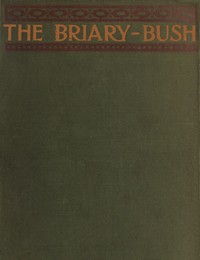
The Briary Bush: A Novel
by Floyd Dell
Language: en573 downloads on Project Gutenberg
Subjects
In: Novels·American Literature
Public-domain ebook sourced from Project Gutenberg #58622.
Public-domain ebook
by Floyd Dell
Language: en573 downloads on Project Gutenberg
Subjects
In: Novels·American Literature
Public-domain ebook sourced from Project Gutenberg #58622.
The opening · free to read
He had hoped, a year ago, to find, in the excitement of a new life in Chicago, healing for the desperate hurts of love. If only he had gone then!...
But he hadn’t had the money to buy a railway ticket.
He had taken this job on the Record, and settled down to life in Port Royal again as a reporter.
His twenty-first year had gone by.
The hurts of love, so intolerably hard to bear, had healed.
After all, Joyce Tennant had loved him; nothing could ever take away his memories of those starlit evenings on the river, and in the little cabin on their lonely island. She had loved him, she had been his. There was comfort in that thought.... The hurts of love had healed.
But the hurts of pride remained. Loving him, she had chosen to marry another. That wound still ached....
She had seen him all along for what he was—a moonstruck dreamer! She had thought him the fit companion of a reckless love-adventure—that was all.
Her scorn, or what seemed to him her scorn, mirrored and magnified by the secret consciousness of his own weakness, came to assume in his mind the proportions of a final and universal judgment.
A dreamer? And a dreamer only? His egotism could not endure the thought.
The shadow-world of ideas, of theories, of poetic fancies, amidst which he had moved all his life, was not enough. He must live in the real world.
Chicago became for him the symbol of that real world. It was no longer a place of refuge—it was a test, a challenge. He would go there not as a moonstruck dreamer, but as a realist, able to face the hard facts of life.
He would become a different person.
He was tired of being Felix Fay the fool, the poet, the theorist. He would rather be anybody else in the world than that Felix Fay whose ridiculous blunderings he knew by heart.
He could imagine himself in Chicago, a changed person—a young man of action, practical, alert, ruthlessly competitive....
Dreaming of success in Chicago, he sat idly at his desk in Port Royal.
Hastings held in his hand the sheaf of items from Wheaton, over which Felix had casually written a heading half an hour before. Felix held out his hand and took them. Something was wrong. He looked anxiously at the items, written in grey pencil on coarse paper in a straggling hand. The page uppermost was numbered “3.” He had hardly glanced at it. Evidently he had overlooked something.
It caught his eye instantly—the second item from the top:
A man named Cyrus Jenks, known as Old Cy, committed suicide last night by hanging himself in the barn. He was a well-known village character, chiefly noted for his intemperate habits. The inquest will be held today. His one good trait was his devotion to his old mother, who died recently. He was her illegitimate child. She was one of the Bensons, who until her disgrace were one of the principal families in the county. Her father was Judge Benson. The family moved to North Dakota years ago, and left her here in the old family home, where she lived alone with her son until she died. Before hanging himself Old Cy set fire to the house, and it was partly burned. Since the old lady’s death he had received several offers for the place, but refused to sell, and said that no one should ever set foot in his mother’s house. The incident is causing much local comment.
Felix drew a long breath. He certainly had overlooked something! He could see that story, with its headlines, on the front page of the Record—rewritten by himself. It was just the kind of story that he could handle in a way to bring out all its values. And he had had it in his hands—and had let it pass through them, buried in a collection of worthless country items!
“The postmistress at Wheaton,” Hastings was saying gently, “is not supposed to know a front-page story. You are supposed to know—that is the theory on which you are hired.”
Felix did not reply. There was nothing to be said.
Hastings was looking at him thoughtfully. “I don’t know what’s got into you, Felix,” he said. “I thought you were going to make a good newspaper man. And sometimes I think so still. But mostly—you aren’t worth a damn.”
“Yes, sir,” said Felix. “—I mean, no, I don’t think I am, either.”
He was going to be fired.... Well, he deserved it. He ought to have been fired long ago. And he was rather glad that it was happening.
Hastings was rather taken aback. “Well,” he said, “frankly, I was going to let you go. But—well, there’s no harm done this time; we’d already gone to press when that stuff came in. Of course, I don’t say that your—your letting it get by was excusable. In fact, I simply can’t understand it. But—if you realize—”
So he was not going to be fired after all! Felix was unaccountably sorry.
“If you think you can pull yourself together—” said Hastings. “I’d hate to have you leave the Record. I’ve always—”
Felix felt desperate. He knew now why he wanted to be fired. It would give him the necessary push into his Chicago adventure. He would never have the courage to leave this job, and venture into the unknown, upon his own initiative. He didn’t have any initiative.
“I don’t think it’s any use, Mr. Hastings,” he said, “keeping me on the Record.”
Hastings stared at him incredulously.
“I mean,” Felix went on hastily, “I’ve got in a rut. I go through my work mechanically. I don’t use my brains. I’m dull. And it’s getting worse. I simply can’t take any interest in my work.”
“You mean you want to be fired?” Hastings asked severely.
It was absurd. In fact, it was preposterous. This was not the way to do it at all. But it was too late now.
“Yes, sir,” he said.
“Well, then, you are.” Hastings looked coldly at the ungrateful and rather sheepish-looking youth standing before him. “Have you got another job?” he asked suspiciously.
“No—I’m going to Chicago to look for one.”
As soon as he said that, he wished he hadn’t. It committed him to going. He couldn’t back out now. He had to go.
“And I haven’t any money except my pay-check for this week.”
He hadn’t thought of that before. How could he go without money?
The book keeps going
Reading is free forever. Sign up and watch scenes appear while you read.



Scenes Storieta drew for other classics.
New illustrated classics
Once or twice a month: the latest books to get full character casts, scene art, and free comic editions. No account needed.