Public-domain ebook
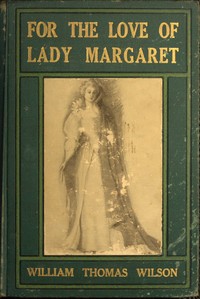
For the Love of Lady Margaret: A Romance of the Lost Colony
Language: en290 downloads on Project Gutenberg
Subjects
In: Historical Novels·Romance·Adventure
Public-domain ebook sourced from Project Gutenberg #58690.
Public-domain ebook
Language: en290 downloads on Project Gutenberg
Subjects
In: Historical Novels·Romance·Adventure
Public-domain ebook sourced from Project Gutenberg #58690.
The opening · free to read
And so this was the end? Well, no matter--I had lived my little day--had played my part. The bell had tapped; the curtain had fallen; and so the scene must end. How many of those who had seen the little game played out, and had applauded the actor, would remember after the lights were out and the house was dark? I had passed from Heaven to Hell in four short hours--four hours!
My new white trunks, with the gray doublet, were on the bed, where I had laid them out. I had planned to wear them to Lady Wiltshire's ball to-night.
The guests were just beginning to arrive--Raleigh, with the gallant air and courtly mien; Lord North, with his stupid and insufferable egotism; Francis Bacon, the austere and brilliant, and the Viscount James Henry Hampden, who would, in my absence, promptly take possession of Lady Margaret Carroll.
Ah, my lady! wouldst thou give one thought to me when I had passed out of thy life forever? Wouldst thou, like the rest, move on without one sigh, thine eyes fixed upon the moving figures about thee, forgetful that there was wont to be another by thy side, who was now gone for aye? Would one tear fall from those beautiful eyes which I had looked into so often within the last two years?--years that seemed so short to me to-night, as I looked back over them, and thought of the golden hours, which had once gleamed so bright and happy before me, but now lay so far behind, lost in the moldering ashes of the forgotten past.
It seemed like long years since I had received that short note from my father, with its few curt lines, saying that our paths must separate; that I had disgraced the family; that he had borne with me till flesh and blood could stand no more, and henceforth I would be as a stranger to him.
Life indeed seemed black to me! Past my first youth (I was thirty-two), brought up to do nothing except to enjoy myself, with an ample income, which my father, Lord Richmond, had always supplied--what wonder that I felt as if the anchor had indeed slipped, and that I was adrift at the mercy of the wind and tide.
I might, it was true, drift on for a few weeks on credit, and borrow from my friends, but I had no mind to do that. Whatever my faults, and they were many and grievous, I had at least lived like a gentleman, and had nothing on that score to reproach myself with.
I did not wish to run deep into debt, and cause honest tradesmen to lose their just dues because they had trusted to my honor. No; whatever came, I would not do that. I would face the situation fairly and squarely--would work out as best I could my own salvation, without fear or favor from any man.
The old lord, my father, had always disliked me; I remember as a boy how he never had a kind word for me. My older brother, Richard, was his favorite, and Richard had never lost an opportunity to prejudice him against me.
My brother, as a little boy, had always treasured up all my mistakes and punishments at school, and when he returned home, would recount them to my father with a grave face, so that he would have the pleasure of hearing him reprove me, which I believe that Richard delighted in.
What wonder was it, when I finished school, that I chose, after a year or two in the Irish campaign, to return and remain in London, rather than journey down to the grim old castle, built by the third Lord Richmond during the reign of Stephen, and live there with my father and Richard.
My mother had been dead for years. From out of the dim memories of my childhood I see her arise--a gentle, sweet-faced woman, who loved her family and her home more than all else. She died when I was young, and there remained of the family only my father, Richard, and myself.
This sudden fury of my father's was Richard's work, I had no doubt. He had played on my father's old hatred for me, and had fanned it by his hints of my extravagance and wildness, until it had burned into a flame ready to sweep all before it. Well, they could go their own way now, and I would go mine. Henceforth they should not be troubled with me.
I walked over to my window, and looked down upon the crowd, as it surged to and fro along Cheapside. Many parties of richly clad gallants hurried along, bound for the playhouse and the rout.
On the opposite side of the street, amidst the throng, I descried Bobby Vane, in his new plum-colored cloak, as he hastened to my Lady Wiltshire's ball. I followed him with my eyes, until the torch of his linkboy was lost in the crowd.
The night was hot and sultry, and to me, exhausted by my painful thoughts, the room seemed insufferably close and stifling. Hardly knowing what I did, I picked up my coat and hat, and passed out into the street.
How long I walked, or where, I know not. The faces about me on the street I saw dimly, as though in some dream--indistinct, faint, which on the morn comes to the mind in broken fragments. Thou knowest that such thoughts, such faces, have passed before thine eyes, but when and where thou canst not tell.
I strode on rapidly, looking neither to right nor left, not knowing or caring whither I went; glad that I was occupied, and not sitting idle, tortured with painful thoughts of the morrow. Many I passed thus, some of whom stopped to look back at me as I left them behind in my rapid walk. Some sound of their conversation came to my ears as they whispered after me.
I was coming now into the less frequented part of London, where I did not remember to have ever been before. The crowd upon the streets was smaller here, and was of the poorer class, mostly laborers and tradesmen, and the sight of a well-dressed stranger must have created some sensation in their minds. They said naught to me, however, and I passed on.
I had halted at a corner to let a cart pass by, and moved by some impulse of the moment, I now looked back. A man stood by a house a few feet away, and as he caught my look he shrank against the wall, as though to conceal himself from my sight. I had seen him before--a short, squat man, with a dark bronzed face, and thick black hair sprinkled with gray. He was dressed in the garb of a well-to-do tradesman, but there was an indescribable something in his appearance or manner, I know not exactly what, that suggested the sea to me. It may have been his walk, rolling and clumsy, or the slits in his ears, which showed where once there had been ear-rings, that made me think of a seaman.
I had seen him several times within the last few days, hanging around the corners near my apartments, as though watching for someone. Once on coming down my steps, I ran full into his arms as he stood on the landing, and as I disengaged myself, he glanced keenly into my face as though to fix it in his mind, and with a word of apology passed on. It seemed as though he followed my footsteps, for half an hour later, on passing a fruit stand near the Thames, I had seen him gazing intently at me through the lattice.
And now the same man was just behind me, and when I glanced at him, innocently enough, he shrank back as though to avoid my look. Could it be that he dogged my steps, and for some purpose of his own wished to keep me in sight? I knew not why he should do so. I had no enemy in the city, who would go to so much trouble on my account. But it was worth looking into, and so I turned into an alley, and stepping quickly into a dark doorway, I waited.
A few moments, and footsteps sounded on the pavement, and the figure of my pursuer, for pursuer he undoubtedly was, came in sight. Pausing at the entrance of the lane, he looked cautiously into it, no doubt pondering where I could have disappeared so suddenly. The moonlight shone full in his face as he stood there, and from my hiding place I could see every sinister feature, as like a baffled hound he sought to rediscover the lost scent. An instant thus he stood, as if undecided; then silently he stole into the dark alley, and passing the doorway where I stood melted away in the gloom.
Waiting a few minutes where I was, I stepped down, and turning strode out of the lane and back to the corner whence I had come only a moment ago. Congratulating myself on the fact that I had shaken this spy, I resumed my walk. Through strange twisted streets, overhung with gabled, many-windowed houses; by dark shops, now closed for the day; and along ill-paved crooked lanes I strode, engaged with my own thoughts, as black and gloomy as my surroundings.
What was I to do? Turn my back upon London and all my friends, and one bright lady, more than all the rest to me? I could not remain among those where once I held high sway, the chief amidst the gay throng--now poor, despised, forsaken, stripped of my rank and means, for I had been dependent upon the old lord, my father, for all that I had. Monthly he had sent to me through a London bank, a good round sum in shining gold, which I had promptly sown to the four winds.
The life of a gentleman of leisure in the reign of Elizabeth was no cheap thing, I can tell thee. There were many new doublets, made of silk and satin, of varied colors and shapes, which were ever changing, even as a maid blushes--and as readily. There were the routs and balls; playhouses where the painted actors strutted and declaimed; the dice games in the evenings at the houses of the noble ladies who entertained, where we threw for the golden coin, stacked high upon the table, until daylight peeped in at the closed shutters, and shone upon the flushed, haggard faces and disheveled hair of the lords and ladies. Then there were our servants, many and skillful; our horses and hounds; our wines and dinners; our banquets and routs--all the most elegant. No wonder the sovereigns melted from our purses as snow before a summer sun.
Those were brave old days in London town, when we laughed and idled around, free and happy as the larks. Naught to do save enjoy ourselves; naught to think of save the color of some fair lady's eyes. Sweet, happy days--but gone forever!
Even now, when my hair has grown as white as the driven snow and my eye is dim and feeble, I think of them sometimes with a smile. I would give all of worldly fame and fortune I possess, if, for one brief moment, I could feel again the bounding blood of youth pulse through my withered veins, and my bent form could straighten with the old proud fire, and my step be as light and care-free as of yore; if in my ears could ring the sound of those dear voices--Walter Raleigh's ringing laugh, Bobby Vane's piping tones--and if those true and tried friends--many of whom are scattered east and west, some of whom sleep the last, long, quiet sleep--could be gathered with me as of yore in the great room about the roaring fire of the Mermaid Inn.
A great bar of light loomed ahead of me across the narrow street, and as I drew nearer I heard the sound of shouting and carousing, the clink of glasses, and the deep roars of laughter of the drinkers. Evidently some crowd held high carnival to-night, bent on feasting and frolic.
Nearing the latticed window, I peered in. It was a low room in a tavern, its ceiling black with smoke and age. A great log fire roared up the wide fireplace. Around a long table in the center of the room was seated what looked to me like the crew of some foreign ship--swarthy-faced, with earrings hanging from their ears, and cutlasses and swords buckled around their waists--they seemed none too good for any wild deed of crime and plunder.
The book keeps going
Reading is free forever. Sign up and watch scenes appear while you read.



Scenes Storieta drew for other classics.
New illustrated classics
Once or twice a month: the latest books to get full character casts, scene art, and free comic editions. No account needed.