Public-domain ebook
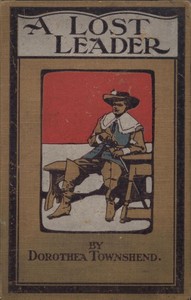
A Lost Leader: A Tale of Restoration Days
Language: en335 downloads on Project Gutenberg
Subjects
In: Historical Novels·British Literature
Public-domain ebook sourced from Project Gutenberg #58755.
Public-domain ebook
Language: en335 downloads on Project Gutenberg
Subjects
In: Historical Novels·British Literature
Public-domain ebook sourced from Project Gutenberg #58755.
The opening · free to read
A LOST LEADER.
PROLOGUE.
"UNDER WHICH KING?"
One December evening, in the year 1648, the little town of Farnham showed unusual signs of life. Troopers were dismounting and leading their horses away to their stables, or were lounging at the doors of the houses where they were quartered, and a crowd of curious country folk and villagers gathered to stare at them, and even to put questions to the more affable-looking of the steel-coated soldiers.
The press was greatest round the entrance of a house of the better class that stood back from the street with all the dignity that a flagged forecourt and a couple of high brick gate-pillars could lend it.
There the sentries, who were stationed at the door, had some ado to keep back the curious throng, and many a sturdy country farmer shouldered his way into the house in the wake of his squire to catch a glimpse of his king, the ill-fated King Charles, who was to rest that night at Farnham on his last journey from the prison at Hurst Castle to the scaffold at Whitehall.
"Be there no chance of seeing his blessed Majesty this even, Master Clarke?" whispered an old woman, clutching the arm of a good-natured neighbour.
"No, dame, no, he be a-going to his supper, folks say, and they won't let none into his parlour but gentry, save these here lobsters as go where they please, and hold themselves as good as gentlefolk, rot 'em!"
These uncomplimentary remarks were not said in a loud enough tone for the sentry to overhear, but they gave great satisfaction to the old woman who nodded agreement, and wiped her eyes with her apron.
"Do'e think now they'll let us get a sight on him in the morning?" she quavered.
"Ay, ay, they can scarce stop it; he must needs pass out this way to come to his horse. But I reckon they must feel mighty vexed to see how the folk press to get a sight on him, God bless him."
"God bless him, and bring him safe out of their wicked hands," echoed the old woman, as she turned to hobble home.
Within the house, the hall and passages were thronged with servants and visitors, most of whom made no secret of their loyal sorrow at seeing their king brought among them as a prisoner. The officers who formed the escort appeared, however, to trouble very little about the sentiments of the crowd, and from good nature or contempt went about their own affairs, allowing the country squires and their wives to show their loyal devotion in any fashion they pleased.
In the panelled dining-parlour the supper-table stood ready, prepared for one guest only, but the room was as yet only lit by the fading gleams of the winter sunset and the dancing flames of the fire. The group of officers and visitors who were gathered round the hearth, spoke to each other in low tones as they glanced with looks of curiosity, and even covert amusement, at two gentlemen who stood in the recessed window, in earnest talk.
But a boy who stood near the door watched all with no amusement in his face. He stood erect, grave, watching with his serious untroubled childish eyes the great things that were passing before him. A bright, eager boy, whose brown hands one would think fitter to hold a top than to caress the hilt of his new sword; a boy young enough to be proud of his position, proud of his soldier's dress; to whom life was a very interesting but a very simple matter. He looked with a child's awe at the two men in the window, and they were worthy of his gaze. The slender, slightly bowed figure in the velvet coat and blue ribbon, with soft curls that flowed from beneath a plumed hat, the sad eyes, the regular features only marred by a look of weakness and almost peevishness about the mouth; the boy had seen them all often enough in pictures, but to-day he stood for the first time in the presence of a king, of King Charles the First of England.
Before the king stood an equally picturesque personage, although at first sight you hardly noticed the features or colouring that went to make up the gallant figure of the man. It was the erect, proud bearing, the vivid life, the eagerness of a high-strung nature, now controlled by the courtesy due to his companion. His buff coat and crimson sash were like those worn by the boy, and the velvet cap he carried in his hand left uncovered curls as brown; but instead of the childish calm of the boy's hazel eyes, the older man's glance now flashed with the fire of an eagle, now glowed with the exalted enthusiasm of a poet. It was no wonder that the boy watched him with a look of dog-like adoration that scarcely spared a glance for the king himself. Young Dick's king stood before him in truth, and his name was not Charles Stuart but Thomas Harrison.
"Show us thy new sword, Dick," whispered a young cornet, whose laughing eyes danced in very unpuritanical fashion.
Dick moved forward, and the firelight gleamed on the slender blade as he held it out.
"By my faith, a rare bit of steel! And how many king's men hast thou skewered with it?"
"None, sir," answered Dick, seriously. "My uncle hath only let me use the foils hitherto."
"Wise uncle!" laughed the other. "He would not expose even our deadliest enemies to the blow of such a paladin. But, hark 'ee, Dick, dost know the king hath sent for thine uncle to make him a duke?"
"No, no," broke in another young soldier, "'tis not a duke; he is to be sworn of the king's privy council, and have the Garter."
Dick looked gravely at the laughing speaker.
"It would be good if the king would make Uncle Tom a councillor," he said.
"Well said, boy," chimed in an older man. "If his Majesty took Major Harrison's counsel, our cause were won; but the stars will go withershins ere that come to pass."
The faces of the younger men changed, and one answered soberly enough--
"You say too true, captain."
Their voices were subdued lest they should reach the king's ears; but, respectful as was the bearing of all the members of the group by the fire, they clearly split into two halves: on the one hand, the officers of the escort who were teasing the boy, and on the other, a group of gentlemen, some wearing the conventional ribbons and laces of a cavalier, others in the rough cloth of country wear, stained with the mud of country lanes, while the master and mistress of the house moved from one guest to another, evidently nervous at the doubtful honour that such a royal visit had brought to their roof.
The lady turned to one of the king's gentlemen-in-waiting with a whispered word--
"I scarce hoped, Mr. Herbert, to see his Majesty in such pleasant spirits, for methinks his condition could scarce be more dolorous."
"Faith, madam," answered Mr. Herbert, "he bears each new change of fortune with the dignity of a king and the resignation of a saint. But I make no doubt that the sight of these your loyal neighbours whom you have called in, and the very blessings of the poor folk in the street, are somewhat of a balm to his heart, also I cannot deny that those gentlemen"--looking over at the officers--"have used us very civilly during the day's ride; methinks his Majesty finds himself more at ease with them than with those crop-eared parliament men and their preachers."
"I marvel, nevertheless, to see his Majesty expend his gracious word on such a rebel as that Major Harrison. We have heard strange and horrible things concerning him, and that he has even dared to plot against his Majesty's most sacred life!"
"'Tis for that reason, madam, that the king made an occasion to speak with him," answered Mr. Herbert. "He was pleased to say, to-day, when Major Harrison was riding behind him, that his aspect was good, and not as it had been represented to him, and I am assured that his Majesty did desire some discussion with him to try what his sentiments may truly be."
They stood in silence watching the strange interview between the royal prisoner and his republican guardian; but no word of the conversation reached their ears, till, in answer to some word of the king's, Harrison said very vehemently--
"Sir, I abhor the very thought of it."
The king's sad face brightened with a look of surprise and pleasure, and his manner towards the soldier took on an indescribable air of gracious dignity. But Harrison's expression did not respond; he continued to speak with grave, almost severe earnestness, and the surprise with which the king heard him quickly froze into a look of offence, and then abruptly his Majesty dismissed Major Harrison with a slight inclination of his head, and came forward to the supper-table; while Harrison, with a silent greeting to his friends by the fire, called Dick, and left the room.
Their horses were in waiting outside, and for a few minutes they rode in silence through the gathering twilight towards their lodging. Then Major Harrison spoke.
"Dick! the king even now asked me whether we do intend to murder him."
"To murder him?" echoed the boy, in horror.
"Ay, to murder him. There are some here that have whispered him that we wait to slay him privily, as we go to London! I told him, Dick, I did abhor the very thought of it." An indignant sincerity rang in his voice. "Nevertheless, I told him roundly that the law is equal for great and small, and justice hath no respect of persons. The blood of Englishmen hath been poured out like water at the word of this man, it crieth out against him unto God; the Cause needeth not the aid of any secret assassin; he shall render his account in public unto the high court of Parliament."
The book keeps going
Reading is free forever. Sign up and watch scenes appear while you read.



Scenes Storieta drew for other classics.
New illustrated classics
Once or twice a month: the latest books to get full character casts, scene art, and free comic editions. No account needed.