Public-domain ebook
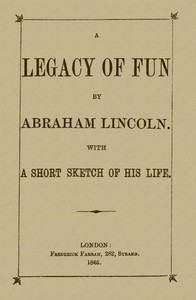
A Legacy of Fun
Language: en251 downloads on Project Gutenberg
Subjects
In: Humour·Biographies·History - American
Public-domain ebook sourced from Project Gutenberg #58850.
Public-domain ebook
Language: en251 downloads on Project Gutenberg
Subjects
In: Humour·Biographies·History - American
Public-domain ebook sourced from Project Gutenberg #58850.
The opening · free to read
BY ABRAHAM LINCOLN.
WITH A SHORT SKETCH OF HIS LIFE.
LONDON: FREDERICK FARRAH, 282, STRAND. 1865.
MEMOIR.
Abe Lincoln, the late President of the United States of America, was born on the 12th of February, 1809, in Hardin County, in the State of Kentucky. His grandfather, who emigrated from Virginia to the above State, was slain by the Indians in 1784. Thomas Lincoln, father of the President, and Nancy Hawks, his mother, were natives of Virginia. The opportunities for education enjoyed by Abraham were few and far between, for at an early age his father needed his assistance in clearing the forest, and making it a fitting dwelling place for man. Still, whenever an opportunity presented itself, it was eagerly grasped, and the result was that, despite of untoward circumstances, Abraham succeeded in acquiring a decent knowledge of his mother tongue and the rudiments of an ordinary education.
“At nineteen,” says one of his biographers, “we find him serving as a common bargeman on a boat plying to New Orleans. In March, 1830, he accompanied his father to Macon County, Illinois, and helped him to build a log cabin for the family home, and he made enough rails to fence in ten acres of land. The next year he was employed as a boat builder to assist in building a flat-bottomed boat, which he afterwards took to New Orleans, and upon his return his employer put him in charge of a store in Illinois.
“In 1832, when the ‘Black Hawk War’ broke out, he joined a company of Volunteer Rifles; and such was his popularity that he was almost immediately unanimously chosen captain by his comrades--an unexpected piece of good fortune which he often said gave him greater pleasure than any subsequent success in life. Here he served for three months only, when he was proposed as a candidate for the Legislature of Illinois, but his opponents being in a majority he was defeated. Soon after this he was appointed post-master of New Salem; and now, having a little leisure time on his hands, he began to study law, borrowing of an evening books from a neighbouring lawyer, and returning them the next morning.
“A survey of Sangamon County was ordered by the Government about this time, and the surveyor offered to depute Mr. Lincoln to survey that portion of the work lying in his part of the county. Nothing daunted, he procured a treatise on surveying, and after reading it, purchased a compass and chain, and did the work.
“In 1834 he was elected member of the Legislature of Illinois by a large majority, and was re-elected in 1836, 1838, and 1840. In 1836 he obtained a licence to practice law, and he removed to Springfield, where he entered into partnership with a Mr. Stuart, and rose rapidly in public favour, being very successful as an advocate in jury trials.
“In 1834 he was elected as one of the members of Congress for Illinois. As soon as his Congressional term had expired, he returned to the study of the law until 1856, when we find him nominated for the Vice-Presidency by the Illinois delegates to the Republican States Convention of that year, but this nomination was overruled.
“Two years afterwards and the Convention met at Springfield, and he was unanimously elected as a candidate for the Senate in opposition to Mr. Douglas. In 1860 the Convention met at Chicago to ballot for a candidate for the Presidency, and after a severe and prolonged struggle Abraham Lincoln was elected President of the United States of America.”
The fearful struggle which commenced upon his elevation to the high office of President, is by far too recent to necessitate description. Suffice it to say that from the commencement to the end, the great trait in Lincoln’s character was ever active, viz., indomitable perseverance. This valuable characteristic served him in lieu of more brilliant qualities, and enabled him to outreach men of far larger capacity and infinitely higher genius. He was brutally assassinated in the presence of his wife and friends by John Wilkes Booth, while witnessing a dramatic representation at Washington, on the 14th day of April, 1865.
ABE LINCOLN, THE GREAT AMERICAN JESTER.
Lincoln and Meagher.
On Lincoln’s receiving a dispatch from Meagher, the Irish General, stating that he had succeeded in capturing an entire division of the seceders, the president remarked that “it was good news, if true; but he suspected it was Meagher (mere) humbug!”
Hooker’s Appointment.
When Seaward proposed that fighting Joe Hooker should have the command of an entire brigade, Lincoln expressed an approval upon the ground that they “must win by Hook-_er_ by Crook” (hook or by crook).
Cut Cavendish.
Upon being interrogated why Americans used so much tobacco, Abe replied “because they _chews_” (choose).
Commodore Wilks.
When the president heard of the capture of Slidell and Mason on board the Trent, he foresaw that it would be likely to breed a rupture with England, but dismissed the consideration of it by saying that “should the commander’s foolish conduct place him in difficulties, he would not fail to give Wilks a hoister (an oyster).” On another occasion in alluding to the same personage and affair, he remarked that “it would serve Wilks right if he lost his _place_” (plaice).
A proper Cognomen.
When Captain Frye, the son of Canon Frye, was, for his distinguished bravery at the Battle of Bull’s Run, jokingly alluded to by Sumner as a son of a gun. Old Abe remarked that “he could with far greater propriety call him a son of a _Canon_” (cannon).
A Princely Pun.
Upon hearing that our Prince, Alfred, had declined to become King of the Greeks, Abraham remarked that “the reason he did not mount the throne of Greece was because he preferred his own native _isle_” (oil).
A Severe Retort.
General Grant once applied for permission to be employed in a special service on the ground that he commanded none but tried men. “Yes,” replied the president, “I admit the truthfulness of your plea, for if they have not been tried in the field they have been tried elsewhere!”
Conundrum.
“Come, Chase,” said Lincoln, on one occasion while sitting tete-a-tete with the great American financier, “I will give you a conundrum: Why is a man who deals in stale jokes like a stock-jobber?” After sundry ineffectual attempts upon the part of his friend to find an answer, the presidential joker gave the following for a reply: “Because he deals in fun dead (funded) property.”
A Grumbler Answered.
A certain well-known American grumbler once appeared before the president to obtain the dismissal of General Grant upon the ground of drunkenness. “Why,” exclaimed the faultfinder, “he, on one occasion, drank twelve bottles of wine at a sitting.” “That,” said Lincoln, “is more than I can swallow.”
Loquacity.
A very loquacious personage once applied for a government situation upon the ground that he had no other mode of obtaining a living, having tried several shops and failed at each! “I cannot grant your request,” was the president’s reply, “but I would suggest that you tried a tongue shop.”
A Slashing Inuendo.
When President Lincoln visited the army of the Potomac, a captain with a face cut and slashed in all directions, complained of the great want of ambulances and the consequent sufferings of the wounded. “I will do my best,” replied Abe, “to supply the deficiency,” and then, turning to another, he remarked that “the captain had no right to complain of the number of his (s) cars.”
Scriptural Criticism.
Abe Lincoln, who is by no means a bad judge of paintings, was shewn a picture done by a very indifferent hand, and asked to give an opinion of it. “Why,” said the president, the “painter is a very good painter, and observes the Lord’s commandments.” “What do you mean by that, Mr. Lincoln?” said a well-known member of the senate, who was standing by. “Why, I think,” answered Abraham, “that he hath not made to himself the likeness of anything that is in the heaven above, or that is in the earth beneath, or that is in the water under the earth.”
A Poultry (paltry) War.
A crony of Abe’s--a man named Payne, was appointed a general at Illinois; in reference to his election the following is recorded, which the president tells with great gusto: One day a wealthy old lady, whose plantation was in the vicinity of the camp, came in and inquired for General Payne. When the commander made his appearance, the old lady in warm language told him that his men had stolen her last coop of chickens, and demanded its restoration or its value in money. “I am sorry for you, madam,” replied the general, “but I can’t help it. The fact is, Madam, we are determined to squelch out the rebellion, if it cost every d----d chicken in Tennessee.”
Lincoln on Physic.
The book keeps going
Reading is free forever. Sign up and watch scenes appear while you read.



Scenes Storieta drew for other classics.
New illustrated classics
Once or twice a month: the latest books to get full character casts, scene art, and free comic editions. No account needed.