Public-domain ebook
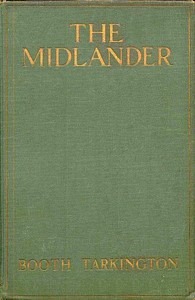
The Midlander
Language: en351 downloads on Project Gutenberg
Subjects
In: Novels·American Literature
Public-domain ebook sourced from Project Gutenberg #58870.
Public-domain ebook
Language: en351 downloads on Project Gutenberg
Subjects
In: Novels·American Literature
Public-domain ebook sourced from Project Gutenberg #58870.
The opening · free to read
PEOPLE used to say of the two Oliphant brothers that Harlan Oliphant looked as if he lived in the Oliphants’ house, but Dan didn’t. This was a poor sort of information to any one who had never seen the house, but of course the supposition was that everybody had seen it and was familiar with its significance. It stood in a great, fine yard, in that row of great, fine yards at the upper end of National Avenue, before the avenue swung off obliquely and changed its name to Amberson Boulevard. The houses in the long row were such houses as are built no more; bricklayers worked for a dollar a day and the workman’s day was ten hours long when National Avenue grew into its glory. Those houses were of a big-walled solidity to withstand time, fire, and tornado, but they found another assailant not to be resisted by anything: this conqueror, called Progress, being the growth of the city. Until the growth came they were indomitable and fit for the centuries.
Moreover, they were of a dignified spaciousness not now to be accomplished except by millionaires with wives content to spend their days getting new servants. The New Yorker, admitted to these interiors upon a visit westward, discovered an amplitude with which he had little familiarity at home, where the brownstone fronts and squeezed apartments showed him no such suites of big rooms; for, of all the million people in New York, only a dozen families could have houses comparable in size or stateliness. “Stately” was the word, though here some little care must be taken, of course, with an eye to those who will not admit that anything short of Blenheim or the Luxembourg is stately. The stateliness of the Oliphants’ house was precisely the point in that popular discrimination between the two young men who lived there: Harlan Oliphant, like the house, was supposed to partake of this high quality, but stateliness was the last thing any one ever thought of in connection with Dan.
The youth of the brothers, in the happy and comfortable nineties of the last century, is well remembered in their city, where the Christmas holidays could never be thought really begun till the two Oliphants had arrived from college and their broad-shouldered, long-tailed coats and incredibly high white collars were seen officially moving in the figures of a cotillion. They usually arrived on the same day, though often not by the same train; but this was the mark of no disagreement or avoidance of each other, yet bore some significance upon the difference between them. It was the fashion to say of them that never were two brothers so alike yet so unlike; and although both were tall, with blue eyes, brown hair, and features of pleasant contour decisively outlined in what is called a family likeness, people who knew them well found it a satisfying and insoluble puzzle that they were the offspring of the same father and mother.
The contrast appeared in childhood and was manifest to even the casual onlooker when Dan Oliphant was eleven or twelve years old and Harlan ten or eleven. At that age Harlan was already an aristocrat, and, what is more remarkable, kept himself always immaculate. If his collar rumpled or was soiled he went immediately to his room and got a fresh one; he washed his hands three or four times a day without parental suggestion and he brushed his hair almost every time he washed his hands. He was fastidious in his choice of companions, had no taste for chance acquaintances, and on a school holiday could most frequently be found in the library at home, reading a book beyond his years. The lively Daniel, on the contrary, disported himself about the neighbourhood—or about other neighbourhoods, for that matter—in whatever society offered him any prospect of gayety. He played marbles “for keeps” with ragtag and bobtail on every vacant lot in town; he never washed his hands or face, or brushed his hair, except upon repeated command, yet loved water well enough to “run off swimming” and dive through a film of ice upon an early Saturday in March. He regaled himself with horseplay up and down the alleys and had long talks with negro coachmen in their stables, acquiring strange wisdom of them; he learned how to swear with some intricacy, how to smoke almost anything not fireproof, how to “inhale,” how to gamble with implements more sophisticated than marbles, and how to keep all these accomplishments from the knowledge of his parents. He kept them from Harlan’s knowledge, also, though not out of any fear that Harlan would “tell.”
At some time in their early childhood the brothers had made the discovery that they were uncongenial. This is not to say that they were unamiable together, but that they had assumed a relation not wholly unknown among brothers. They spoke to each other when it was necessary; but usually, if they happened to find themselves together, they were silent, each apparently unconscious of the other’s presence. Sometimes, though rarely, they had a short argument, seldom upon a subject of great importance; and only once did a difference between them attain the dimensions of a quarrel.
This was on a summer day of feverish temperature, and the heat may have had something to do with the emotion displayed by young Daniel, then aged twelve. He was engaged, that afternoon, with a business friend, Master Sam Kohn, and they were importantly busy in a latticed summer-house, an ornament of the commodious lawn. They had entered into a partnership for the sale of “Fancy Brackets and Fittings,” which they manufactured out of old cigar boxes, with the aid of glue, a jig-saw, and blue paint. The computed profits were already enormous, though no sales had been attempted, since the glue was slow to harden on such a hot day; and the partners worked diligently, glad to shed their perspiration for the steadily increasing means to obtain riches.
At five o’clock Harlan dropped lightly from the big stone-trimmed bay window of the library, crossed the lawn, where the grass was being gilded now by the westering sun, and halted before the entrance of the summer-house. He was the picture of a cool young gentleman, perfect in white linen; his coat and trousers of this pleasant material were unflawed by wrinkle or stain; his patent-leather pumps, unmarred by the slightest crack, glittered among the short green blades of grass; his small black satin tie was as smooth as his brown hair.
To this perfection the busy partners within the summer-house were a sufficient contrast. Soiled blue upon every available surface, they continued their labours, paying no visible attention to the cold-eyed young observer, but consulting each other perhaps the more importantly because of the presence of an audience, however skeptical. Master Kohn, swarthy, bow-legged, and somewhat undersized for his thirteen years, was in fact pleased to be associated with the superior Harlan, even so tenuously. He was pleased, also, to be a partner of Dan’s, though this was no great distinction, because Dan, as the boys’ world knew, would willingly be friendly (or even intimate) with anybody, and consequently no social advancement was to be obtained through him. That commodity is to be had of only those who decline to deal in it, and thus Sam Kohn felt that he was becoming imbued with a certain amount of superiority because Harlan Oliphant had come to look on at the work.
Sam decided to make a suggestion. “Look at your brother,” he said to Dan. “Maybe he’d like to git into our partnership. We could give him a share, if he starts in fresh and works hard.”
“Thanks!” Harlan said with cold sarcasm, and addressed his brother: “Do you know what time it is and what the family is supposed to do this evening?”
“Yes,” Dan answered, not looking up from his jig-saw. “We’re goin’ to dinner at grandma Savage’s.”
“Mother sent me to tell you it’s time for you to come in and wash yourself and dress up,” said Harlan. “The mess you’ve got yourself in, it’ll take you till after six o’clock, and we’re supposed to be there then.”
“Sam and I got some pretty important jobs to finish,” Dan returned carelessly. “I got plenty time to change my clo’es and get washed up.”
“No, you haven’t. You quit playing with that boy and those dirty things and go in the house.”
Upon this, Dan stopped the operation of the jig-saw and looked at his brother in a puzzled way. “What you mean callin’ our brackets and fittin’s ‘dirty things?’” he inquired. “I expect you don’t hardly realize Sam Kohn and I got a regular factory here, Harlan.”
“A ‘factory,’ is it?” said Harlan, and laughed in the manner of a contemptuous adult. “Well, you close up your old factory and come in the house and get ready.”
“I can’t for a while,” Dan returned, beginning his work with the jig-saw again. “I told you we got lots to do before we quit to-night.”
“You stop playing with that silly little saw,” Harlan said sharply, for he had begun to feel some irritation. “You come in the house right this instant.”
“No; I can’t yet, Harlan. Sam and I got to——”
“Never mind!” Harlan interrupted. “You come in the house and let this boy go home.”
There was a frosty sharpness in his way of saying “let this boy go home” that caused Dan to stop his work again and stare at his brother challengingly. “Here!” he exclaimed. “This is as much my father and mother’s yard as it is yours, and you got no business hintin’ at any friend of mine to go home.”
“Haven’t I?” Harlan inquired, adopting a light mockery. “So this is a friend of yours, is it?”
“Yes, it is.”
“Oh, a friend?” Harlan mocked. “Oh, excuse me! I didn’t understand!”
This proved to be intolerably provocative;—Dan abandoned the jig-saw and stepped out of the summer-house to confront his brother frowningly. “You shut up, Harlan Oliphant,” he said. “This is Sam Kohn’s and my factory, and he’s got a right here. You quit your talkin’ so much around here.”
“You quit your own talking,” Harlan retorted. “You do what mother sent me to tell you to, and let that dirty little Jew go home!”
“What?” Dan cried.
“You better!” Harlan said, standing his ground, though Dan lifted his hand threateningly. “We don’t want any dirty little Jews on our premises.”
Dan gulped. “It isn’t his fault he’s a Jew. You take that back!”
“I won’t,” said Harlan. “He is little and he is dirty and he’s a Jew. How you going to deny it?”
Flushed with anger and greatly perplexed, Dan glanced over his shoulder at Master Kohn, who looked on with an inscrutable expression. “Well, what if I can’t?” Dan said desperately, after this glance at his guest and partner. “You got no right to insult him.”
“It isn’t an insult if it’s true, is it?”
“Yes, it is; and you ought to be ashamed of yourself. I got a notion—I got a notion——”
“What notion have you got?” Harlan asked scornfully, as his brother paused, swallowing heavily.
“I got a notion to make you ashamed!”
“How would you do it?”
“‘How?’ I’ll show you how!” And again Dan’s clenched right hand lowered threateningly. The brothers stood eye to eye, and both faces were red.
“Go on,” said Harlan. “Hit me!”
The book keeps going
Reading is free forever. Sign up and watch scenes appear while you read.



Scenes Storieta drew for other classics.
New illustrated classics
Once or twice a month: the latest books to get full character casts, scene art, and free comic editions. No account needed.